An IB subject guide is not a textbook, and reading it from beginning to end is rarely useful. It is better treated as a map: first confirm that you have the correct version, then extract the syllabus, assessment structure, command terms, and criteria that shape what you will actually do.
Your subject guide quick-start checklist
Before making detailed notes, complete these steps:
Confirm the subject, level, examination session, and first-assessment year.
Ask your teacher whether you have the complete guide or a shorter subject brief.
Locate the syllabus or curriculum overview.
Find the assessment objectives and assessment model.
Mark the internal assessment requirements and criteria.
Find the subject-specific command terms, conventions, and appendices.
Turn current classroom topics into a simple checklist.
Revisit the relevant pages before each major school assessment.
The aim is not to memorize the document. It is to make the document useful.
Start by checking that the guide is current
IB subjects change on different schedules. Two documents with almost identical titles may describe different syllabuses, assessment components, or first-assessment years. Before highlighting anything, check the cover and introductory pages for four details:
The full subject name
Standard Level or Higher Level coverage
First teaching or first assessment date
The examination session that applies to you
Ask your teacher or Diploma Programme coordinator when any detail is unclear. Complete guides are normally obtained through schools and official IB systems, while public subject briefs provide shorter summaries of course aims, curriculum content, recommended teaching hours, and assessment.
RevisionDojo's IB syllabus hub can help you navigate subject topics and resources, but your current school-supplied guide remains the authority for your course. This simple version check can prevent months of studying obsolete content or practising the wrong format.
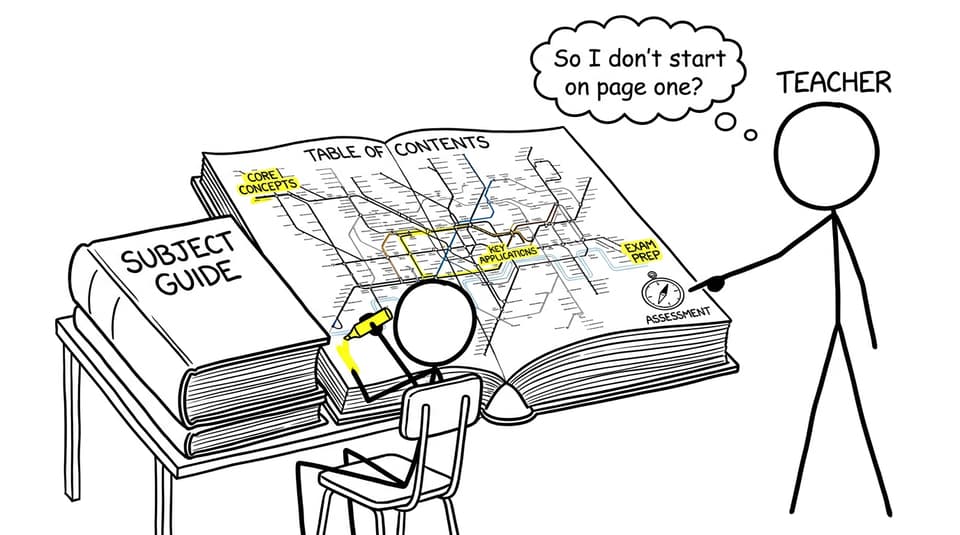
A student navigates an enormous subject guide by following the assessment compass
Read the assessment pages before the content list
Students instinctively begin with the syllabus because it looks most like a familiar course outline. A more useful first move is to inspect the assessment model.
Find out:
Which external assessment components exist
What each component asks you to produce
How long each examination component lasts
Which components differ between SL and HL
How much internal assessment contributes
Whether special materials, portfolios, performances, investigations, or oral tasks apply
Write a one-page assessment map for each subject. Keep it brief enough to consult throughout DP1. The broader IB resources hub can then help you connect each component with relevant notes, questions, videos, and worked examples.
Turn the syllabus into a living checklist
The syllabus should not become another document you passively reread. Convert it into something that changes as you learn.
Copy the main topics and subtopics into a spreadsheet, notebook, or digital planner. Add three status labels:
Untaught: your class has not reached it.
Developing: you recognize it but cannot yet apply it independently.
Secure: you can explain it and answer an unfamiliar question without support.
Only label a topic secure after testing it. Recognition is a weak signal. A heading can look familiar because you saw it yesterday, while the underlying idea remains unavailable when a question changes the context.
RevisionDojo's Study Notes by subject can clarify a listed topic, while the IB Questionbank tests whether that understanding survives contact with a real question. That sequence matters: identify, learn, retrieve, apply, review.
Translate assessment objectives into visible actions
Assessment objectives describe what students should be able to do. Depending on the subject, this may include demonstrating knowledge, applying methods, analysing evidence, evaluating arguments, communicating effectively, or conducting an investigation.
Do not leave these objectives in abstract language. Translate each one into observable work.
If an objective asks you to analyse, your practice should reveal relationships, patterns, implications, or structure. If it asks you to evaluate, your response needs supported judgment rather than a longer description. If it concerns practical or investigative skills, reading notes alone cannot satisfy it.
Build a command-term reference you will use
Command terms tell you what intellectual action a question requires. The topic tells you what to discuss; the command term tells you what to do with it.
Find the glossary in your current subject guide and choose the terms appearing most often in class. Turn each into a compact card containing:
The official meaning from your guide
A plain-language translation
A miniature answer structure
One subject-specific example
Use the IB command terms guide for extra practice, then turn difficult distinctions into RevisionDojo Flashcards. When answering a question, circle the command term, underline the content, notice the scope, and decide what evidence the response must contain.
Read criteria as instructions, not as a verdict
Rubrics can feel like documents designed to explain a mark after the work is finished. Their greater value appears before you begin.
This becomes especially important when coursework begins. RevisionDojo's Coursework Grader provides rubric-based annotations and criterion-level feedback for supported IB coursework. Its Coursework Library can help you inspect how successful work makes criteria visible, while Tutors can provide human guidance when your difficulty involves judgment, planning, or sustained explanation. Your teacher and official guide should still settle formal requirements.
Use the guide throughout the IB DP1 fall term
A subject guide becomes valuable through repeated, short visits. You do not need another large reading assignment.
September: orient yourself
Confirm the correct guide, make the assessment map, and build your syllabus checklist. Learn the difference between SL and HL requirements. Save the command-term glossary somewhere easy to reach.
For a wider setup routine, use RevisionDojo for IB DP1 students to connect your subjects, levels, deadlines, and weekly study habits.
October: connect lessons to assessment
After each topic, ask which syllabus point and assessment objective the lesson addressed. Use Study Notes for clarification, Flashcards for retrieval, and short Questionbank sets for application. AI Chat can explain a difficult idea, but close the explanation and reproduce the reasoning independently.
November: audit the first term
Review early assessments and classify lost marks. Was the problem missing knowledge, weak application, a misread command term, poor evidence, or time management? Update your syllabus checklist based on that diagnosis.
Full Mock Exams and Predicted Papers have greater value later, once you have studied enough content to make realistic performance meaningful. In early DP1, short targeted practice is usually the better instrument. The IB Diploma preparation guide provides a broader timeline for building toward those later stages.
Make the guide your filter
The internet offers more IB material than any student could use. The subject guide helps you decide what deserves your attention.
Before using a resource, ask whether it matches your current syllabus, level, assessed skill, and component. If it does not, its polish is irrelevant. If it does, RevisionDojo can turn the official blueprint into action through Study Notes, Flashcards, the Questionbank, AI Chat, Grading tools, the Coursework Library, Mock Exams, Predicted Papers, and Tutors.
A guide cannot teach the course by itself. What it can do is quietly remove uncertainty. By November, you should no longer see a dense official document. You should see a map of what you are learning, how you will be assessed, and what your next useful step should be.