Listening doesn’t usually fail because your Chinese is “bad.” It fails because the moment you miss one word, your brain tries to rewind the audio that won’t rewind.
That spiral is common in IB Languages, and it’s especially brutal in IB Chinese B listening, where you only hear each recording twice. So the real skill isn’t “understanding everything.” It’s staying present long enough to extract meaning.
Active listening practice turns listening from a stressful guessing game into a repeatable process. Below are techniques you can train in short sessions, then execute under Paper 2 pressure.
Quick checklist for IB Languages listening practice
Keep this small and consistent. In IB Languages, the students who improve fastest do less… but do it daily.
-
Listen 10-15 minutes most days (short, focused, repeatable)
-
Read questions first, then predict topic vocabulary
-
Track signal words (because/however/firstly/in conclusion equivalents)
-
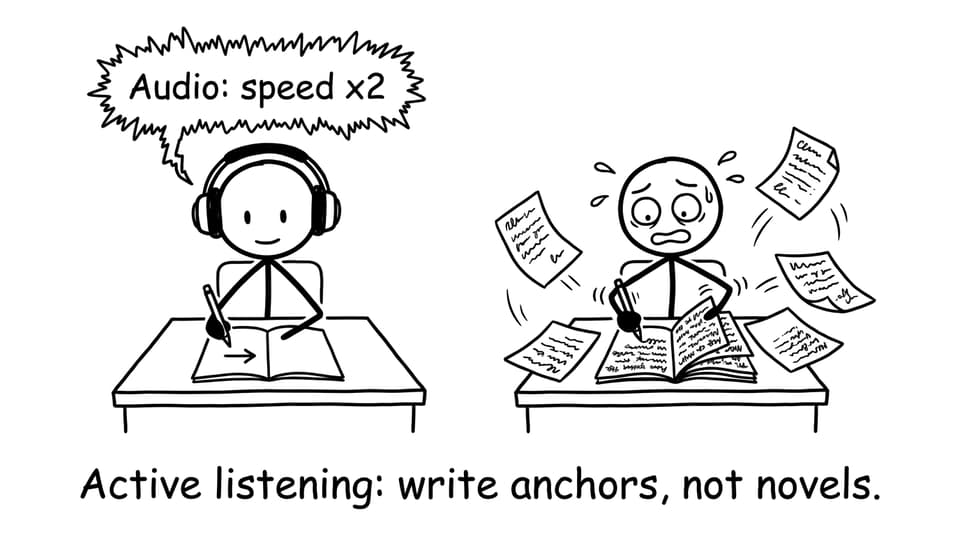
Take keyword notes (numbers, names, places, opinions)
-
Use a transcript loop to diagnose what you missed
-
Train accents and speeds intentionally
-
Simulate Paper 2: two plays only
If you want a structured hub for what to practise, start from IB Chinese B Resources and build outward.
How IB Chinese B listening works (and why active practice wins)
In IB Chinese B Paper 2, listening rewards a calm kind of attention: gist first, details second. You’re assessed on comprehension (main idea, specific details, inference), not on perfect word-for-word decoding.
That’s the core mindset shift for IB Languages: you’re not translating; you’re extracting.
For a clearer overview of the full Paper 2 routine (listening plus reading), use How to Prepare for IB Chinese B Paper 2 (Listening & Reading) as your planning reference.
Active technique: Predict before you press play
Active listening starts before the audio begins.
Build a “theme snapshot” in 30 seconds
-
Scan the questions and underline what they’re really hunting (opinion? reason? number? consequence?).
-
Guess the setting (interview, announcement, conversation, report).
-
Predict likely vocabulary.
Example: if the context looks like 环境保护, your brain should be ready for 污染, 节能, 垃圾分类, 可持续发展.
This is a high-leverage habit in IB Languages because it reduces surprise. Less surprise means less panic.
To practise prediction using syllabus-aligned content, work through IB Chinese B Listening Skills 听力理解技巧 and pull 10-15 recurring words into Flashcards.
Active technique: Use signal words as your map
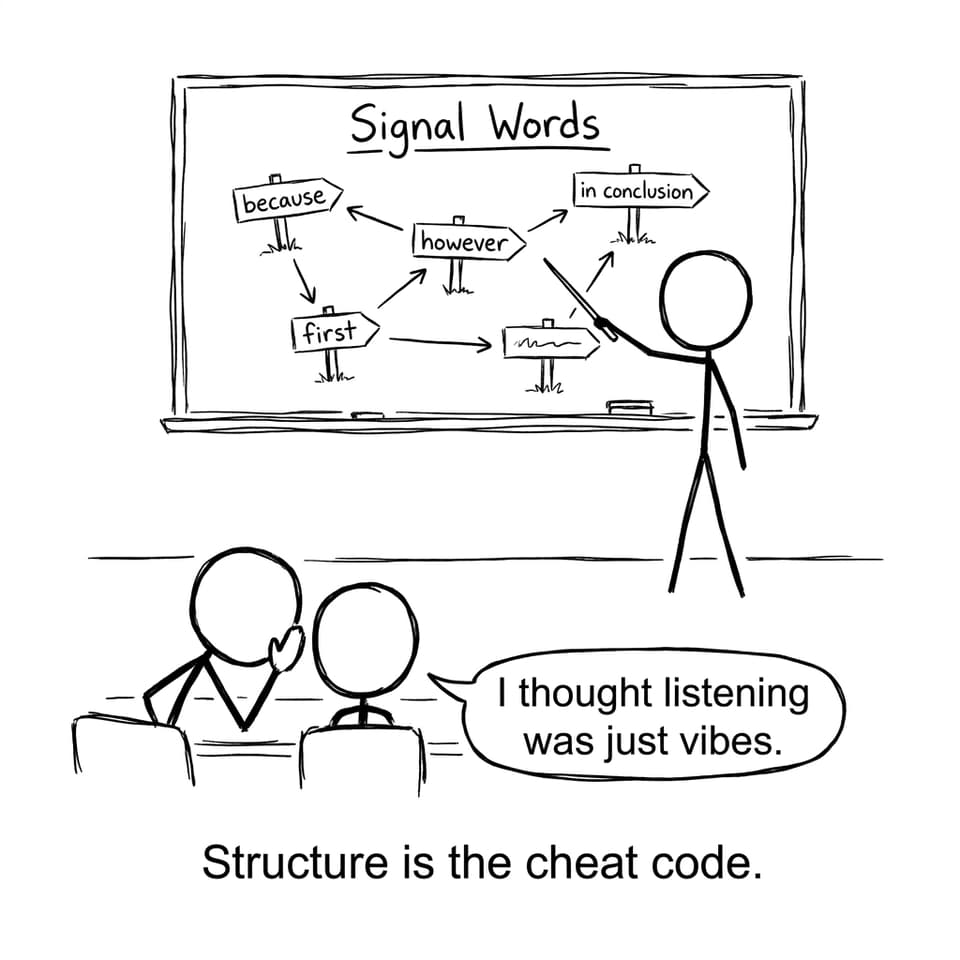
Signal words are the audio’s skeleton. If you can catch them, you can often rebuild meaning even when vocabulary is incomplete.
Listen for patterns like:
-
Cause/effect: 因为…所以… / 因此
-
Contrast: 虽然…但是… / 然而
-
Sequence: 首先 / 其次 / 然后 / 最后
-
Wrap-up: 总的来说 / 总之
When you hear a signal word, don’t just “notice” it. Draw a symbol in your notes (→, ↔, +/-) so your brain tracks structure in real time.
For a step-by-step, exam-style version of this approach, keep Notes for Paper 2 (Listening) strategies 听力理解策略 open when you practise.
Active technique: Note keywords, not sentences
In IB Languages listening, writing too much is a quiet form of panic.
Train yourself to capture:
-
Numbers (dates, prices, percentages, times)
-
Proper nouns (names, places, organizations)
-
Repeated nouns (the topic usually repeats)
-
Opinion markers (赞成/反对, 应该/必须, 觉得/认为)
-
One or two verbs that show change (增加/减少/改善/影响)
A simple rule: if your note can’t be read in one second, it’s too long.
To drill this under pressure, use the IB Chinese B Listening Skills Questionbank. RevisionDojo’s Questionbank workflow also makes review easier because you can immediately log which question type you missed.
Active technique: Shadowing (but do it like training, not performance)
Shadowing means repeating along with the speaker, slightly behind them.
Done properly, it trains three exam skills at once:
-
Your ear learns common sentence shapes
-
Your brain gets comfortable with speed
-
Your mouth learns tones and rhythm (which improves recognition)
Start tiny: 20-30 seconds, repeated 3 times. Then expand to 2 minutes.
If you’re unsure which parts of the syllabus your listening should match, follow the guided pathway in IB Chinese B Lessons, then convert tricky phrases into RevisionDojo Flashcards.
Active technique: The transcript loop (diagnose, don’t comfort-read)
Transcripts are useful only when they’re used to explain mistakes.
Try this loop:
-
Listen once without transcript (gist and anchors)
-
Listen again with transcript (circle what you missed)
-
Extract 5 “miss reasons” (speed? accent? unknown word? connector? number?)
-
Listen once more without transcript and see what changed
Then use RevisionDojo AI Chat to turn that transcript section into mini-questions: inference, attitude, cause/effect, and paraphrase checks. In IB Languages, the fastest growth comes from turning one mistake into ten reps.
Active technique: Train accents and speed on purpose
Mandarin isn’t one sound. Beijing, Taiwan, Singapore, and international speakers can differ in rhythm, pronunciation, and word choice.
A simple plan:
-
Weekdays: 1 accent you find comfortable (confidence-building)
-
Weekends: 1 accent you find difficult (flexibility training)
If you’re a non-native learner, combine accent training with theme vocabulary using IB Chinese B: Tips for Non-Native Learners.
Simulate Paper 2 conditions (two plays only)
This is where active practice becomes exam performance.
Your two-play script
-
Before play 1: read questions, predict, mark key targets
-
Play 1: storyline + anchors (who/what/where/stance)
-
Play 2: confirm details (numbers, reasons, contrasts)
-
After: answer concisely in the required language format
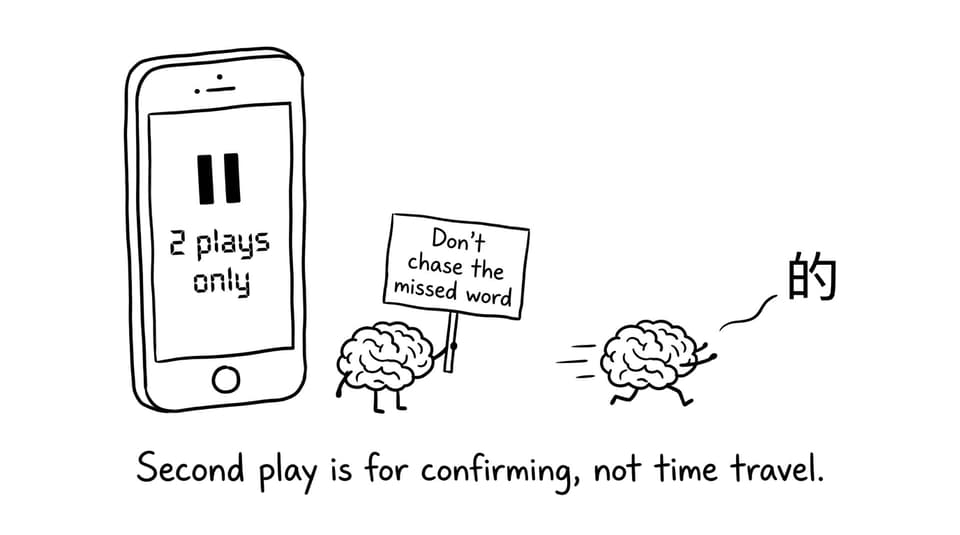
The discipline is the point: no pausing, no replaying.
When you want to scale this into full exam readiness, RevisionDojo’s Mock Exams and Predicted Papers help you practise timing and decision-making the same way you’ll need it in IB Languages exam season.
Common traps (and what to do instead)
-
Trap: translating in your head: Instead, track structure (signal words) and anchors.
-
Trap: chasing one missed word: Instead, rejoin the flow and mark a blank.
-
Trap: writing everything down: Instead, write only what answers questions.
-
Trap: using the second play like a “do-over”: Instead, use it like a confirmation scan.
A simple weekly routine (15-25 minutes a day)
-
Monday: 10 minutes easy listening + 5 minutes signal-word spotting
-
Tuesday: Questionbank set + error log (question type + why)
-
Wednesday: transcript loop on one short clip
-
Thursday: shadowing (3 x 30 seconds)
-
Friday: accent training (one unfamiliar speaker)
-
Weekend: Paper 2 simulation (two plays only) + review with Study Notes
To keep all of this in one place, build your workflow around RevisionDojo: Study Notes for clarity, Flashcards for retention, Questionbank for application, AI Chat for targeted drilling, and Grading tools to understand what “full marks” answers look like in IB Languages.
FAQ
How do I stop panicking when I miss a word in IB Chinese B listening?
Start by accepting that panic is usually a timing problem, not an ability problem. When you miss one word, your brain tries to rewind, but the audio keeps moving, so you miss the next clue too. Train a replacement habit: write a small blank mark, then immediately listen for the next signal word or repeated noun. This keeps you inside the structure of the audio, which is where the marks often live. In daily practice, deliberately allow yourself to miss one word and practise “rejoining” within two seconds. Over time, this becomes automatic, and IB Languages listening feels less like survival and more like strategy.
Should my listening notes be in English or Chinese?
Use whichever is faster, as long as it doesn’t slow your comprehension. Many strong IB Languages students use symbols, abbreviations, and occasional English because speed matters more than purity during the audio. The key is that your notes must translate into correct exam answers under time pressure. If writing Chinese characters causes you to look down too long, switch to pinyin initials or simple symbols for the audio phase. Then, after the second play, convert those anchors into clean answers. Practise this conversion step during simulations so exam day feels familiar.
What’s the fastest way to improve listening accuracy before exams?
Do fewer resources, but review them more intelligently. Choose short clips and run the transcript loop until you can explain exactly why you missed certain details (numbers, connectors, paraphrases, accent shifts). Then turn those misses into Flashcards and mini-drills, because IB Languages improvement comes from repetition of the same weakness in multiple forms. Use Questionbank sets to expose yourself to predictable question styles and to build confidence with timing. Finally, simulate two-play conditions weekly so your brain learns the real constraint of the exam. Accuracy improves when your process is stable, not when your playlist is endless.
Closing: make IB Languages listening predictable
IB Chinese B listening gets easier when you stop treating it like magic and start treating it like a routine: predict, map structure, capture anchors, confirm on play two.
If you want one home base to run that routine, RevisionDojo is built for it: Chinese B Study Notes for clarity, Flashcards for spaced recall, Questionbank for active practice, AI Chat for custom drills, plus Grading tools, Predicted Papers, Mock Exams, Coursework Library support, and Tutors when you need human feedback.
Build the habit now, and IB Languages listening stops being the part you fear most and becomes the part you can control.


