


If you’ve ever opened your phone to “study Chinese” and somehow ended up reorganizing icons, watching random clips, and downloading three new apps you’ll never open again, you’re not lazy. You’re just unprotected.
For IB Languages students, technology is either a quiet advantage or a loud distraction. The difference is never the app. It’s the system. In IB Chinese B, where writing, listening, reading, and speaking all count, the best tech setup is the one that turns small daily effort into exam-ready skill.
This guide shows how to use technology and apps effectively for IB Chinese B, without collecting tools like souvenirs.
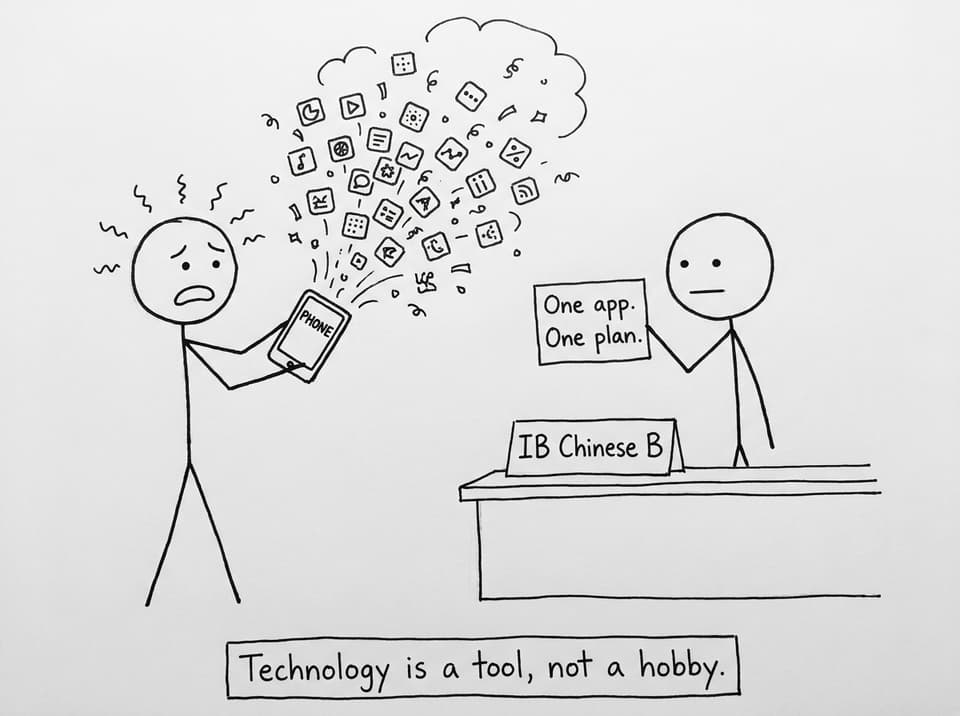
Quick setup checklist for IB Chinese B tech
Use this short checklist as your “tech rules” for IB Languages revision:
-
Pick 2-3 core tools only: vocab (SRS), input (listening/reading), output (speaking/writing).
-
Organize everything by the five IB Chinese B themes, not random folders.
-
Turn every new word into one usable sentence.
-
Track progress weekly (minutes and outputs), not just streaks.
-
Put distractions in a box: Focus mode, notifications off, and a timer on.
If you want a hub that matches the course structure, keep IB Chinese B Resources open as your home base.
Use SRS for vocabulary (but make it exam vocabulary)
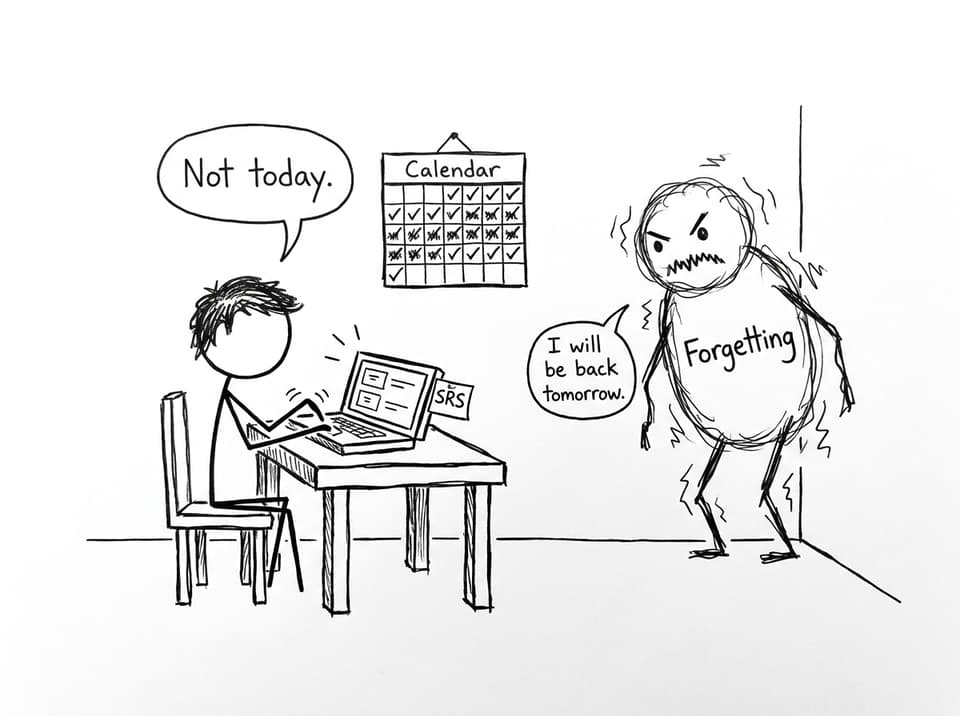
Spaced repetition systems (SRS) are one of the few “learning hacks” that actually hold up under pressure. They work because they bring a word back right when your brain is about to lose it.
The mistake: building huge decks of isolated translations.
The better approach for IB Languages students: build micro-decks that match IB Chinese B prompts and themes. Start from the official theme map and create lists like “Identities: opinions + relationships,” or “Human Ingenuity: technology + media.” You can anchor your theme choices using IB Languages: The 5 Core Themes of IB Chinese B.
On RevisionDojo, the rhythm is simple: learn fast, then lock it in with Flashcards and short daily reviews, then prove it with exam-style practice.
Make every card do more than one job
When you add a word, add:
-
pinyin + tones
-
a collocation (common pairing)
-
a sentence you could reuse in Paper 1 or the oral
That way, your SRS time trains writing and speaking at the same time, a very IB Languages way to study.
Use digital dictionaries like a coach, not a crutch
Digital dictionaries are fantastic for reducing friction during reading practice. Typing pinyin or drawing characters is faster than guessing, and it keeps your momentum.
But here’s the rule: every lookup has to create a “return path.” Save the word into a theme-based list, then convert it into a flashcard, then use it in a sentence later that day.
If you want your reading practice to look like the exam, pair your daily reading with structured skill work from How to Revise Effectively for IB Chinese B Exams.
Grammar apps are useful when you force output
Grammar drills can be helpful for patterns like 是…的, 的/地/得, and aspect markers (了, 过, 着). The danger is doing endless quizzes and feeling “productive” without changing your writing.
Try this loop instead:
-
Learn one grammar point (5-10 minutes).
-
Write 6 sentences using it across two different themes.
-
Paste your sentences into RevisionDojo AI Chat and ask for: corrections, a more natural version, and one “upgrade” connector.
Then bring it back to exam writing structure using IB Languages: Writing Strategies for IB Chinese B.
Listening practice: turn passive audio into active marks
Listening is hard because it feels like the language is moving without you. Apps help most when they let you control difficulty.
Use this three-step method:
First listen: meaning only
No pausing. Train your brain to stay calm and catch the main idea.
Second listen: signposts
Listen for opinion shifts, contrast, cause-effect, and examples.
Third listen: details you can prove
Now pause and capture key numbers, names, time markers, and tone.
To keep your prep aligned with what’s assessed in IB Languages, review the overall structure in IB Languages: IB Chinese B Exams 2025 Overview.
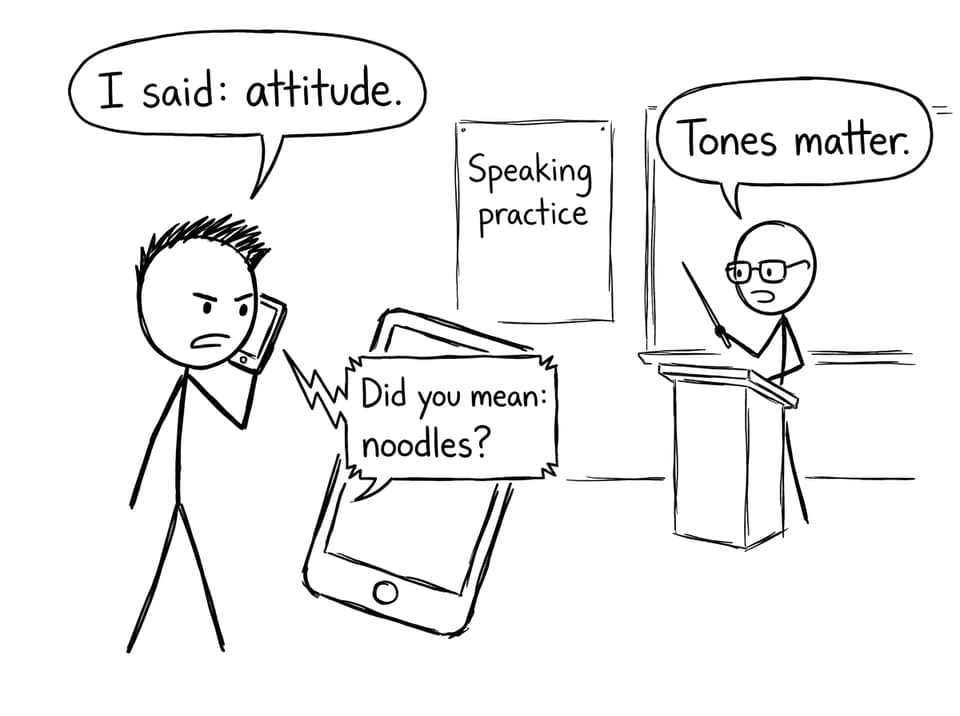
Speaking practice: use voice tech to diagnose tones and clarity
Speaking improves fastest when it becomes frequent and slightly uncomfortable. Voice recognition is excellent for this because it gives instant, blunt feedback.
Do short “oral reps”:
-
Pick a theme.
-
Speak for 60 seconds: opinion + reason + example.
-
Replay and notice: tone errors, filler words, and missing connectors.
-
Repeat the same prompt tomorrow and aim for smoother delivery.
RevisionDojo supports this approach by keeping everything in one ecosystem: you can build theme vocab with Flashcards, test comprehension with the Questionbank, and use AI Chat to generate oral follow-up questions.
Stay organized: the simplest system that works
The best students don’t have better apps. They have fewer decisions.
Try this weekly structure:
-
Mon-Thu (20-30 min/day): Flashcards + one short listening + one 6-sentence writing burst.
-
Fri (30-45 min): one targeted skill session using IB Chinese B Lessons.
-
Weekend (60-90 min): timed exam practice using RevisionDojo Mock Exams and Predicted Papers, then review errors with Grading tools.
If you’re not sure what quality looks like, ground yourself in criteria and weighting using IB Chinese B Grading Explained.
Common tech mistakes (and the quick fixes)
-
Collecting apps instead of collecting repetitions: Delete anything you didn’t use in the last 7 days.
-
Passive scrolling labeled as “input”: Add one output step (summary sentence, voice note, or mini response).
-
No connection to IB themes: Rename lists by theme and keep examples ready for Paper 1 and the oral.
For a broader view of what works across IB Languages, see How to Effectively Revise for Language B Exams.
FAQ
Can I prepare for IB Chinese B using apps alone?
Apps can accelerate your progress, but they can’t replace real performance under IB conditions. IB Chinese B assesses communication, not just recognition, which means you need regular writing and speaking output. Many apps optimize for convenience, so they let you stay comfortable, and comfort is the opposite of exam training. The best approach is to use apps for repetition and feedback, then prove your skill with timed tasks and exam-style questions. This is why IB Languages students benefit from a platform approach, not a single app. RevisionDojo helps by combining Study Notes, Flashcards, Questionbank, AI Chat, Mock Exams, and Grading tools in one workflow.
How many apps should I use for IB Chinese B?
Most students do best with two or three core tools, because consistency beats variety in language learning. One tool should handle spaced repetition (vocab and phrases), one should provide listening or reading input, and one should help you produce output (speaking recordings or writing practice). If you add more than that, you usually spend your energy managing tools instead of practicing Chinese. In IB Languages, the biggest bottleneck is not finding resources, it’s repeating the right behaviors often enough. A tight toolkit also makes it easier to track progress and spot what’s actually improving. If you want to reduce app-hopping, use RevisionDojo as the main hub and let it connect practice, feedback, and review.
Are translation apps useful for IB Chinese B?
They’re useful in emergencies, but risky as a daily habit. Translation tools can hide your grammar weaknesses by giving you sentences you wouldn’t naturally produce. That becomes a problem in Paper 1 and the oral, where you must generate language in real time. A smarter use is “translation as feedback”: write your own version first, then compare, then rewrite in your own style. This keeps you learning instead of outsourcing the thinking. For IB Languages, the goal is control of tone, register, and clear meaning, not perfect literary phrasing. RevisionDojo’s AI Chat can be a safer alternative because you can ask it to explain corrections and help you build reusable templates.
Conclusion: make technology boring, and you’ll get good fast
The best tech strategy for IB Chinese B is surprisingly calm. Pick fewer tools. Use them daily. Force output. Tie everything to themes. Then simulate the exam often enough that it stops feeling like a surprise.
If you want one place to run that whole IB Languages system, from theme vocabulary and Flashcards to exam-style Questionbank practice, AI Chat support, Mock Exams, Predicted Papers, plus Grading tools, a Coursework Library, and Tutors when you need a human plan, start with IB Chinese B Resources and build your next week around repetition that actually transfers to marks.