
Starting the Diploma Programme can make every hour feel newly expensive. Classes become more demanding, CAS enters the calendar, and assignments may require several stages. Add paid work, and the week can feel full before it begins.
Balancing an IB and part time job is possible for many DP1 students, provided shifts are predictable and school, sleep, and health remain protected. Start with one or two short shifts, then review after several weeks. The right workload is not the maximum you can survive. It is what you can sustain without borrowing time from sleep or tomorrow's assignments.
Your DP1 balance checklist
Before accepting a job or adding shifts, check these questions:
- Are your hours limited and predictable?
- Does your employer understand that you study full-time?
- Can you protect sleep, meals, travel time, and genuine rest?
- Is there space for homework, revision, CAS, and coursework?
- Can you reduce shifts during assessment-heavy weeks?
- Which adult will you approach if the arrangement stops working?
- Have you checked local employment rules for students your age?
If several answers are no, the structure needs to change, not your motivation.
Decide how many working hours are realistic
There is no universal number for every IB DP1 student. Someone with a nearby workplace and predictable weekend shifts has a different week from someone with a long commute or caring duties.
Measure fixed commitments first: lessons, travel, meals, sleep, CAS, family responsibilities, and scheduled activities. Then estimate academic work outside class. RevisionDojo's guide to studying outside class in DP1 suggests roughly 8-12 focused academic hours weekly during the first term, including homework. Treat that as a planning range, not a quota. Your subjects, working pace, and assessments will affect it.
Try one or two shifts for three or four weeks before reconsidering. Avoid accepting extra recurring hours because one quiet week felt manageable.
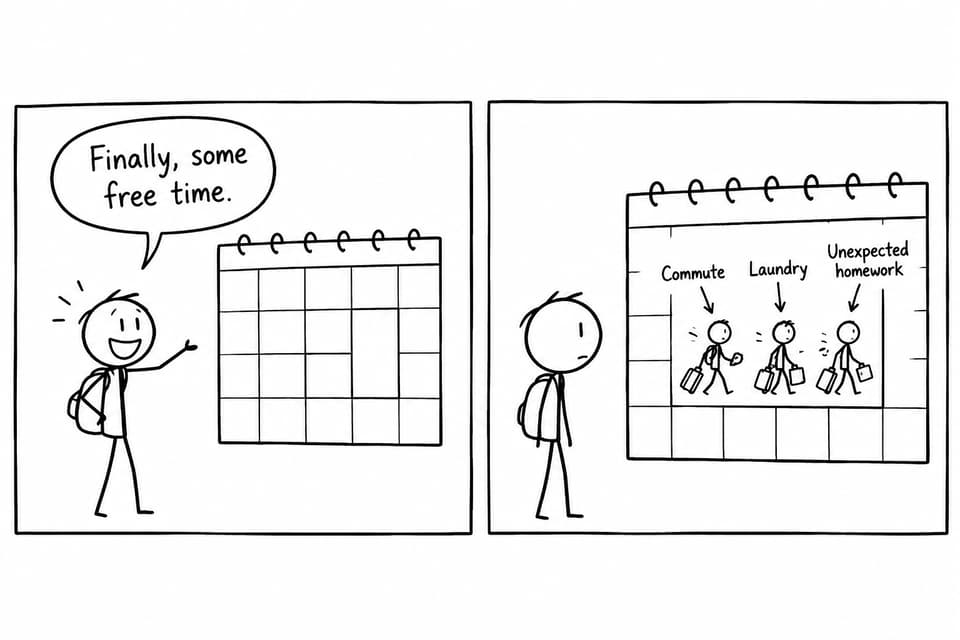
Include the hidden time around each shift. A four-hour shift might also require travel, changing clothes, and eating afterward. Record those commitments alongside the paid hours so the calendar reflects the whole cost. For your first few weeks, note how much study you actually complete rather than how much you intended to complete. That small record gives you a better basis for adjusting availability than a timetable built entirely on optimism.
After work, can you complete important tasks without sacrificing sleep repeatedly? If not, the job costs more time than the rota shows.
Build a concrete weekly routine
A calendar should reflect energy, not just availability. Two hours after a tiring shift are not equivalent to two alert hours on a free afternoon.
Here is a starting routine for one weekday evening shift and one weekend shift:
| Day | Suggested routine |
|---|---|
| Monday | 60-75 minutes of priority homework, then a short Flashcards review |
| Tuesday | 60 minutes on an HL subject, followed by 30 minutes for CAS or administration |
| Wednesday | After-school shift, with only a 15-minute planning check afterward |
| Thursday | Two blocks of 45-60 minutes for assignments and retrieval practice |
| Friday | Light review or rest, depending on deadlines and energy |
| Saturday | Morning study block, afternoon work shift, quiet evening |
| Sunday | 90-minute deep-work block, 45-minute weekly review, then protected rest |
The unclaimed space is deliberate. A schedule without margins works until a bus is late or an assignment takes twice as long as expected.
Review the next two weeks, not only the next two days. Add tests, drafts, CAS commitments, and shifts. The RevisionDojo guide to using a planner for the IB workload can help turn dates into daily actions rather than vague instructions to study.
Study differently on workdays
Do not expect every day to carry the same work. Workdays suit smaller, lower-friction tasks. Free afternoons are better for essays, difficult problem sets, and coursework planning.
Before a shift, choose one task for 20-30 minutes: review Flashcards, annotate a short text, or correct several questions. Afterward, avoid starting a major task if exhausted. Write down the next action, prepare your materials, and return to it tomorrow.
Make that next action specific enough to begin without another planning session. Instead of “revise chemistry,” write “answer five questions on the topic I missed, then check each correction.” Instead of “work on my essay,” identify the paragraph or evidence you need. A clear stopping point also matters: finish the planned task, record any uncertainty, and leave the rest for the next suitable study block.
RevisionDojo can make short sessions more purposeful. Use its Questionbank for targeted practice, Study Notes for review, AI Chat to clarify concepts, and Grading tools for feedback. These resources should focus your study, not fill every spare minute.
Reserve longer blocks for Predicted Papers or Mock Exams when timed practice is useful. The Coursework Library can help clarify assignment expectations, while Tutors provide human guidance. Together, these features make RevisionDojo a comprehensive IB resource for studying around a real life rather than an imaginary empty calendar.
Protect sleep before protecting the job
Sleep often becomes the flexible part of a schedule because it does not appear as a deadline. That is exactly why it disappears first.
Do not build a routine around studying late after evening shifts. Protect a consistent bedtime and calculate backward from waking time. Travel, eating, showering, and winding down all take time. They are not inefficiencies.
Watch for a cycle of exhaustion: late nights can make homework slower, pushing the next bedtime later. What looks like poor time management may actually be an overloaded schedule.
If essential schoolwork regularly competes with adequate rest, ask your employer for fewer or different shifts. A parent, guardian, teacher, coordinator, or school counsellor can help you plan that conversation.
Make your job more compatible with IB
Job quality matters as much as hours. Predictable shifts are easier to plan around than last-minute scheduling. A nearby workplace may be more sustainable than a shorter shift with a long commute.
Be specific about availability. Rather than saying school is busy, explain which evenings you need for study and when assessments may require changes. Give notice early. An advance boundary is easier to accommodate than a crisis cancellation.
Consider asking for:
- A stable weekly rota
- A cap on school-week hours
- No shifts on your most demanding academic evening
- Advance notice of schedule changes
- Reduced availability during major assessments
If your income pays for essentials, reducing hours may not be a simple option. Start by identifying the minimum income you need and which parts of the arrangement can change. A different shift pattern or lower travel costs might help without immediately cutting earnings. Speak privately with a trusted adult or school support team about your circumstances. The aim is a workable agreement, not advice that assumes every student can simply stop working.
Paid work does not automatically replace CAS responsibilities. Discuss any possible connection with your CAS coordinator before making assumptions. The guide to avoiding CAS overcommitment in DP1 can help you choose activities that fit your actual week.
Recognise when the balance is failing
One difficult week does not necessarily mean you should quit. A repeated pattern is more revealing.
Warning signs include missed assignments, persistent lateness, falling grades, repeated late nights, skipped meals, withdrawing from friends, or anxiety whenever a work notification appears. Losing all unstructured time also matters. Rest is part of a workable system, not a reward for perfect productivity.
If these patterns persist, review the workload with a trusted adult rather than imposing a stricter timetable. A counsellor, tutor, coordinator, or teacher can help distinguish a temporary deadline cluster from an unsustainable routine.
Students already feeling behind can use this practical DP1 reset plan. Reducing commitments early is usually easier than recovering from a growing backlog.
If work harms your health, creates an unsafe situation, or prevents school attendance, tell a trusted adult promptly. Do not wait for a scheduled review.
Prepare for busy periods before they arrive
DP1 demands change throughout the year. Assessments cluster and coursework grows. A quiet week can create false confidence about how many shifts you can maintain.
Create two versions of your routine:
- Standard week: normal shifts, regular study blocks, CAS, and rest
- Heavy week: reduced work availability, essential CAS commitments, and extra assessment preparation
Discuss this distinction with your employer early. Set realistic goals for your first IB term, especially while learning how long assignments take.
Once a month, ask: Are my grades broadly stable? Am I sleeping consistently? Do I still have time that belongs to nobody else? If two answers are no, adjust the system rather than blaming yourself.
Build a week you can repeat
Balancing work with IB means choosing what must remain protected. A job can bring income, responsibility, and experience. It becomes unsustainable when the arrangement leaves no room for sleep, recovery, or unexpected schoolwork.
Begin small. Track energy alongside deadlines. Speak early when something stops working. Explore RevisionDojo's time-management techniques for IB students for additional structure, while keeping your plan flexible enough to survive a real week.
Your next step is simple: map next week's shifts, deadlines, revision blocks, and rest before accepting more hours. Then choose the RevisionDojo resources that address your biggest study obstacle. The goal is not to schedule every minute. It is to see the trade-offs early enough to make good decisions.