


Sometimes your confidence in IB Math doesn’t collapse with a dramatic moment. It leaks.
One weird question on functions. A timed quiz where your mind goes blank. A classmate who finishes early and looks relaxed, like they were born holding a graphing calculator.
Then you sit down to revise, and the page feels louder than you are.
This is the quiet truth of IB: confidence isn’t a personality trait. It’s the side-effect of evidence. You get confident when you repeatedly see yourself do the work, make mistakes, fix them, and come back tomorrow.
This guide is built for the days you don’t feel confident but still want to move forward. It’s a calm, practical way to study IB Math using the RevisionDojo loop: understand, practice, get feedback, and repeat.
Quick confidence checklist (save this)
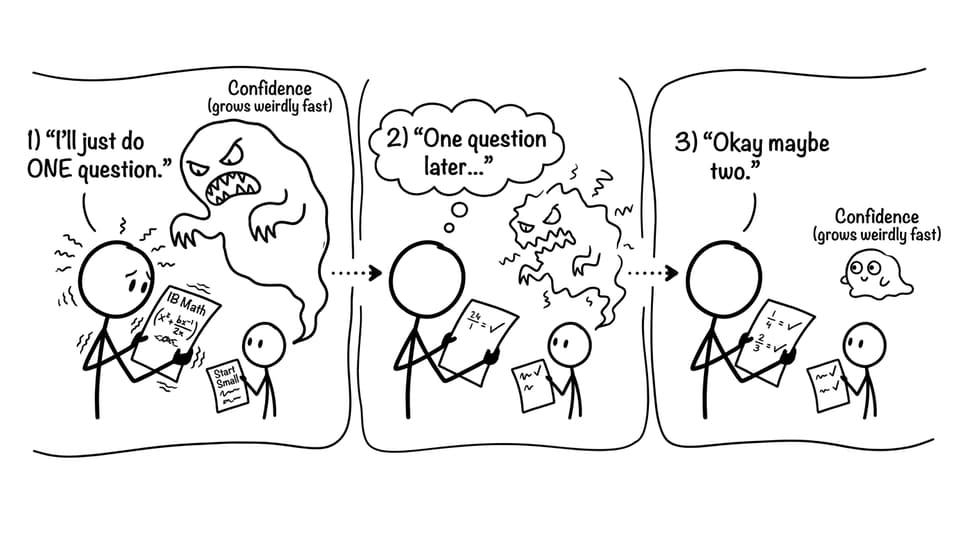
If your confidence is low right now, don’t try to “fix your mindset” first. Start with actions that create proof.
-
Pick one IB Math topic you can name clearly (not “calculus,” but “chain rule” or “binomial conditions”).
-
Use Study Notes for a fast reset on the idea.
-
Do a short set in a Questionbank to get immediate feedback.
-
Tag mistakes and turn the pattern into 2-3 Flashcards.
-
Once a week, do a short timed block with Mock Exams or Predicted Papers.
-
If you’re stuck, ask AI Chat or a Tutor quickly, then return to practice.
That’s the whole system. Confidence comes from repeating it.
Why confidence disappears in IB Math (and why that’s normal)
In IB Math, you’re rarely just learning math. You’re learning math under rules: command terms, mark allocation, timing, and the feeling that every topic connects to five others.
So when you miss a question, your brain often makes it global: I’m bad at math. But IB questions are specific. They test a specific micro-skill: selecting a method, setting up a model, interpreting a parameter, showing working clearly.
The fastest path back to confidence is to shrink the problem back to its real size.
A good place to start is building a routine that is intentionally small and repeatable. If you want a structure you can copy, borrow from The Ultimate IB Math Study Routine for Busy Students, then adapt it to your week.
Study IB Math when you don’t feel confident: the “small proof” method
Confidence doesn’t respond well to pep talks. It responds to completed reps.
Here’s a simple, evidence-based workflow you can run even on low-energy days.
Name the fear precisely
Write one sentence:
-
“I freeze on trig identities.”
-
“I get lost when a question mixes calculus with functions.”
-
“I panic when I can’t see the first step.”
Specific fear is workable fear. Vague fear becomes avoidance.
If you need help separating topics, open the IB math hub for your course: IB Mathematics Analysis and Approaches Resources or IB Mathematics Applications & Interpretation Resources.
Start smaller than your pride wants
When confidence is low, your pride will suggest a dramatic reset: “Today I’ll relearn the entire unit.” That plan fails by lunch.
Instead, pick a sub-skill small enough to finish in 20-30 minutes:
-
one differentiation rule
-
one type of probability setup
-
one common modeling step
This is where How to Review Each IB Math Topic in 15 Minutes helps. The goal is not to do everything. It’s to prove you can do something.
Use Study Notes to get clarity fast
Low confidence often comes from fuzzy foundations. You can’t practice calmly if you’re unsure what the concept even means.
Use RevisionDojo Study Notes as a quick clarity pass, then stop reading before it becomes passive revision. If you’re in AI, the workflow is explained well here: How to Use RevisionDojo Notes to Simplify IB Math AI Concepts.
Then immediately shift into practice. Reading without testing is comforting, but it’s not confidence.
The most confidence-building habit in IB: active practice with feedback
The students who look confident in IB aren’t fearless. They’re familiar. They’ve seen the patterns before.
Practice in Questionbank, not in your head
Do 8-12 questions that match your micro-skill. On RevisionDojo, that’s exactly what the Questionbank is designed for: targeted, syllabus-aligned practice with feedback.
Two rules that rebuild confidence quickly:
-
Stop after a small set, even if it goes well. Leave the session with energy.
-
Review every wrong answer like a scientist. No drama, just data.
If you want more context on confidence through repetition, read How to Build Exam Confidence Through Consistent Practice.
Turn mistakes into flashcards (so they stop haunting you)
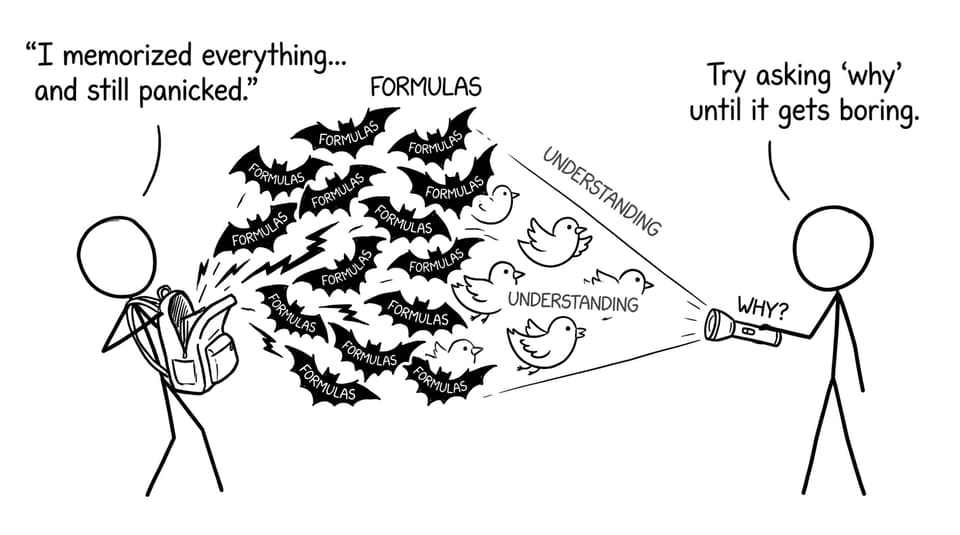
Most IB students collect mistakes like souvenirs. They remember the pain, not the fix.
After practice, create 2-3 Flashcards from your errors:
-
the trigger: “When a question says hence...”
-
the decision: “I should use the previous result and show substitution.”
-
the trap: “I forgot to state domain restriction.”
Flashcards aren’t just for formulas. They’re for decision-making. That’s what speeds you up and calms you down.
For a broader view of how RevisionDojo connects Notes, Flashcards, and practice into one system, see RevisionDojo App: The Smarter Way to Prep for IB Exams.
How to handle time pressure when you’re not confident
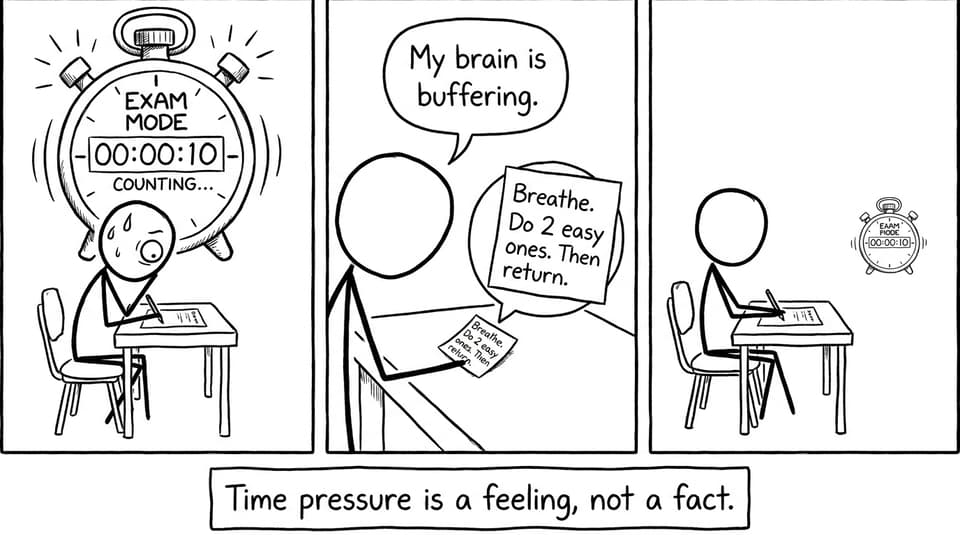
Time pressure is a multiplier. If you already feel uncertain, a timer can turn uncertainty into panic.
So train timing the same way you train content: gradually.
Use short timed blocks first
Start with 10-15 minutes. Your goal isn’t a perfect score; it’s staying calm while the clock exists.
Then build toward longer sets, and eventually full timed sessions using Mock Exams and Predicted Papers inside RevisionDojo.
If you’re in the middle of mock season, this guide is a steadying read: How to Study for IB Mocks (Without Burning Out).
Use Grading tools like a mirror, not a verdict
When you’re not confident, feedback can feel personal. But the best IB feedback is mechanical: it shows you where marks are gained.
Use RevisionDojo’s Grading tools and AI-powered feedback to locate the exact step where your method breaks. Then use AI Chat to ask one narrow question: “What is the first decision I should make when I see this command term?”
That keeps help targeted. You’re building independence, not dependence.
Build emotional momentum (the part nobody schedules)
IB students often treat emotions as irrelevant to study. But confidence is emotional fuel.
A simple practice: after each session, write three lines:
-
One thing I understood better today.
-
One mistake pattern I noticed.
-
One next action I will do tomorrow.
This is how you convert chaos into a plan.
If you want a wider confidence lens beyond math, read How to Build Confidence During IB (Without Faking It).
Closing: build evidence, then let it build you
When you don’t feel confident, it’s tempting to wait for confidence to return before you study.
IB doesn’t work that way.
Study first. Create small proof. Repeat it until your brain believes you again.
If you want a single platform that makes that loop easier, RevisionDojo is built for it: Study Notes to simplify, Flashcards to lock recall, a Questionbank to practice with feedback, AI Chat when you’re stuck, Grading tools to learn how marks work, plus Predicted Papers and Mock Exams to make exam day feel familiar. And when you want real human support, Tutors and the Coursework Library help you stay steady across the whole IB workload.
Pick one topic. Do one small set today. In IB, that counts. Near the end of the week, it becomes confidence.