


Consistency looks boring from the outside.
But in the final stretch of IB exams, boring is often the point.
Most students think confidence arrives the day they finally “understand everything.” In reality, exam confidence shows up earlier, in smaller moments: when you open a question and your brain doesn’t freeze, when you spot the command term and structure your answer without drama, when a timer starts and you keep moving anyway.
That kind of calm is built the same way a callus is built: repeated friction, small doses, enough recovery, and time.
RevisionDojo exists for that exact loop: Study Notes for clarity, Flashcards for recall, Questionbank for repetition with feedback, AI Chat for quick unblocking, plus Grading tools, Predicted Papers, Mock Exams, a Coursework Library, and Tutors when you need a sharper strategy.
The IB confidence checklist (save this)
If you want a simple plan that builds IB exam confidence through consistent practice, run this:
-
Daily (30-60 min): one small topic block + questions
-
Daily (10-15 min): Flashcards (spaced repetition)
-
After every session (5-10 min): review mistakes and write 1-3 “error rules”
-
Weekly (30-90 min): one timed mini-mock to practice pressure
-
Every 48 hours: retest yesterday’s mistakes (fast, targeted)
If your routine isn’t repeatable on a tired Wednesday, it won’t hold on exam day.
Why consistent practice creates IB exam confidence
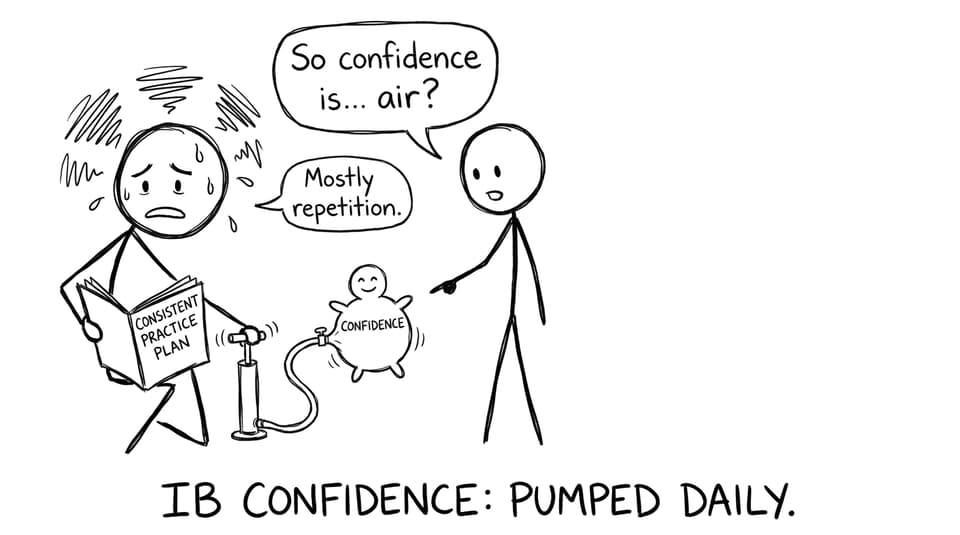
Confidence in IB isn’t a personality trait. It’s familiarity.
When you practice consistently, your brain starts caching patterns: how Paper-style questions are phrased, what “Evaluate” actually demands, how to show working cleanly, what a top-band paragraph sounds like, how long you can spend on a 6-marker before it quietly steals marks from the rest of the paper.
That’s why students who do fewer “hero” study days but more steady practice often feel calmer. Their preparation contains evidence. Not hope.
A good place to anchor that evidence is the RevisionDojo Questionbank, because it turns practice into a habit you can measure: accuracy, weak topics, and what to revisit next.
Build a small daily practice loop (the one that actually sticks)
Most IB students don’t need a longer schedule. They need a smaller one.
Try this daily loop:
Start with clarity (10 minutes)
Read one narrow slice of content. Not a whole chapter.
Use your own class materials, or get a clean, syllabus-aligned explanation from RevisionDojo’s notes workflow (see Digital IB Study Notes: Access Anywhere, Anytime).
Your only goal is to become “question-ready,” not “textbook-complete.”
Move straight into questions (25-40 minutes)
Do a short set in the Questionbank on the exact subtopic you just reviewed. This is where consistent practice starts converting knowledge into performance.
If you want a simple structure for targeted sets, borrow the workflow from How to Use the Questionbank for Targeted Math Revision and apply the same idea to any subject: one topic, one skill, immediate feedback.
End with a tiny review (5-10 minutes)
Write 1-3 “error rules.” Examples:
-
“Underline the command term before I write.”
-
“Define first, then apply to the case study.”
-
“State the principle, then show substitution, then final answer with units.”
This is the difference between practice that feels productive and practice that actually changes your next attempt.
Use Flashcards to make confidence portable
Confidence disappears fastest when recall is fragile.
That’s where Flashcards earn their keep in IB: they make memory predictable. You stop relying on mood, adrenaline, or “I think I saw this once.”
RevisionDojo’s IB Flashcards with Spaced Repetition (SRS) are built for this. A little daily recall goes further than a lot of occasional rereading.
If you want to tighten how you use them, steal tactics from Flashcard Techniques for Long-Term Retention in IB. Then keep it simple: definitions, processes, formulas, command-term stems, key examples.
The goal isn’t to “know everything.” The goal is to remove the most common moments of panic.
Track progress like a scientist, not a critic
Many IB students lose confidence because improvement is invisible. They study, they feel tired, and they assume nothing changed.
But progress leaves tracks:
-
Your accuracy rises on a topic.
-
Your time per question drops.
-
Your explanations become more structured.
-
Your mistakes become more specific (which is a strange kind of victory).
If you’re stuck in the “I study all day but remember nothing” spiral, your fix is usually not more hours. It’s a tighter feedback loop. This is described well in IB: I Study All Day but Remember Nothing.
Treat your results like data. Not a verdict.
Revisit mistakes until they stop being your mistakes
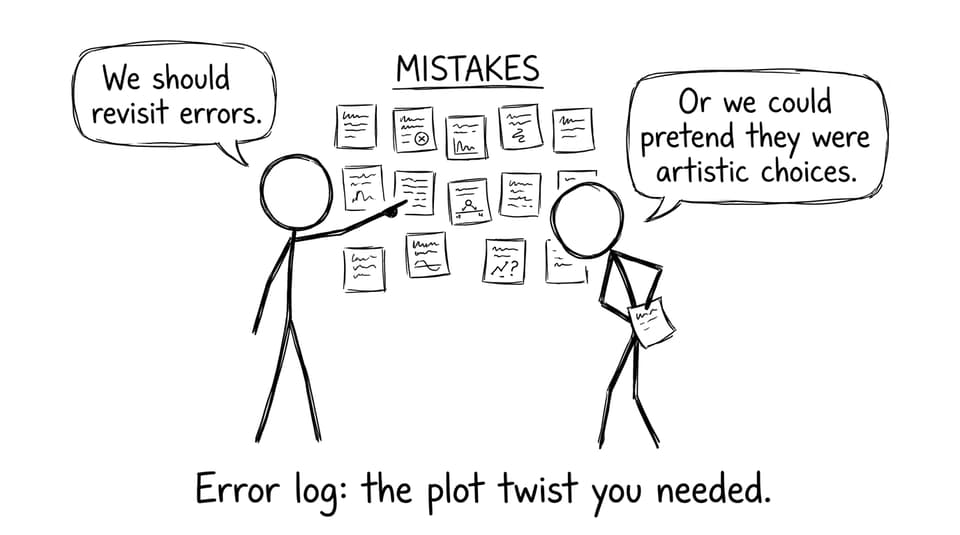
The fastest way to build IB exam confidence is to stop repeating the same error pattern.
Most students do this once:
-
Get a question wrong
-
Read the solution
-
Move on
What builds confidence is the extra step:
- Retake a similar question within 48 hours
That retest is where doubt gets replaced by proof.
Use RevisionDojo’s AI Chat to ask one sharp question about the mistake (“What would earn full marks here?”), then redo a short set in the Questionbank focused on the same skill.
If you want encouragement for practicing hard questions (instead of only comfortable ones), read How Hard IB Papers Secretly Help You. The point is not suffering. The point is adaptation.
Add pressure once a week (so exam day feels familiar)
Consistent practice builds accuracy.
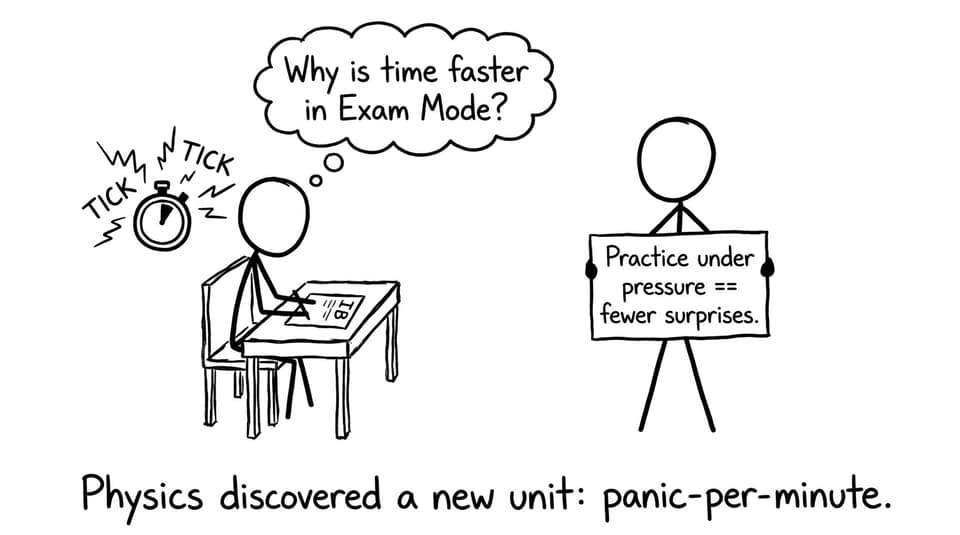
Timed practice builds composure.
Once per week, run a timed section or mini-mock. Not to prove yourself. To train the feeling of constraint.
RevisionDojo supports this with Mock Exams and Predicted Papers that simulate real paper rhythm without you having to build everything from scratch. If you’re unsure how to structure exam rehearsal, Why IB Mock Exams Are Essential for Diploma Success lays out the purpose: diagnose weaknesses early, practice pacing, and reduce surprises.
For custom practice sets, use the approach in Custom IB Exams: Create Personalized Practice Tests for Target Topics.
A realistic 2-week confidence ramp for IB students
If your exams are close, don’t chase perfection. Chase stability.
Days 1-10: small proof, daily
-
10-15 min Flashcards
-
30-45 min Questionbank (one subtopic)
-
5-10 min error rules + quick review
Days 11-14: add exam behavior
-
Keep the daily loop
-
Add 1-2 timed blocks (mini-mocks)
-
Review longer than you wrote
If you’re in the final stretch, IB: The Last 2 Weeks Before Exams (What Matters) is a useful reminder that consistency beats intensity when energy is limited.
Closing: Make IB confidence inevitable
The students who walk into IB exams looking calm aren’t always the smartest in the room.
They’re often the ones who made confidence boring: small daily practice, honest feedback, retesting mistakes, and one weekly session that rehearses pressure until it feels familiar.
If you want one platform to run that system without juggling tabs, use RevisionDojo: Questionbank for consistent practice, Study Notes and Flashcards for clarity and recall, AI Chat and Grading tools for fast feedback, plus Predicted Papers, Mock Exams, the Coursework Library, and Tutors when you need the next level.
Build the loop. Keep it small. Repeat it.
That’s how IB exam confidence becomes less like a feeling, and more like something you’ve earned.