You can feel it in the last ten minutes before an IB exam.
The room is quiet, but your mind is loud. It replays mistakes you haven't made yet. It argues with the syllabus. It invents new disasters and calls them "planning." Overthinking feels like preparation because it uses the same raw material: your desire to do well.
But in IB, overthinking isn't a sign you care more. It's a sign you need a better system.
This guide is about building that system: a few simple habits that turn spinning thoughts into decisions, and decisions into marks.
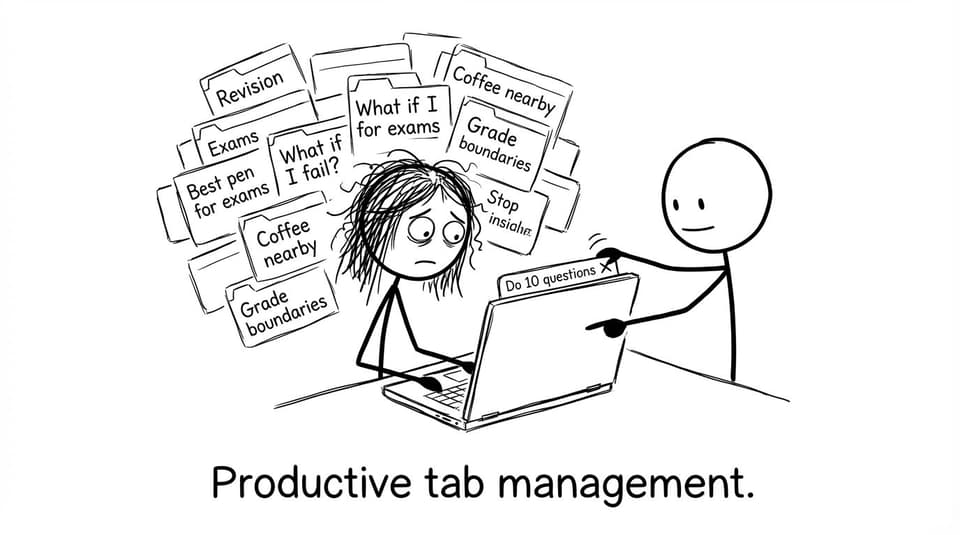
A quick checklist to stop overthinking (save this)
When IB overthinking hits, run this mini-checklist in order:
- Name the loop: "I am overthinking, not solving."
- Shrink the task: one topic, one question set, one timed block.
- Switch to output: write an answer, not a plan.
- Get feedback fast: mark it, review it, correct it.
- End with a next action: the next 25-minute block is already chosen.
If you want the simplest place to run this loop in one tab, start with RevisionDojo Questionbank and let questions decide what you do next.
Why IB students overthink right before exams
Overthinking shows up when three things collide:
Uncertainty
IB exams feel "high signal." A small change in question wording can swing your confidence. Your brain reacts by trying to predict every possible question.
Identity
At some point, your grades start to feel like a verdict on you, not a measurement of work. Overthinking is what happens when performance becomes personal.
Lack of a finish line
Many IB students revise until they feel calm. The problem is: calm doesn't arrive on schedule. A plan that depends on a feeling will always drift.
A better approach is to revise until you have evidence: timed answers, marked work, and a clear list of what actually breaks under pressure.
For timed practice that creates evidence quickly, use Exam Mode to train your brain to perform while slightly stressed, which is the only kind of calm that matters.
The core idea: trade rumination for reps
Overthinking is often a quiet form of procrastination. It's not laziness. It's avoidance dressed as analysis.
In IB, your goal isn't to have perfect thoughts about revision. It's to build automatic moves:
- seeing a command term and knowing what to do
- planning quickly
- writing a clean structure
- checking units, definitions, assumptions
You build those moves the same way you build stamina: repetition with feedback.
If you're not sure where to start, Notes + Flashcards + Question Bank (Free) is the simplest "one platform" setup for IB: learn, recall, practice, mark, repeat.
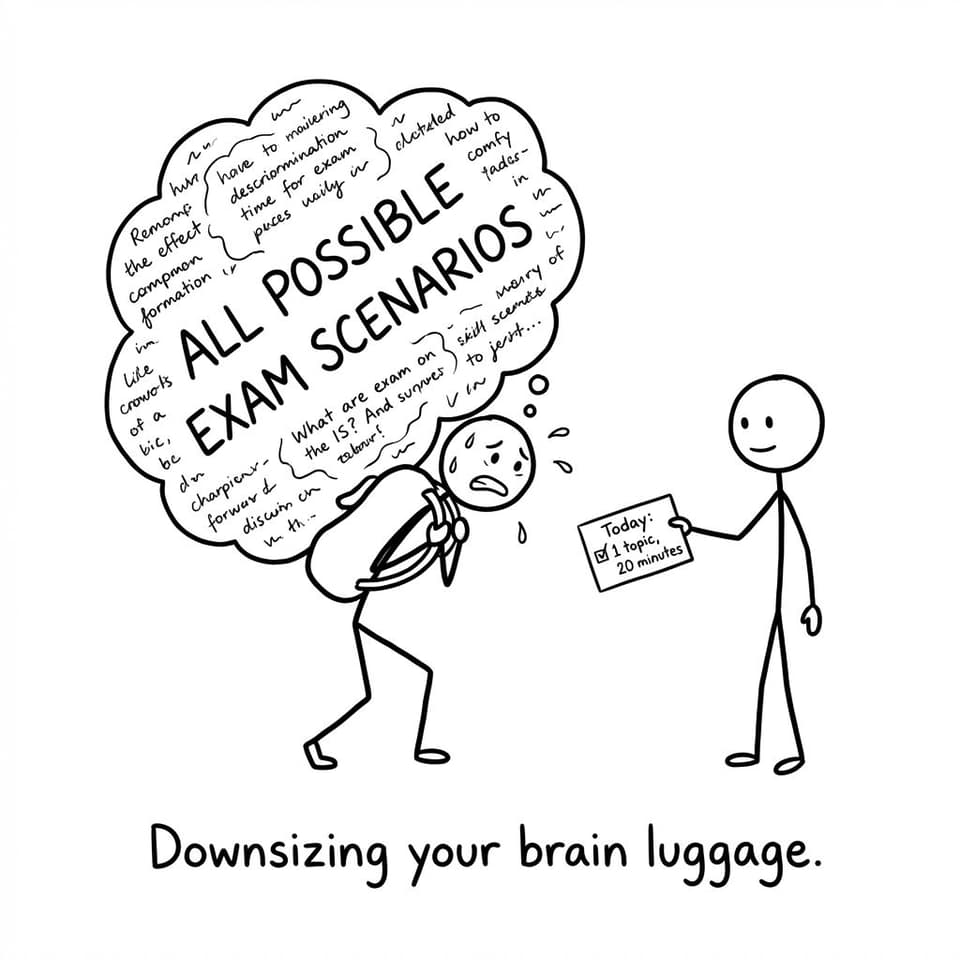
Stop overthinking by using the "one-page plan" method
Overthinking loves infinite options. A one-page plan removes them.
Build your one-page plan (15 minutes)
For each IB subject, write:
- 3 weak topics (not "the whole unit")
- 2 exam skills you lose under time (planning, diagrams, evaluation, explanation)
- 1 routine you will repeat daily
Then choose a single daily routine that fits real life.
A strong default routine:
- 10 min: skim the relevant chapter in Study Notes
- 25 min: Questionbank set (untimed, accuracy)
- 20 min: review mistakes + rewrite 1 answer
- 7 min: Flashcards (spaced repetition)
That is not glamorous. That is why it works in IB.
If you need help turning "I don't know what to do today" into a plan, use IB revision timetable as a structure you can actually follow when motivation dips.
A mental trick that works: "worry is allowed, but not in the study block"
Overthinking doesn't respond well to suppression. Your brain interprets "don't think about it" as "think about it louder."
Try containment instead:
- Set a 10-minute "worry appointment" once per day.
- Write the worries down as bluntly as possible.
- For each worry, write one action that can be done in 25 minutes.
Then, during your study block, you're not fighting anxiety. You're following instructions you already wrote.
This is especially powerful for IB students juggling coursework. If your worry is about an IA, EE, or TOK draft quality, route it to fast feedback using RevisionDojo for Schools (for teacher workflows) or RevisionDojo's Grading tools (for students) so uncertainty doesn't linger.
Use IB-style practice to break the "what if" spiral
The fastest way to stop "what if this comes up?" is to face the format directly.
The two practice modes you need
Accuracy mode (reduce fear)
- short sets
- open notes at first if needed
- focus on understanding and clean method
Pressure mode (reduce surprise)
- timed blocks
- no notes
- strict pacing
Overthinking hates pressure mode because it forces a result. But IB marks come from results.
A clean way to build pressure mode without burning out is to run shorter timed sections. RevisionDojo's How to Run Timed IB Mock Exams in RevisionDojo (Exam Mode + Test Builder) explains how to do this without turning every day into a full-length marathon.
And when you want to target your weakest areas without guessing, use the Advanced IB Test Builder workflow to generate focused practice that feels like the real thing.
The "after" problem: stop overthinking between exams
Some of the worst IB overthinking happens after you walk out of a paper.
You replay a question. You hear someone say a different answer. Your brain starts bargaining.
That stress has only one place to go: into the next exam.
The fix is a deliberate reset routine. Use this guide: How to Mentally Reset Between IB Exam Papers. Treat it like part of your exam technique, not a wellness add-on.
A calm IB pre-exam routine (that doesn't require being calm)
Here is a routine you can do even when you're not okay.
The night before
- Pack materials.
- Do 30--45 minutes of light recall (Flashcards or a tight notes skim).
- Stop early enough to sleep.
If you always spiral the night before, follow What to Do the Night Before a Big Exam and treat it like a script.
The morning
- Eat something predictable.
- 5 minutes of breathing.
- Review only a micro-sheet: definitions, formulas, common errors.
For a targeted calm-down routine, use Meditation and Breathing Techniques for Exam Stress. In IB, focus is a skill you practice, not a mood you wait for.
At your desk, before writing
- Read the first question.
- Write a tiny plan.
- Start.
The antidote to overthinking is motion.
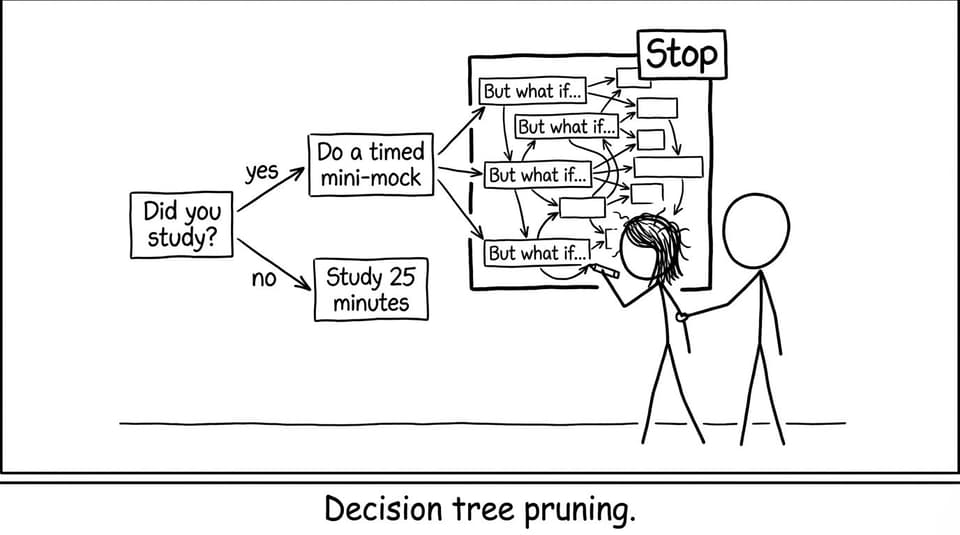
How RevisionDojo turns overthinking into progress
Overthinking thrives when feedback is slow and practice is vague. RevisionDojo is designed to remove both.
- Questionbank gives you endless IB-aligned practice so you're not stuck "thinking about studying."
- Study Notes help you rebuild understanding quickly when a topic feels foggy.
- Flashcards keep definitions, formulas, and key phrasing alive through spaced repetition.
- AI Chat helps you ask the kind of questions you wish you could ask a teacher at 11:30pm.
- Grading tools reduce uncertainty for IAs, TOK, and essays by giving rubric-aligned next steps.
- Predicted Papers (and Mock Exams) help you practice realistically without guessing what matters.
- The Coursework Library gives you examples when you're stuck.
- Tutors provide human accountability when your brain is too noisy to steer alone.
If you want the simplest "practice-first" loop, begin with Effective Revision Techniques for IB Exams in 2024 and then implement it inside Questionbank and Exam Mode.
Closing: your IB mind doesn't need more thoughts, it needs fewer decisions
The quiet secret of IB success is that the highest scorers aren't thinking more than everyone else. They're deciding faster.
They decide what to practice today. They decide how long they'll work. They decide how to review mistakes. And they decide, once the timer starts, to write imperfectly but clearly.
If you want that kind of calm, build it the simple way: practice in small blocks, get feedback immediately, and repeat.
Start your next 25-minute block now with RevisionDojo Questionbank, then lock it in with Exam Mode. Your IB exams don't reward the best worries. They reward the best work.