

Friction is the invisible teammate you only notice when it fails.
One rainy training day, everyone looks the same: a little cautious, a little slower, and strangely polite about changing direction. It is not confidence that disappears first. It is friction. And in IB SEHS, friction is one of those concepts that feels simple until an exam question asks you to apply it to a specific sport, surface, and injury risk.
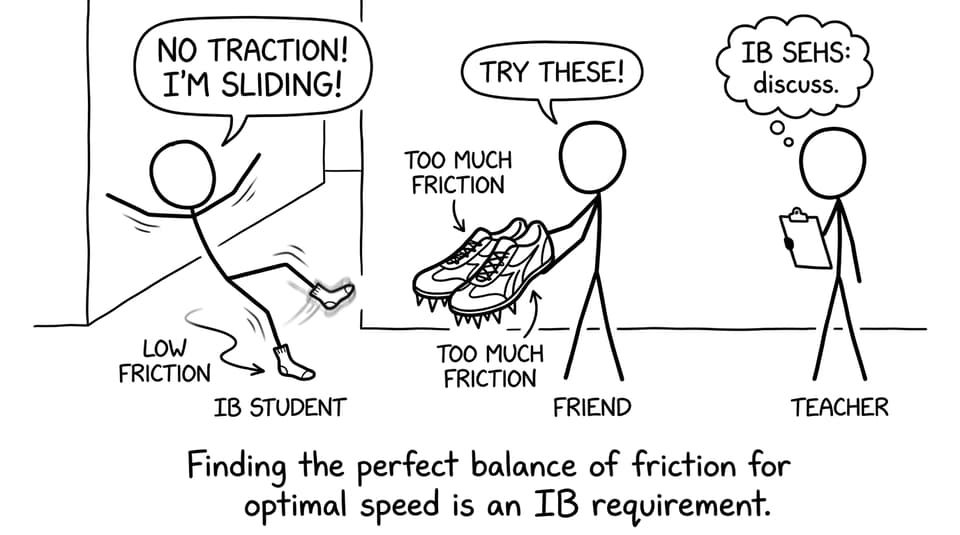
IB SEHS quick checklist: what to say about friction
Use this mini-structure to build exam-ready answers in IB SEHS:
-
Define friction as a contact force that opposes relative motion between surfaces
-
State it acts parallel to the surfaces and opposite the direction of movement (or potential movement)
-
Apply it to traction and control (start, stop, cut, grip)
-
Contrast with speed sports where reducing friction can improve performance
-
Link to injury mechanisms (high friction can increase joint loading) and prevention (surface, footwear, technique)
If you want the syllabus-aligned wording, keep Friction and Drag (HL) Notes open while you practise.
What friction means in IB SEHS (without overcomplicating it)
In IB SEHS, friction is the force resisting motion when two surfaces touch: shoe and court, hand and bat, ball and turf. It is not automatically “good” or “bad.” It is a performance dial.
Two key factors influence friction in sport:
-
The nature of the surfaces (rough, smooth, wet, textured)
-
The normal force pressing them together (often body weight or grip force)
Revision tip: build comfort with exam language like “static friction supports initiation of movement” and “dynamic friction opposes sliding once movement has started.” You can review that distinction in Static vs Dynamic Friction Coefficients and the formula-focused summary in Coefficient of Friction Notes.
Friction as control: acceleration, stopping, and changing direction
Most of the time, athletes do not “move on the ground.” They move by pushing against it.
In IB SEHS, that is where friction shows up as traction. A sprinter needs enough friction to apply force backwards so the body accelerates forwards. A footballer cutting sharply needs enough friction to prevent the foot from slipping during deceleration and re-acceleration. A gymnast needs enough friction through hands or footwear to stabilize contact with apparatus.
To score higher marks, connect friction to forces and motion rather than leaving it as a standalone idea. This is why it helps to revise friction within the bigger unit of B.2 Forces, Motion and Movement and practise applied questions via the Friction and Drag (HL) Questionbank.
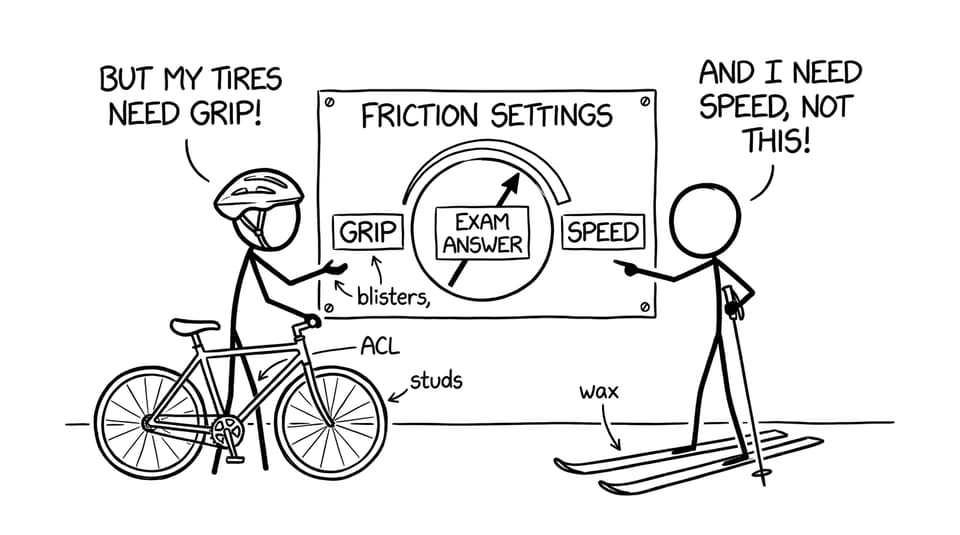
Friction as resistance: when less is faster
There is a reason ice feels “fast.” Low friction reduces resistive forces, so an athlete maintains velocity more easily.
In IB SEHS, you can explain performance gains when friction is minimized:
-
Ice skates reduce friction between blade and ice, enabling glide
-
Ski wax reduces surface resistance, improving speed
-
Smooth road tyres reduce unnecessary resistive friction on consistent surfaces
The exam-friendly nuance is balance: too little friction harms control; too much friction increases resistance and can reduce speed. That trade-off is often the entire command term hidden inside “discuss” or “evaluate.”
Friction and injury risk: why “more grip” is not always safer
High friction can be useful, but it can also raise injury risk during rapid deceleration or pivoting. When the foot “sticks,” the body still rotates. That can increase torsional stress at joints.
In IB SEHS, common links include:
-
Knee injuries on high-traction surfaces during cutting actions
-
Blisters from repeated friction between skin and footwear
-
Overuse stress when friction increases braking forces repeatedly
For deeper biomechanics context and the way examiners like applied explanations, pair this topic with How to Revise Forces and Motion and the broader Biomechanics visual guide.
Equipment and surfaces: designed friction (not accidental)
Sport technology is often friction management in disguise.
-
Studs and spikes increase friction to improve traction
-
Textured grips increase friction between hand and equipment
-
Courts, turf, and track surfaces are engineered for a friction “sweet spot” between speed and safety
That is a strong IB SEHS angle because you can propose modifications: surface choice, footwear choice, grip aids, or technique changes. If you want a broader map of where friction sits in the course, use the IB SEHS resources hub.
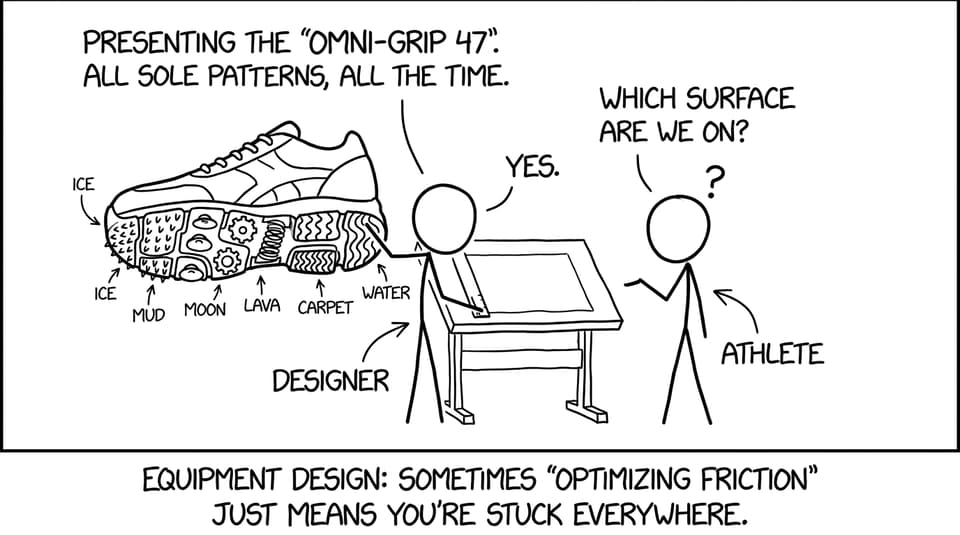
Final takeaway: treat friction like a dial, not a label
In IB SEHS, friction is best described as a dial you adjust depending on the sport: more for control, less for speed, and always with an eye on injury risk. If you want to make this topic feel automatic, build your revision around applied practice, not rereading definitions.
On RevisionDojo, you can combine Study Notes, Flashcards, Questionbank practice, AI Chat explanations, Grading tools, Predicted Papers, Mock Exams, the Coursework Library, and Tutors to turn friction from “I get it” into “I can explain it in any scenario.”