

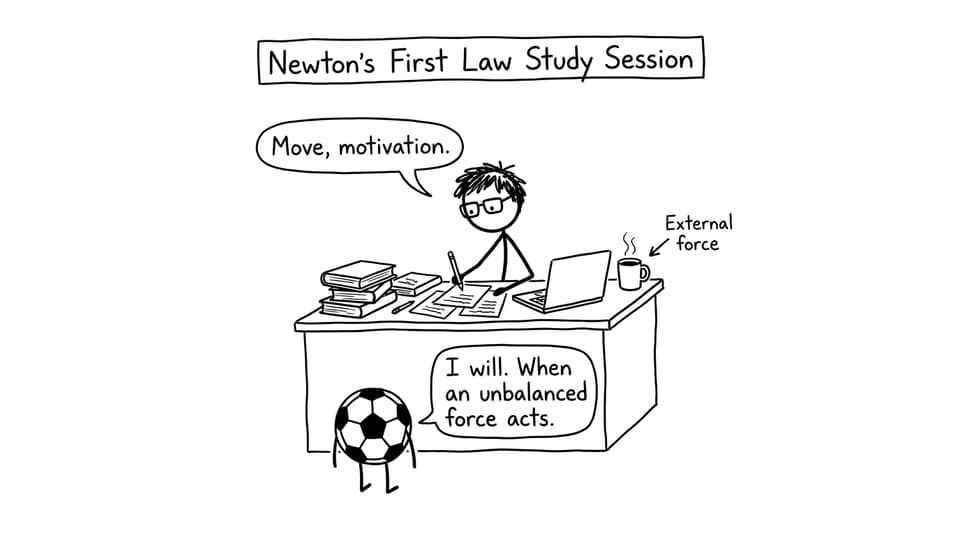
When you watch a striker wind up for a shot, the ball looks calm, almost indifferent. Then the foot arrives, and everything changes. That “nothing happens until something acts” feeling is the heartbeat of IB SEHS biomechanics, and it’s exactly what Newton’s First Law is trying to teach you: motion doesn’t change by accident. It changes because a net external force shows up.
Newton’s First Law (law of inertia) states that an object will remain at rest, or continue moving at constant velocity, unless acted upon by an unbalanced external force. In IB SEHS, the marks usually live in how you apply that sentence to sport.
The IB SEHS quick checklist for Newton’s First Law
Use this as your mini-structure for short answers:
-
State the situation: at rest or moving at constant velocity
-
Name inertia (resistance to change in motion)
-
Link inertia to mass (more mass == more inertia)
-
Identify forces as balanced or unbalanced
-
Explain the result: no change in velocity vs acceleration/deceleration/change in direction
If you want the syllabus-aligned backbone for this topic, start with B.2.1 Newton’s laws of motion and keep the Notes for B.2.1 Newton’s laws of motion open while you practise.
IB SEHS and inertia: why “mass matters” in sport
Inertia is a body or object’s resistance to changing its state of motion. In sport, you feel inertia when:
-
a rugby player is hard to stop once moving
-
a shot put takes serious effort to start moving
-
a sprinter needs a powerful drive phase to overcome stillness
The IB SEHS scoring habit is to write the link explicitly: greater mass leads to greater inertia, so more force is required to start, stop, or change direction. That one line turns a definition into applied understanding.
For a fuller set of examples and phrasing, see B.2.1.1 Newton’s laws of motion in linear and angular contexts.
Balanced forces in IB SEHS: constant velocity looks “boring” for a reason
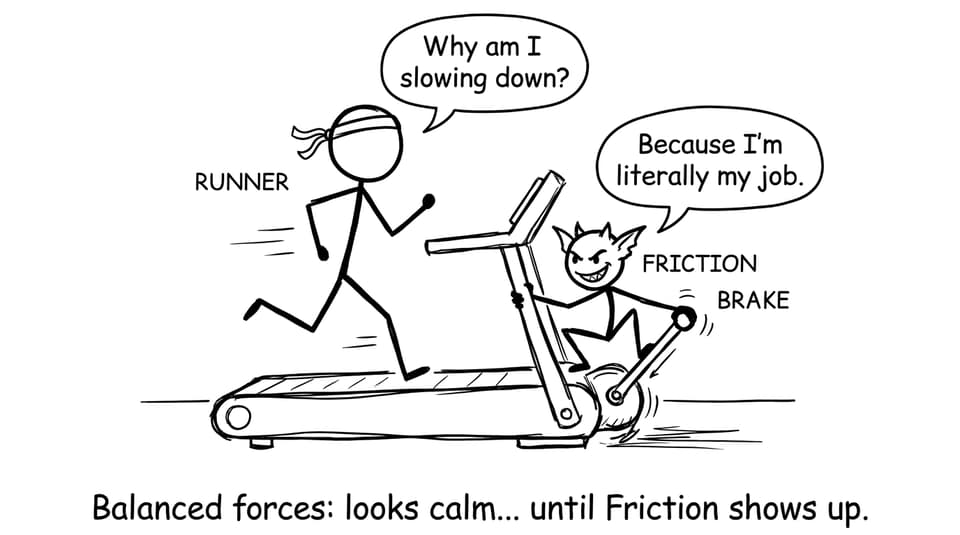
Balanced forces mean the net force is zero, so velocity does not change. That could look like:
-
an object staying at rest
-
an athlete moving at constant speed in a straight line
A classic sport link is a puck or ball gliding until friction (a contact force) reduces speed. Your job in IB SEHS is to identify the force that breaks the balance: friction, air resistance, a collision, or a muscular push against the ground.
To strengthen this whole forces-and-motion toolkit, pair this post with How to Revise Forces and Motion and the broader hub for B.2 Forces, motion and movement.
Unbalanced forces: the moment sport actually changes
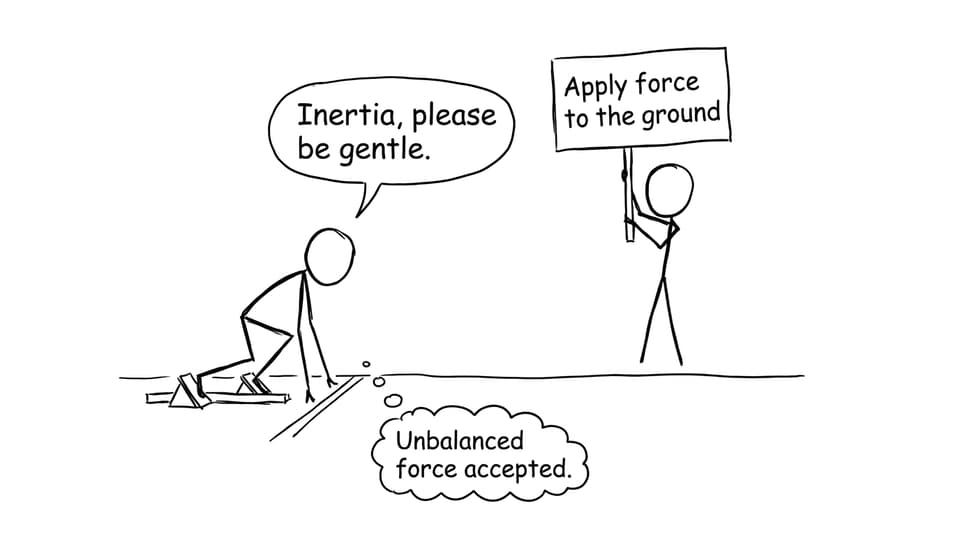
Unbalanced forces create a net force, which changes velocity (acceleration). In sport, that includes starting, stopping, speeding up, slowing down, and turning.
Think sprinting: the athlete applies force to the ground; the ground provides a reaction force; friction prevents slipping; the result is a net force forward. In IB SEHS, you don’t need complicated math to score well. You need clean cause-and-effect.
For targeted exam practice, use the B.2.1 Newton’s laws of motion Questionbank and the step-by-step Lessons for B.2.1 Newton’s laws of motion.
How to write a top-mark IB SEHS example (template)
Try this sentence pattern:
“Because of inertia, the athlete/object resists changing motion. When an unbalanced external force (name it) acts in (direction), the net force is non-zero, so velocity changes (how), improving performance or altering control.”
If you want to avoid common wording traps, read Common Forces and Motion Mistakes and keep one or two go-to sporting scenarios you can reuse.
Bring it home with RevisionDojo
Newton’s First Law is simple, but IB SEHS questions reward students who can explain it calmly under pressure. RevisionDojo helps you build that calm with Study Notes for clarity, Flashcards for recall, and the Questionbank for application. When you’re ready to simulate real exam decision-making, use Mock Exams and Predicted Papers, then tighten your phrasing with AI Chat and Grading tools. Keep Newton’s First Law close: in sport, nothing changes until something acts, and in IB SEHS, marks don’t appear until your explanation does.