


Even the strongest IB Math student can feel their confidence shrink the moment the invigilator says, “You may begin.” The room goes quiet. The clock gets loud. And suddenly your brain treats a normal differentiation question like a personal attack.
If you are searching for How to Manage Exam Pressure During IB Math Papers, you are not looking for motivational quotes. You are looking for something repeatable: a way to stay steady when Paper 1 feels tight, Paper 2 feels long, and your mind keeps trying to sprint ahead to the final grade.
The good news is that exam calm is not a personality trait. It is a trained response. And like any skill in IB Math, it improves fastest when you practice it under realistic conditions, with feedback, and with a system you can trust.
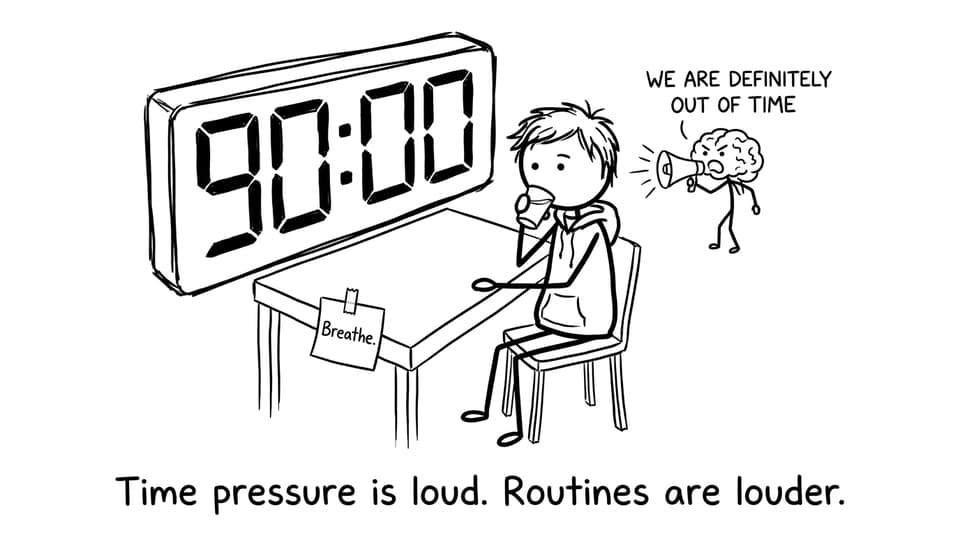
A quick checklist for exam calm
Use this as your short, practical “default settings” for How to Manage Exam Pressure During IB Math Papers:
-
Know your paper structure (AA vs AI, SL vs HL) and what each paper rewards.
-
Train with timed sets weekly, not just topic drills.
-
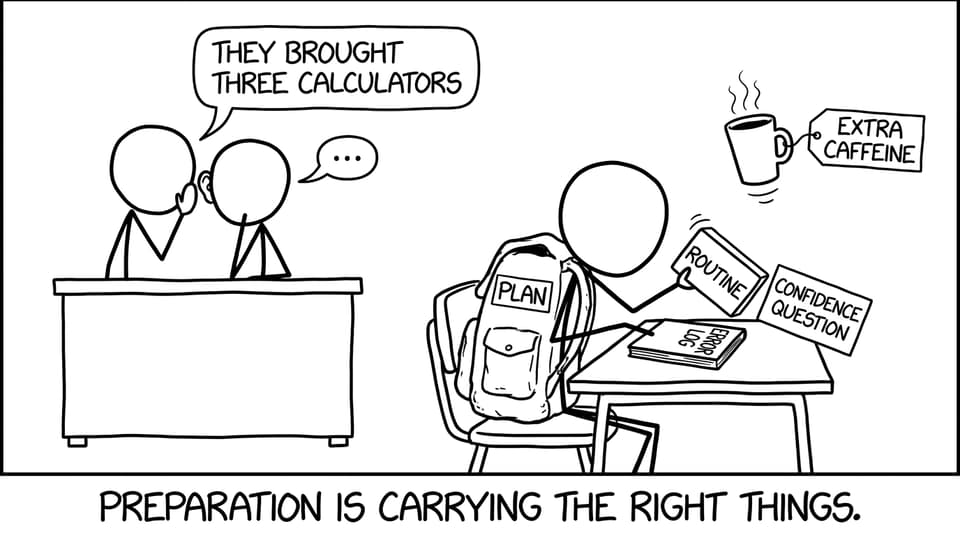
Choose a simple pre-exam routine (same steps, every time).
-
Use a reset protocol for panic (breathing + tiny action).
-
Start with a confidence question to build momentum.
-
Track recurring mistakes so pressure does not resurrect them.
If you want a structured practice loop for the weeks before exams, pair this article with The Ultimate IB Math Study Routine for Busy Students.
Why IB Math pressure feels so intense
Pressure in IB Math papers is rarely about “not studying.” It is usually about uncertainty under time. IB questions are designed to test decision-making: which method, which assumption, which representation, which next step.
That is why pressure often spikes when:
-
You cannot immediately see the route to a solution.
-
A question looks unfamiliar, even if the underlying topic is familiar.
-
You make one small mistake early and start predicting disaster.
-
The clock forces you to trade perfection for progress.
If you have ever frozen mid-question, it is not proof you are bad at math. It is your nervous system reacting to threat. You can learn the mechanics of that reaction in Why Your Brain Freezes During IB Exams.
How to Manage Exam Pressure During IB Math Papers by reframing the feeling
A useful mental shift is this: anxiety and readiness share the same fuel.
Your heart rate rises because your body is preparing to perform. The problem is interpretation. If you label the sensation as danger, you tighten up and rush. If you label it as energy, you keep your hands moving and your thinking clearer.
Try a sentence you can actually believe:
“My body is switching on. I will use it to focus on the next step.”
This is not positive thinking. It is accurate thinking.
Build a pre-exam routine that lowers your baseline
When students ask How to Manage Exam Pressure During IB Math Papers, they often focus on what to do once panic begins. The deeper win is lowering your baseline so panic is less likely to start.
A strong pre-exam routine is boring on purpose. It reduces novelty. For example:
-
The night before: pack materials, choose clothes, stop heavy revision early.
-
Morning: light breakfast, water, a short walk.
-
10 minutes before: review only a one-page formula summary or a tiny flashcard set.
-
60 seconds before: slow exhale breathing and one clear intention: “Start steady.”
To keep your revision light but effective right before the exam, use How to Review Each IB Math Topic in 15 Minutes. This kind of short review prevents the classic mistake: cramming until your head feels full and your confidence feels empty.
A 60-second reset protocol for panic (mid-paper)
Pressure is physical first. So your first move should be physical, not intellectual.
Use this reset protocol during reading time or anytime you feel yourself spiraling:
-
Exhale slowly for 6 seconds.
-
Inhale for 4 seconds.
-
Exhale for 6 seconds again.
-
Drop your shoulders and unclench your jaw.
-
Then do one tiny action: underline what the question is asking, or write the first formula you might use.
That last step matters. It gives your brain evidence you are not stuck.
For more exam-day composure tactics beyond math, see How to Stay Calm and Focused During Timed Assessments and How to Stay Calm During IB Exams.
Start with a confidence question to create momentum
A fast way to reduce pressure is to collect early marks. Not because they are “easy,” but because they rebuild trust.
When you start with a question you can do, you trigger a quiet chain reaction:
-
Your writing becomes cleaner.
-
Your checking becomes more rational.
-
Your time awareness improves.
This is especially important in Paper 1, where one early algebra slip can make you feel behind for the next hour.
If you want Paper 1-specific strategy, use How to Prepare for IB Math AA Paper 1 (No Calculator).
Focus on process, not perfection
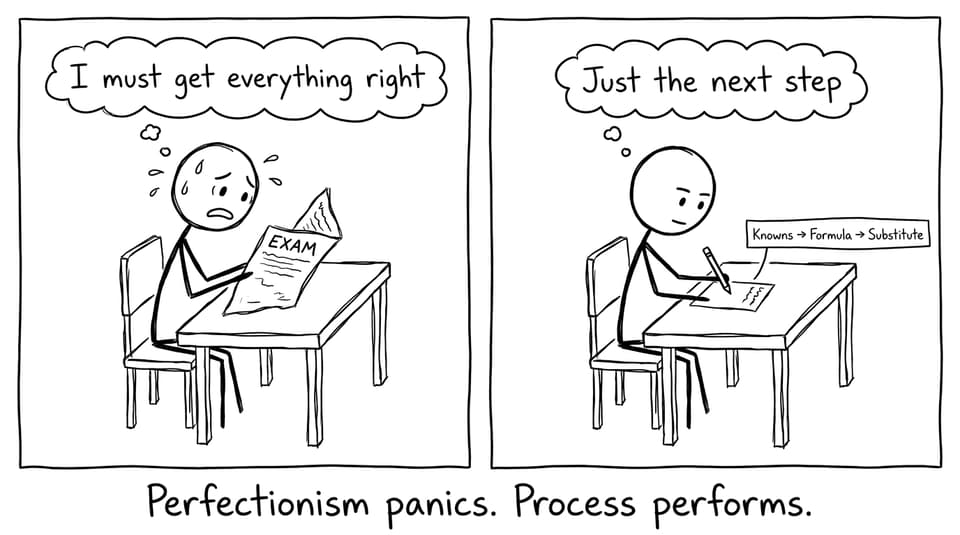
Perfectionism sounds like ambition. In an exam, it behaves like panic.
Instead of “I need full marks,” aim for “I need the next logical step.” In practice, that means writing a mini-template on your scrap paper:
-
Knowns
-
Goal
-
Method
-
Execute
-
Check
This approach is the heart of How to Manage Exam Pressure During IB Math Papers because it shrinks big uncertainty into a sequence your brain can handle.
Use smart time checks (without obsessing)
Time pressure is real. But checking the clock every two minutes turns time into a threat.
A calmer approach:
-
Budget roughly by marks (a simple heuristic is about 1.5 minutes per mark).
-
Make one planned checkpoint halfway through.
-
Protect the final 8-10 minutes for quick review and finishing steps.
If you are consistently running out of time, the fix is not “work faster.” The fix is training pacing under exam conditions.
On RevisionDojo, that is where timed practice becomes practical: you can drill targeted weaknesses in the IB Math AA resources hub, then pressure-test them with the IB Mathematics AA Calculus Questionbank (or the relevant topic filters for your course).
Train calm during practice, not on exam day
The most reliable answer to How to Manage Exam Pressure During IB Math Papers is “make pressure familiar.”
Here is a training loop that works because it mirrors how the brain learns safety:
-
Use How to Use the Questionbank for Targeted Math Revision to pick one topic and do a short set.
-
Immediately review errors using RevisionDojo’s Grading tools and explanations.
-
Turn your top three repeated mistakes into “error rules” (one sentence each).
-
Lock formulas and definitions with How to Use RevisionDojo Flashcards for Formula Mastery.
-
Once a week, do a timed simulation using RevisionDojo Mock Exams and Predicted Papers (the goal is stamina, not ego).
If you need a full workflow for simulation, use How to Use RevisionDojo to Prepare for IB Math Mock Exams and Online IB Mock Exams: Practice Anywhere, Anytime.
RevisionDojo becomes especially powerful here because it keeps everything in one loop: Questionbank for exam-style practice, Study Notes for fast clarity, Flashcards for daily recall, AI Chat for quick explanations when you get stuck, Grading tools for feedback, Mock Exams and Predicted Papers for timing, the Coursework Library to reduce background stress from deadlines, and Tutors when you need a human diagnosis.
Closing: calm is a skill, not a mood
The students who handle IB Math papers best are not the ones who never feel pressure. They are the ones who know what to do when pressure shows up.
If you want a single sentence summary of How to Manage Exam Pressure During IB Math Papers, it is this: train a routine, rehearse it under time, and lean on feedback instead of feelings.
RevisionDojo is built for that exact journey. Use the Questionbank to make uncertainty visible, Study Notes and AI Chat to fix it fast, Flashcards to keep recall sharp, Grading tools to turn mistakes into rules, and Mock Exams plus Predicted Papers to make exam pressure feel familiar. When the clock starts, you will still feel something. But you will also have a plan.