


You don’t notice how often you lean on a calculator until it’s taken away.
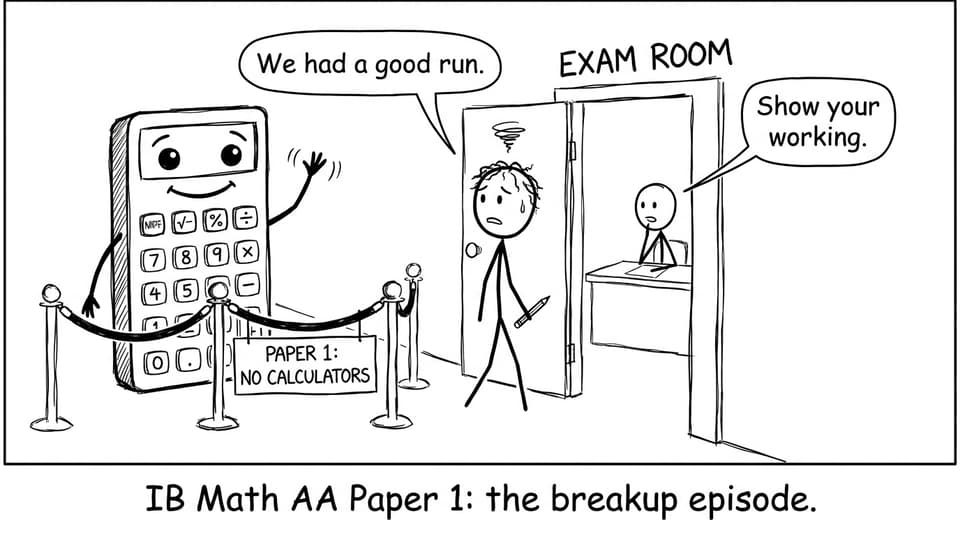
On IB Math AA Paper 1, that tiny screen is replaced by something more uncomfortable and more powerful: your own understanding. The first time you sit a no-calculator paper, it can feel like your brain is “buffering.” But Paper 1 isn’t designed to trap you. It’s designed to reveal what you actually own: algebraic fluency, exact values, clean reasoning, and the habit of writing steps that earn marks.
This guide is a practical, calm plan for IB students who want Paper 1 to feel predictable. You’ll build the skills that show up again and again, then pressure-test them in timed conditions using RevisionDojo.
A quick Paper 1 checklist (save this)
Before each study session for IB Math AA Paper 1, do these in order:
-
Choose one high-value topic set (algebra, functions, trig, or calculus).
-
Do 10 minutes of exact-value recall (radicals, special angles, log rules).
-
Complete 6-10 exam-style questions with full written working.
-
Mark your work and rewrite any solution that was messy or unclear.
-
Log one recurring mistake and turn it into a flashcard.
For targeted practice, start from the IB Math AA hub and work outward: IB Mathematics Analysis and Approaches Resources.
What IB Math AA Paper 1 actually rewards
Paper 1 rewards the kind of thinking that looks slow at first and then becomes automatic: transforming expressions, choosing a method quickly, and writing steps that match how IB markschemes award method marks.
You’ll repeatedly see:
-
Algebraic manipulation (factorising, rearranging, solving)
-
Functions language (domain/range, inverses, transformations)
-
Trig identities and exact values (no decimals as a crutch)
-
Calculus by hand (rules from memory, clean simplification)
-
Proof-style “show that” logic (especially for AA)
If you want context on the AA course itself (SL vs HL, assessment structure, what skills matter), keep this open in another tab: IB Mathematics: Analysis and Approaches (AA) Complete Guide.
Build “algebra first” speed (because it touches everything)
Most Paper 1 time loss isn’t from “hard math.” It’s from slow algebra.
A useful way to think about Paper 1 is this: the question is rarely asking for a number. It’s asking for a transformation. Can you turn what you have into something usable?
Focus your practice on:
-
Factoring efficiently (common factors, difference of squares, quadratics)
-
Handling fractions without panic (LCDs, simplifying rational expressions)
-
Rearranging multi-step equations without sign errors
Do your drills with exam-style questions so your algebra becomes contextual, not isolated. RevisionDojo’s Questionbank is built for this kind of repetition with feedback. Pair your practice with the broader strategy article: How to Master IB Math AA Paper 1: Step-by-Step Strategy.
Exact values: the quiet separator between 6 and 7
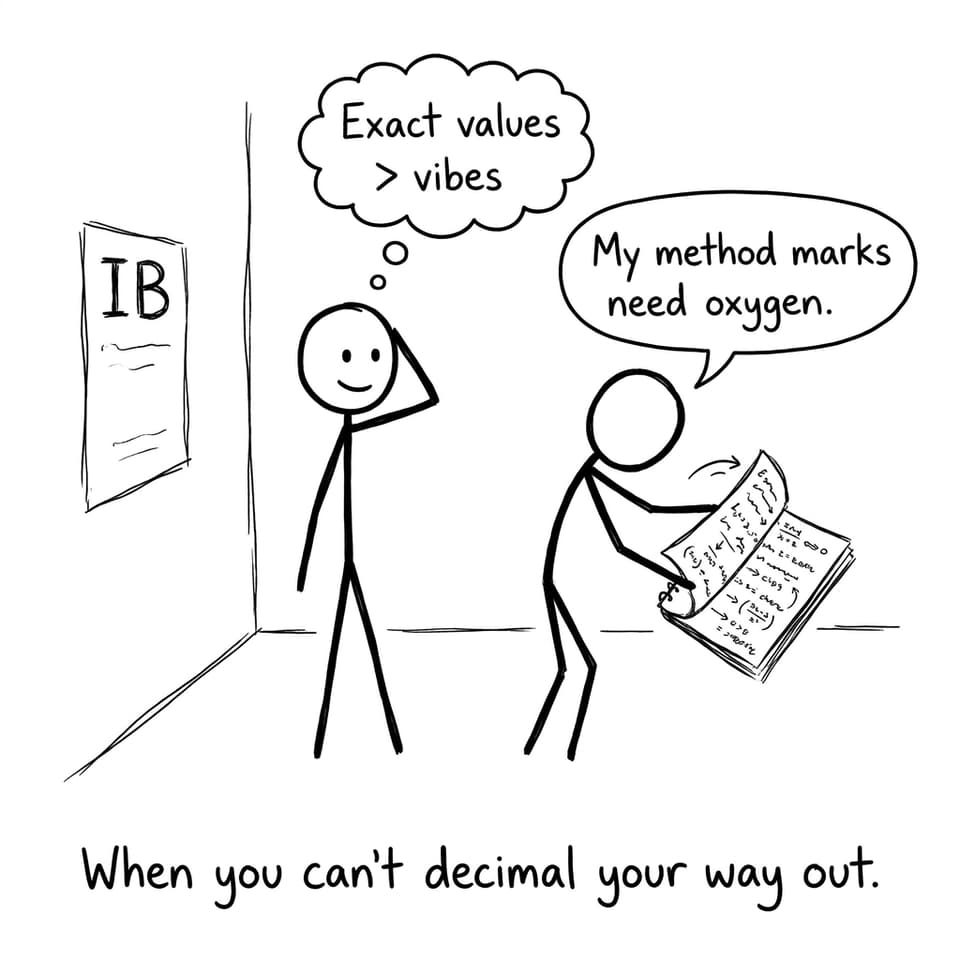
In a calculator paper, you can survive with approximations. In Paper 1, approximation is often a wrong turn.
Train yourself to prefer exact forms:
-
Special angles: (\sin 30^\circ), (\cos 60^\circ), (\tan 45^\circ)
-
Radicals and rationalising (especially in final answers)
-
Log laws and index rules (simplify first, solve second)
A practical habit: after every line you write, ask “Can this be simplified?” That single question prevents the slow drift into messy working.
To systemise recall, use RevisionDojo Flashcards so exact values become instant. This guide shows how to build decks that actually stick: How to Use RevisionDojo Flashcards for Formula Mastery.
Trig identities: learn the few that unlock the rest
Many IB students try to memorise trig like a phone book. A better approach is to master a small set and practice transforming expressions until the patterns feel familiar.
Make sure you can use, not just recite:
-
(\sin^2x + \cos^2x = 1)
-
(\tan x = \sin x/\cos x)
-
(1 + \tan^2x = \sec^2x)
Then do mixed questions where the identity is not announced. That’s the real Paper 1 skill: recognition.
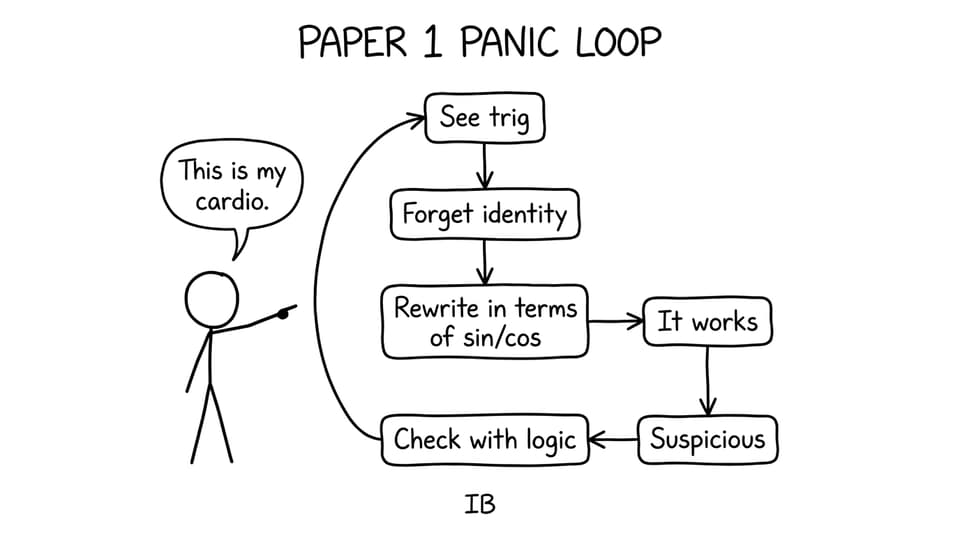
A simple drill that works: rewrite everything in (\sin) and (\cos), simplify, then decide if converting back helps. It’s not elegant, but it’s reliable under pressure.
Calculus by hand: practice the “clean line” method
Paper 1 calculus isn’t about creativity. It’s about execution.
Your goal is to make your working so clean that the examiner can’t miss your method marks:
-
Write the rule you’re using (chain/product/quotient) through structure, not commentary
-
Simplify after differentiating, not during (to avoid errors)
-
Keep brackets visible until the end
If calculus is your weak area, do focused sets until your hands know the process. Here’s a ready-made entry point: IB Math AA Calculus Questionbank.
Train the “markscheme mindset” (without seeing the markscheme)
Paper 1 isn’t just about being right. It’s about being legible.
When you practice, force yourself to:
-
Show one step per line when the algebra is delicate
-
Indicate substitutions clearly (especially in trig and calculus)
-
Box final answers in exact form
-
Leave a short concluding statement when a question asks to “hence” or “show”
This is where RevisionDojo’s ecosystem helps: Study Notes to refresh methods, AI Chat to interrogate your logic (“Where did my sign flip?”), and Grading tools to learn what earns method marks. When you’re ready to simulate pressure, use Mock Exams and Predicted Papers to build pacing, then review with the Questionbank to patch gaps.
For a compact AA reference you can keep returning to, bookmark: Mathematics Analysis and Approaches (AA) Notes.
Timed practice: mini-papers beat marathons
Stamina matters, but consistency matters more.
Instead of waiting for the “perfect” weekend to do a full paper, build endurance with mini-papers:
-
20 minutes: 4 short questions (algebra/trig)
-
25 minutes: 1 structured functions question
-
30 minutes: 1 longer calculus problem
Then do a slow, ruthless review. Rewrite any solution that you couldn’t explain out loud. That rewrite is where your IB marks are hiding.
To sharpen the broader routine around this, see: The Ultimate IB Math Study Routine for Busy Students.
Closing: make Paper 1 feel teachable
The strange gift of IB Math AA Paper 1 is that it’s honest. If your algebra is sharp, if your exact values are ready, and if your working is clear, the paper becomes less mysterious each week.
Start small: one mini-paper, one clean review, one improvement logged. Then repeat.
When you want everything in one place, RevisionDojo is built for this exact process: Questionbank for targeted Paper 1 practice, Study Notes and Flashcards for fast recall, AI Chat for stuck moments, Mock Exams and Predicted Papers for timing, and Tutors when you want a human to tighten the last 10%.
Go to the AA home base and begin with your weakest topic today: IB Mathematics Analysis and Approaches Resources.