
For IB students sitting exams in May 2028 (started DP1 in August 2026).
To earn a 7 in IB SEHS, build precise scientific knowledge, practise applying it to unfamiliar situations, and treat data analysis as a skill rather than a chapter. Your preparation must cover Paper 1, Paper 2, and the scientific investigation because the current assessment model gives all three a meaningful influence on your final grade.
The May 2028 cohort is studying the SEHS course first assessed in 2026. As of October 2026, the IB has not published May 2028 grade boundaries or a final public examination timetable, so no responsible guide can promise a particular mark for a 7. What you can control is whether your work consistently demonstrates the knowledge, application, analysis, evaluation, and inquiry expected by the course.
The short checklist for a 7 in IB SEHS
A strong plan should include:
- Complete coverage of the current syllabus at your registered level
- Frequent retrieval practice rather than repeated rereading
- Timed Paper 1A, Paper 1B, and Paper 2 practice
- Accurate use of SEHS terminology in context
- Confidence with graphs, data, uncertainties, and experimental design
- Extended responses that connect evidence to physiological, biomechanical, or psychological principles
- An IA built around a focused research question and defensible method
- An error log that converts every mistake into a future revision task
Begin with the IB SEHS new syllabus resource hub. It brings the course structure, Study Notes, Flashcards, and practice resources into one place, which makes it easier to see whether your revision actually covers the syllabus.
Know the May 2028 assessment model
The official IB subject brief identifies the current course as first assessed in 2026. It organizes SEHS around three broad themes: exercise physiology and nutrition of the human body, biomechanics, and sports psychology and motor learning.
Unless the IB announces a later change, this is the syllabus and assessment model relevant to May 2028 students:
| Component | Current format | Weighting |
|---|---|---|
| Paper 1 | Paper 1A multiple-choice questions plus Paper 1B data-based and experimental-work questions | 36% |
| Paper 2 | Short-answer and extended-response questions | 40% |
| Scientific investigation | An individual written investigation based on the student's own research question | 24% |
Paper 1 lasts 1.5 hours at SL and 1.75 hours at HL. Paper 2 lasts 1.5 hours at SL and 2.5 hours at HL. The scientific investigation is allocated 10 hours and has a maximum overall report length of 3,200 words under the current guide.
These details are published. The exact May 2028 examination dates, final grade boundaries, and session-specific marking outcomes are not yet published. Grade boundaries can also vary between examination sessions, so plans built around an assumed cutoff create false confidence.
What 7-level performance looks like across the papers
A 7 is not simply evidence that you remember more facts. It usually reflects a smaller gap between what you know and what you can do with that knowledge under pressure.
Paper 1A: discriminate between plausible answers
Multiple-choice questions often place one accurate answer beside several statements that sound scientific. High-level performance depends on reading every qualifier, recalling the exact relationship involved, and rejecting alternatives for a specific reason.
Consider this illustrative question:
During increasing exercise intensity, which energy system makes the greatest contribution during a brief maximal effort?
A weak approach is to choose an answer because it contains the word “anaerobic.” A stronger approach identifies the duration and intensity first, recalls the dominant pathway for that context, and then checks whether the wording asks for the greatest contribution rather than the only contribution.
Annotation: The deciding evidence is embedded in the scenario. A top-grade student uses the qualifiers before using memory.
Build this habit with the SEHS Questionbank, then review the relevant energy systems Study Notes whenever an error reveals a conceptual gap.
Paper 1B: turn data into scientific reasoning
Paper 1B rewards more than describing whether a line rises or falls. You need to identify patterns accurately, support observations with data, recognize limitations, and connect evidence to experimental design.
Suppose an unfamiliar graph shows mean heart rate increasing across three workloads while error bars overlap at two workloads.
A limited response might say:
Heart rate increases as workload increases.
A better response would be:
Mean heart rate rises across the three workloads, suggesting a positive relationship between workload and cardiovascular response. However, the overlapping error bars for two conditions reduce confidence that their difference is meaningful without an appropriate statistical analysis.
Annotation: The first sentence identifies and interprets the pattern. The second recognizes uncertainty without claiming that overlapping error bars automatically prove there is no difference.
Practise asking four questions whenever you meet data: What is the pattern? What evidence supports it? How certain is the interpretation? What design feature could explain or weaken it?
Paper 2: build connected explanations
Paper 2 requires short answers and extended responses. The challenge is often not knowing an isolated fact, but arranging several facts into a causal chain that answers the command term.
For an illustrative prompt asking you to explain fatigue during repeated high-intensity exercise, compare these approaches:
Fragmented response: “ATP decreases. Lactate increases. The athlete gets tired.”
Connected response: “Repeated high-intensity efforts increase demand for rapid ATP resynthesis. As recovery between efforts becomes insufficient, changes associated with fatigue can reduce the muscle's capacity to maintain force and power. Performance therefore declines across repeated efforts, although the relative contribution of each mechanism depends on factors such as intensity, duration, and training status.”
Annotation: The stronger answer establishes a mechanism, links it to performance, and avoids presenting a complex process as having one universal cause.
Use command terms deliberately. “Describe” needs an accurate account, “explain” needs causal reasoning, and “evaluate” requires a supported judgment that considers strengths, limitations, or competing interpretations. The fatigue and recovery section is useful for HL students practising this movement from fact to explanation.
What a top-grade SEHS IA looks like
The scientific investigation is worth 24%, so it should not be treated as a side project. Under the current criteria, the report is assessed through four equally weighted areas: research design, data analysis, conclusion, and evaluation.
A strong investigation normally has:
- A focused research question identifying measurable variables and a defensible context
- A method detailed enough to reproduce, with relevant controls, safety, ethics, and environmental considerations
- Raw and processed data presented clearly with suitable units and uncertainties
- Mathematical or statistical processing justified by the data and question
- A conclusion that directly answers the research question and refers to processed results
- An evaluation that explains the impact of specific limitations and proposes realistic improvements
For example, “Does exercise affect heart rate?” is too broad to guide a precise investigation. A more useful structure is: “How does changing [independent variable] across defined levels affect [measured dependent variable] in [specified population or setting] under [key controlled conditions]?” This is a template for precision, not a ready-made research question.
Evaluation should also move beyond lists. Instead of writing “human error affected the results,” identify the vulnerable measurement, explain the likely effect on reliability or validity, and propose a feasible procedural change. If timing began manually after each effort, for example, the delay might systematically miss part of a rapid recovery response. Automated or continuously recorded measurement could reduce that problem.
Read the current SEHS IA criteria explanation before choosing a method, not after collecting data. The SEHS IA timeline guide can then help you separate planning, collection, processing, writing, and revision.
A two-year plan for how to get a 7 in IB SEHS 2028
The advantage of starting early is not that you can study all the time. It is that you can build feedback loops before mistakes become habits.
August-December 2026: build the system
Create one syllabus tracker for SL or HL. After each lesson, condense the topic into a small set of retrieval prompts, then use Flashcards and short Questionbank sets within a few days.
Keep three records: concepts you cannot explain, command terms you mishandle, and data skills that cause errors. When studying mechanics, for example, connect equations and definitions to sporting movement through the Newton's laws of motion resources.
January-June 2027: move from recall to application
Continue learning content, but make unfamiliar questions routine. Once each week, complete a mixed set without notes and classify every mistake as knowledge, interpretation, calculation, command-term, or time-management related.
Begin considering IA areas only after learning enough methodology to judge feasibility. A modest question with controlled variables and reliable measurements is usually more defensible than an ambitious question your school cannot test well.
July-December 2027: integrate topics and complete the IA
Use the break to revisit weak foundations, not to race through every topic again. Build cross-topic connections, such as how hydration affects physiological response or how arousal can influence performance decisions. The arousal and anxiety resources can support the psychological side of that integration.
Complete IA data collection early enough to correct presentation and reasoning problems without changing results dishonestly. RevisionDojo's Coursework Library and Grading tools can help you understand structure and obtain feedback, while Tutors can provide human guidance where your school permits it. Your final investigation must remain your own work and follow IB academic integrity requirements.
January-March 2028: train complete performances
Shift toward timed sections and full Mock Exams. Use Predicted Papers as fresh simulations rather than forecasts of exact May content. After every attempt, spend at least as much attention on correction as completion.
RevisionDojo's AI Chat can clarify a difficult mechanism, but follow the explanation by answering a question unaided. Understanding that disappears when the notes close is recognition, not mastery.
April-May 2028: refine rather than rebuild
Use your error log to select high-value weaknesses. Alternate short retrieval sessions with timed paper practice, then protect sleep and routine as examinations approach.
Do not chase an unofficial 2028 grade boundary. Aim instead for repeatable evidence: precise definitions, clear calculations, supported data interpretation, and extended answers that remain relevant from first sentence to last.
The final principle
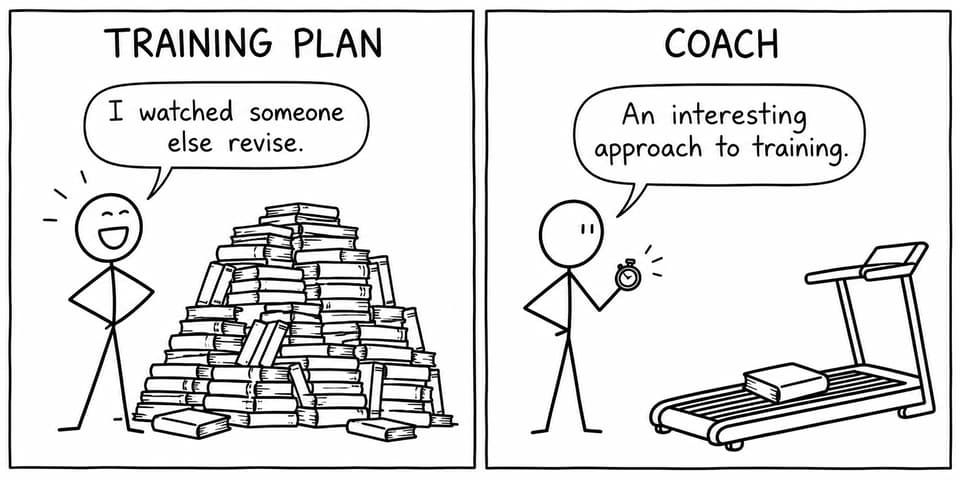
The route to an IB SEHS top grade resembles athletic training more than cramming. Knowledge provides capacity, but deliberate practice makes that capacity usable when the task changes and the clock is running.
RevisionDojo is the ultimate IB resource for building that process in one place, combining the Questionbank, Study Notes, Flashcards, AI Chat, Grading tools, Predicted Papers, Mock Exams, Coursework Library, and Tutors. Your specific next step is to open the SEHS Questionbank, answer 10 mixed questions without notes, and record the reason for every lost mark.