


If you have ever stared at a clean algebraic model and thought, “This is neat, but it feels static,” you already understand why algebra and calculus belong together in an IB Math IA.
Algebra is the blueprint. Calculus is the motion sensor. One tells you what the system is; the other tells you how it behaves. When you combine them well, your IB IA stops looking like a collection of techniques and starts reading like a single argument that earns marks for Use of Mathematics and Communication.
The goal is not to sprinkle differentiation on top of a quadratic and hope the examiner is impressed. The goal is to make algebra and calculus feel inevitable in your story: the algebra sets up a model worth studying, and calculus answers the question your model naturally creates.
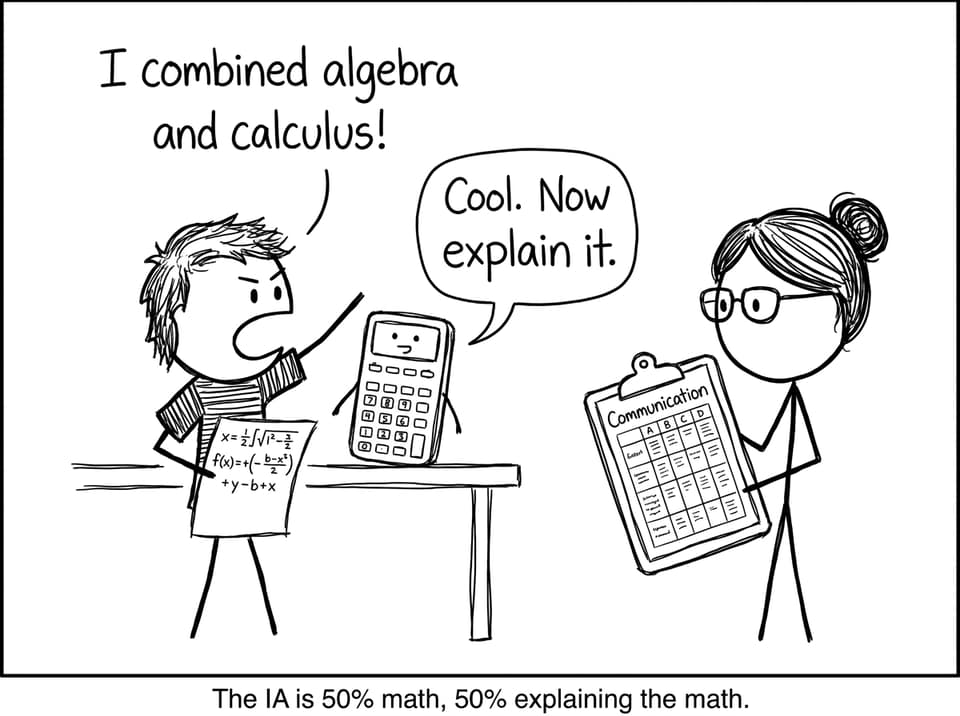
A fast checklist for combining algebra and calculus in an IB IA
Use this as a quick “sanity scan” before you commit to a draft.
-
Your research question requires both algebra and calculus to answer honestly (not just to look advanced for IB).
-
You define variables, parameters, domain restrictions, and units early.
-
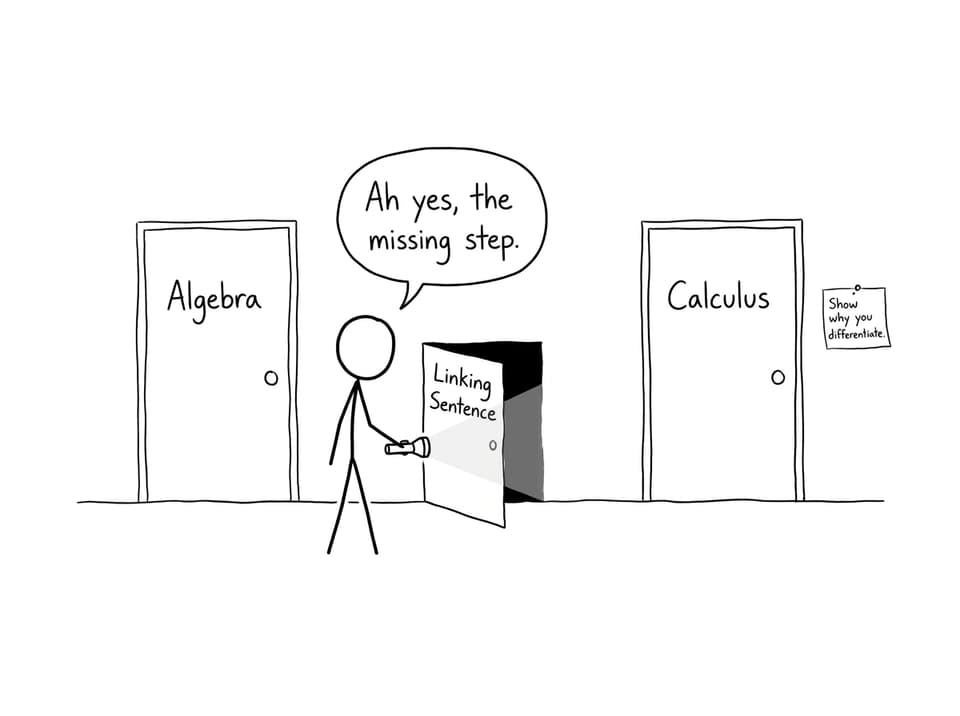
Every calculus move has a sentence that starts with “Therefore…” or “This allows me to…”
-
You return to algebra after calculus: substitute back, simplify, and interpret.
-
You check reasonableness: does the result make sense in context?
-
You plan transitions so the IA reads smoothly (not “Algebra Section” then “Calculus Section”).
If your IA structure is still fuzzy, borrow a proven layout from How to Structure Your IB Math IA Logically and refine it for your topic.
Why this combination scores well in IB Math IAs
Examiners reward coherence. In a strong IB IA, algebra and calculus are not two separate skills; they are two lenses looking at the same object.
-
Algebra gives precision: defining relationships, rearranging constraints, forming functions, and keeping notation disciplined.
-
Calculus gives insight: rates of change, maxima/minima, accumulation, and behavior over time.
-
Together they create a complete investigation: model (\rightarrow) analyze (\rightarrow) interpret (\rightarrow) evaluate.
This is exactly the kind of “connected mathematics” that elevates your writing from correct to compelling. If you want a rubric-aware feel for what examiners look for in the IA criteria, start with the official-style guidance in the IB Mathematics AA IA Guide.
Picking an IB Math IA question where algebra and calculus naturally meet
Not every topic deserves calculus. The easiest way to stay “examiner-safe” in an IB IA is to choose a context where change or optimization is genuinely meaningful.
Here are reliable directions:
Optimization with constraints
Algebra sets up the constraint (often by expressing one variable in terms of another). Calculus finds the optimum. Algebra then verifies and interprets.
Examples:
-
Packaging design: maximize volume with a fixed surface area.
-
Minimize cost with production constraints.
Growth and saturation models
Algebra defines the function (exponential, logistic, or a fitted regression). Calculus explains speed: when growth is fastest, when it slows, what the parameters mean.
Motion and curvature
Algebra models position (or a fitted trajectory). Calculus turns the model into velocity, acceleration, or curvature and interprets what that means.
Area/accumulation problems
Algebra defines bounds and expressions. Calculus (integration) captures total quantity, then algebra simplifies and helps compare scenarios.
If you are still choosing, pull ideas from IB Math IA Ideas (Analysis and Approaches & Applications & Interpretation) and sanity-check scope using The Best IB Math IA Topics for 2025.
A step-by-step method that actually integrates algebra and calculus
The mistake most IB students make is using calculus as a decoration. The fix is to treat your IA like a chain where each link justifies the next.
Start with an algebraic model that can carry the investigation
Write the relationship between variables clearly and with purpose.
Good algebraic setup includes:
-
A definition of variables and parameters
-
A constraint equation
-
A target function (what you will optimize or analyze)
-
Domain restrictions (what values are physically or contextually possible)
For example, if your aim is to maximize an area with a fixed perimeter, your algebra defines the function (A(x)) under the constraint. The key is that your reader should see why calculus is coming next.
RevisionDojo helps here in a practical way: you can use Study Notes for clean function/notation reminders, and AI Chat to check whether your variable definitions are internally consistent before you write pages of math.
Use calculus only when it answers the next natural question
Once the model exists, calculus should arrive as a response to curiosity:
-
“How does this quantity change as (x) changes?” (\rightarrow) differentiate
-
“Where is the best or worst case?” (\rightarrow) critical points and tests
-
“What total amount accumulates over an interval?” (\rightarrow) integrate
If you want a structured way to present differentiation and integration in an IB IA without skipping steps, follow the worked approach in How to Apply Calculus Effectively in the IB Math IA.
Translate calculus results back into algebraic meaning
This is where many IAs quietly lose marks: they get a derivative, solve it, and stop.
Instead, do the full loop:
-
Solve (f'(x)=0) (calculus)
-
Substitute the solution back into the original model (algebra)
-
Interpret: what does (x) represent, and why is this value meaningful?
-
Verify constraints and domain restrictions
A simple sentence template that works well in IB writing:
“Since (f'(x)) represents the rate of change of ___ with respect to ___, setting (f'(x)=0) identifies where the change switches sign, which corresponds to a maximum/minimum in this context.”
That sentence is not filler. It is Communication marks.
Add a second check (graphical, numerical, or alternative reasoning)
High-scoring IB IAs often include a quick “reality check”:
-
A graph that matches your calculus conclusion
-
A table of values around the optimum
-
A brief alternative method (completing the square, inequality reasoning, or a numerical approach)
This is also where RevisionDojo becomes a full workflow, not just content:
-
Use Flashcards to keep differentiation rules and interpretation phrases quick to recall.
-
Use the Questionbank to practice the exact optimization and interpretation patterns you are using in your IA.
-
Use Grading tools to stress-test whether your explanation matches what IB criteria reward.
If you want a stronger “commentary voice,” steal techniques from IB Math: 10 Tips for a Strong IA Commentary.
Common mistakes when combining algebra and calculus in an IB IA
Treating calculus like a separate chapter
If your IA reads like: setup, then random calculus, then conclusion, it will feel stitched.
Fix: add linking sentences that explain why you move methods. Your transitions should sound like cause and effect.
Ignoring domain restrictions and context limits
Algebra can produce solutions that calculus happily accepts, even when your scenario does not.
Fix: state constraints explicitly and eliminate impossible solutions with a short justification.
Overcomplicating for “depth”
Extra differentiation does not automatically equal a better IB IA.
Fix: use the simplest tool that answers the question, then deepen your Reflection by discussing limitations, assumptions, or sensitivity.
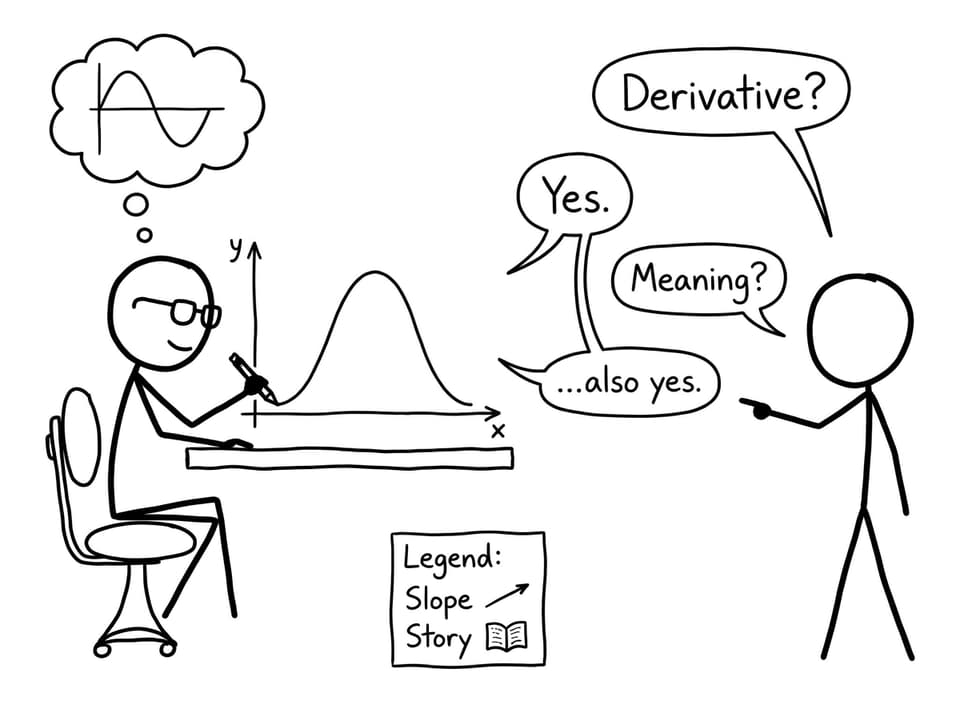
Forgetting to interpret derivatives and integrals in words
In an IB IA, math without meaning is like a map without a destination.
Fix: after every major equation, write 2-4 lines of interpretation.
Not checking the result
A maximum that is actually a minimum is a classic mark-loser.
Fix: use a second derivative test, sign chart, or a quick graph/table.
For a broader exam mindset (because most students write the IA while revising too), RevisionDojo’s ecosystem helps you keep both plates spinning: Mock Exams and Predicted Papers build exam readiness while your IA develops. If you are rebuilding confidence after a bad practice run, Failed Mock Exams? You Can Still Pass IB is a calm reset.
A simple mini-example blueprint you can adapt
You do not need to copy a specific topic to combine algebra and calculus well in an IB IA. You need a repeatable structure.
Blueprint: constrained maximum (the classic IA backbone)
-
Algebra: define variables and constraint; form target function (f(x))
-
Calculus: compute (f'(x)); solve (f'(x)=0); test for max/min
-
Algebra: substitute back; simplify; compute final value in context
-
Interpretation: explain what the optimum means and what assumptions created it
-
Reflection: discuss sensitivity (what happens if a parameter changes?)
If you need exemplar-style inspiration, explore the IA resources in Math AA Internal Assessment (IA) Videos or compare approaches using Math AI IA Examples.
Closing: Make your IB IA read like one story
The strongest IB Math IA is not the one with the most techniques. It is the one where every technique earns its place.
Let algebra build your model with clean assumptions and careful notation. Let calculus reveal the behavior your model hides. Then return to algebra for interpretation, checking, and meaning. That loop is what makes your IA feel mature.
If you want that process to be smoother, RevisionDojo is built for the full IB workflow: learn quickly with Study Notes, remember with Flashcards, practice with the Questionbank, get unstuck with AI Chat, refine with Grading tools, rehearse exam pressure with Mock Exams and Predicted Papers, and compare against strong standards through the Coursework Library and Tutors.
When you combine algebra and calculus like this, you are not just doing IB math. You are telling an argument the examiner can follow, trust, and reward.