
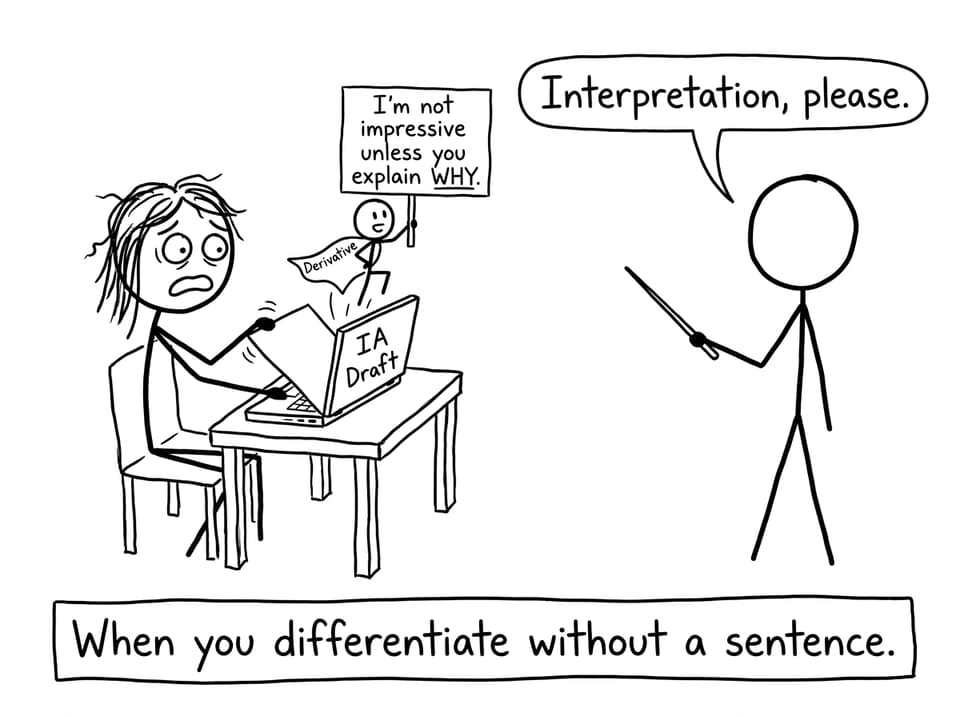
Calculus can make an IB Math IA feel like it has real weight. But it also has a way of exposing shortcuts. You know the moment: you differentiate, you get a neat expression, you circle an answer, and then you realize you cannot explain what it means without waving your hands.
That gap, between doing calculus and using calculus, is where IB marks are won or lost.
This guide shows how to apply calculus effectively in the IB Math IA: not as decoration, but as a tool that creates insight. Along the way, you’ll see how RevisionDojo helps you build the kind of IA examiners trust: clear variables, justified methods, tidy math communication, and reflection that sounds human.
A quick IB checklist for calculus that actually scores
Before you add calculus to your IB Math IA, sanity-check these points:
-
Your research question needs change, accumulation, or optimization.
-
Variables (with units) are defined before any differentiation or integration.
-
Every derivative/integral is followed by one sentence of interpretation.
-
You state assumptions and limits of the model (domains, rounding, technology use).
-
You connect results back to your real context or dataset.
If you want a structure that matches what examiners look for, start with How to Structure Your IB Math IA Logically and then pressure-test your topic using The Best IB Math IA Topics for 2025.
Why calculus raises the ceiling in an IB Math IA
In an IB Math IA, calculus is rarely impressive because it is “hard.” It’s impressive because it answers questions that simpler tools cannot.
-
Differentiation tells you instantaneous change: speed at a moment, marginal cost, steepness, sensitivity.
-
Integration tells you total change: accumulated distance, total profit, area under a curve, expected value-like quantities.
-
Optimization shows decision-making: the best dimensions, the maximum efficiency, the minimum error.
That directly supports the criterion often summarized as “Use of Mathematics,” because you’re showing purpose, process, and conclusions, not just computation.
If you need a clean refresher on the IB-calculus foundations, RevisionDojo’s IB Math AA Calculus and IB Math AA Calculus Notes are fast ways to close gaps before you write.
Choose a context where change is unavoidable (not optional)
The easiest way to make calculus feel forced is to start with a situation that doesn’t genuinely involve change.
Instead, pick contexts where your reader almost expects calculus:
-
Motion: projectile height, braking distance, reaction time models
-
Growth/decay: battery drain, cooling, population saturation
-
Optimization: packaging, cost vs revenue, design constraints
-
Shape modeling: maximizing volume, minimizing surface area, best fit curves
A good IB move is to phrase the aim as a decision or a turning point:
-
“When is the growth rate highest?”
-
“What dimensions minimize material?”
-
“How sensitive is the output to parameter changes?”
If you’re still choosing, scan IB Math IA Ideas (Analysis and Approaches & Applications ...) and keep a shortlist of topics where calculus is a natural next step.
Define variables like you’re writing for a tired examiner
In an IB Math IA, the examiner is not trying to be impressed by your symbol choices. They’re trying to follow your logic quickly.
Before calculus:
-
Define each variable in words
-
Include units
-
State domain restrictions (time ≥ 0, lengths within constraints)
-
Clarify what is measured vs modeled
Example phrasing that earns trust:
Let (h(t)) be height (m) at time (t) seconds after launch. Let (v(t)=h'(t)) represent vertical velocity (m/s). The model assumes constant acceleration and ignores air resistance.
That small setup makes your derivative interpretation almost automatic.
Use differentiation for insight, not just a slope
Differentiation becomes “effective” in an IB IA when you do three things in order:
Justify why the derivative answers your question
Write a purpose line before the math:
To find the time of maximum height, we need the instant when height stops increasing. This occurs when the rate of change of height is zero, so we solve (h'(t)=0).
Show clear steps (but don’t drown the page)
Include the meaningful stages: rule used, simplification, solve step, and final value with units. You can compress trivial algebra, but never skip reasoning.
Interpret immediately in context
One sentence is enough, but it must be specific:
At (t=1.22,s), the velocity becomes zero, so the object reaches its maximum height at that moment.
If you tend to get lost in multi-step calculus, revise method clarity with How to Review Complex Calculus Problems Systematically. Then drill similar question styles in RevisionDojo’s Questionbank and confirm understanding using AI Chat (ask it to check your interpretation sentence, not just your derivative).
Use integration to show accumulated meaning
Integration works best in an IB Math IA when your reader can say, “Yes, that’s what total should mean here.”
Common high-value uses:
-
Area under a curve as a real quantity (work done, total growth, total distance)
-
Displacement from velocity (with sign and direction explained)
-
Comparing two models by integrating absolute error over an interval
Be explicit about what the definite integral represents:
(\int_0^T v(t),dt) represents net displacement over (). If I want total distance traveled, I must consider where (v(t)) changes sign.
If you need the IB-standard notation patterns for integrals, use Notes for SL 5.5-Integration introduction, areas between ... and SL 5.10-Indefinite integration, reverse chain, by substitution.
Optimization: where most IB calculus IAs quietly lose marks
Optimization is a classic IB calculus move, but it is also where students accidentally stop thinking.
To make optimization convincing:
-
Define the objective function clearly (what you’re maximizing/minimizing)
-
State constraints (physical limits, domain restrictions)
-
Find critical points with derivatives
-
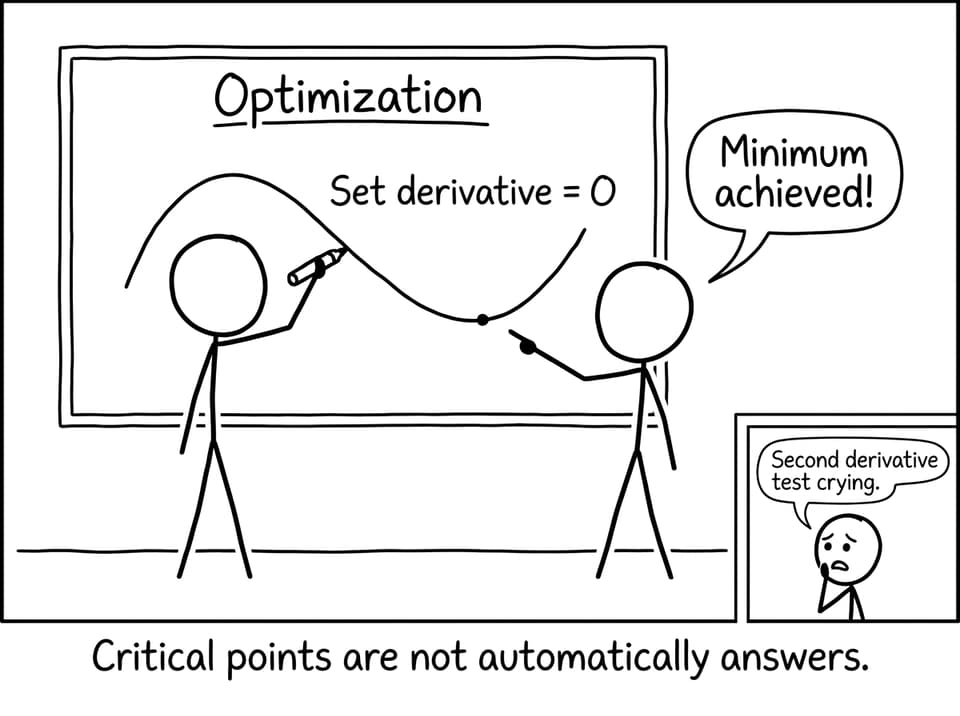
Check endpoints and use a test (second derivative or sign analysis)
-
Interpret the solution in words with units
Most importantly: critical points are candidates, not conclusions.
If you’re blending algebraic modeling with calculus (often the best path), use How to Combine Algebra and Calculus in the IB Math IA.
Connect calculus back to data, technology, and limitations
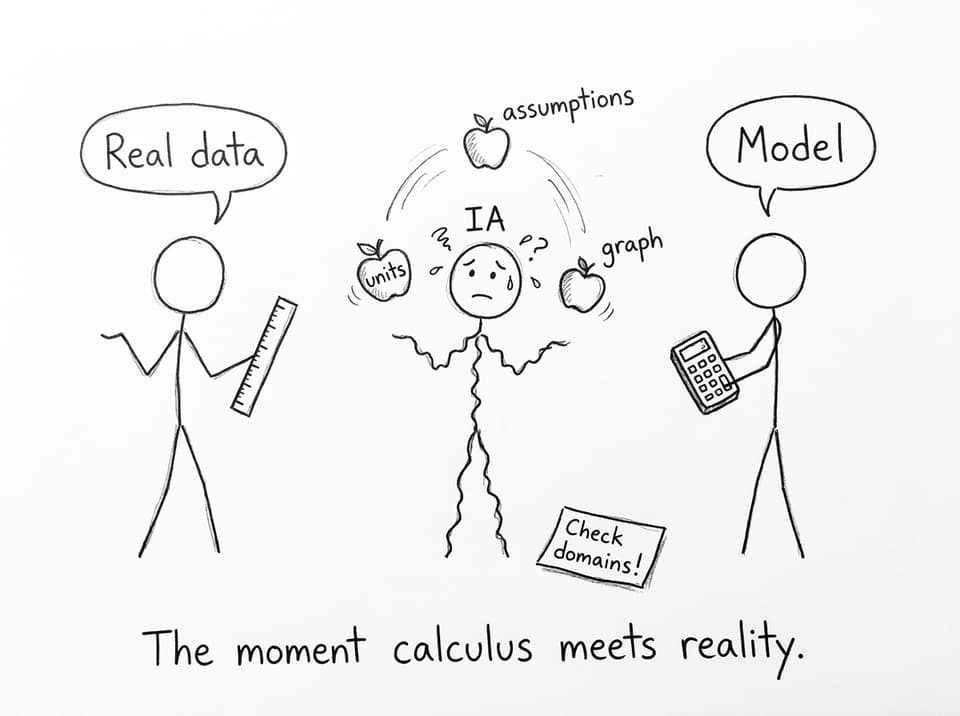
A strong IB Math IA doesn’t pretend the model is perfect. It explains what the model can and cannot claim.
Practical reflection prompts:
-
“How would measurement error affect (h'(t)) or the regression parameters?”
-
“What assumptions make the derivative meaningful in the real system?”
-
“Where does the model break down outside the domain?”
You can and should use technology for regression, numerical integrals, or graphing. But the IB expects you to explain what the tool did and why the output supports your conclusion.
For integrity and responsible tool use, read IB Math - Avoiding Common Integrity Pitfalls.
Closing: make calculus feel inevitable
The best IB Math IA calculus section reads like a story with no wasted scenes: the context creates a need, the derivative or integral answers it, and your interpretation shows you understand what you just found.
If you want that kind of control, build your process with RevisionDojo: start from the IA guides, borrow structure from exemplars, tighten techniques with Study Notes and Flashcards, and pressure-test your explanations using AI Chat and the Grading tools. Then reinforce the underlying skills in the Questionbank, and finish with Mock Exams and Predicted Papers to make sure your calculus fluency holds under exam conditions.
Calculus isn’t there to impress the IB examiner. It’s there to make your thinking precise. When you treat it that way, your IA becomes easier to write, and much harder to dismiss.

