


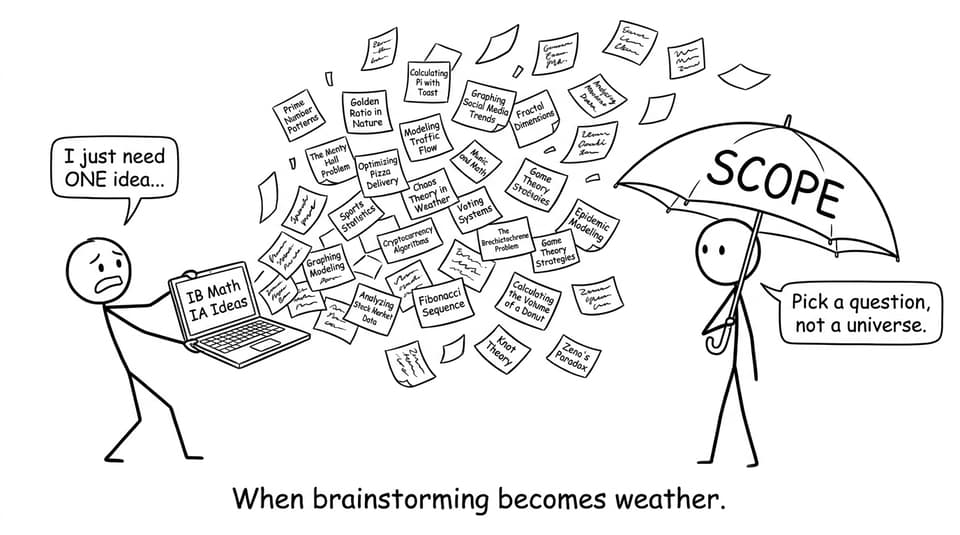
If you’ve ever Googled IB Math IA ideas at 1 a.m., you already know the feeling: everything sounds either too simple to score well, or so ambitious you can’t imagine finishing it in 12-20 pages.
Here’s the quiet truth: a strong IB Math IA is rarely the most impressive idea. It’s the idea with a clean question, a clear method, and honest reflection. In IB Math, examiners reward mathematical decisions you can explain, not topics you can name-drop.
A quick IB Math IA idea checklist (steal this)
Use this 3-minute filter before you commit to any IB Math exploration:
-
Can you state your aim in one sentence?
-
Do you know whether it’s mainly data (AI-style) or theory (AA-style), or a deliberate mix?
-
Can you name two techniques you’ll actually use (regression, calculus, probability, proof, sequences)?
-
Can you collect/find data quickly, or generate it reliably?
-
Is there room to evaluate assumptions, limitations, and improvements?
For a rubric-aligned roadmap, keep these open while planning: IB IA Guides and IB Math IA 2025 Guide: Write a Top-Scoring Exploration.
IB Math IA ideas for Analysis and Approaches (AA)
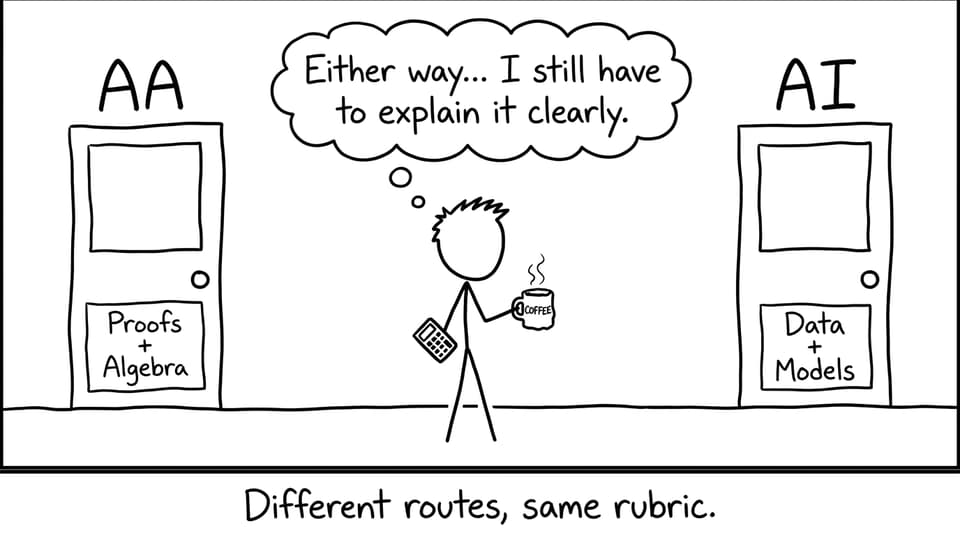
IB Math AA topics tend to shine when your math does the talking: algebraic reasoning, calculus depth, and proof-like structure.
Crisp AA-style topic angles
-
Cryptography and modular arithmetic: test how key length affects security assumptions, then justify the underlying number theory.
-
Differential equations for growth/decay: compare models (logistic vs exponential) and analyze parameter meaning.
-
Infinite series and approximation: explore convergence and error bounds in real approximations.
-
Game probability with combinatorics: model a card/board game, then optimize strategy with expected value.
If you want your structure to feel inevitable (instead of chaotic), follow: IB Math IA Structure: A Logical, High-Scoring Flow.
IB Math IA ideas for Applications and Interpretation (AI)
IB Math AI is where real-world context becomes fuel: statistics, modeling, technology, and interpretation. The trap is describing the context too much and doing too little math.
Practical AI-style topic angles
-
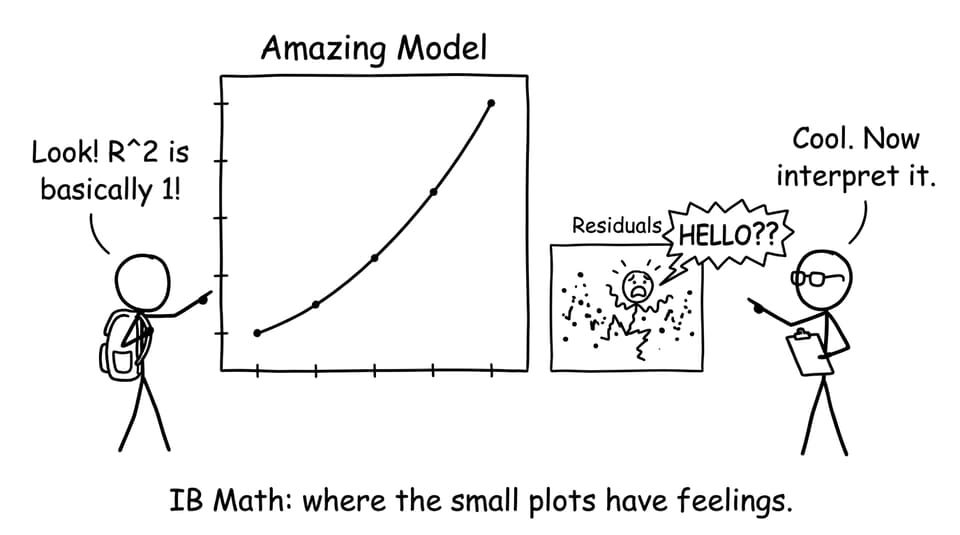
Regression with meaning: predict a measurable outcome (sports performance, revision time vs scores, sleep vs reaction time) and interpret coefficients and residuals.
-
Music or social media pattern analysis: quantify a pattern (tempo changes, engagement rates) and test model fit.
-
Climate or population data modeling: compare two models and defend which is more appropriate.
-
Business growth forecasting: use exponential/logistic models, then evaluate where the model fails.
To strengthen your math communication and reflection, use RevisionDojo’s IB Maths AI IA Grader and compare against strong samples like IB Maths AI IA Examples.
How to turn an IB Math IA idea into exam-ready confidence
Most students treat the IA as separate from exams. In IB Math, they feed each other.
Here’s a practical loop:
-
Use Study Notes to learn the exact methods you’ll need to explain.
-
Drill technique with the Questionbank mindset (targeted, not random): IB Math: Targeted Revision Using the Questionbank.
-
Build daily recall with Flashcards.
-
When you get stuck mid-exploration, use RevisionDojo’s AI Chat to diagnose the next step and check your explanation clarity.
-
Rehearse exam stamina with Mock Exams and IB Predicted Papers (timed practice, feedback, then fix your errors).
If you’re choosing your pathway or trying to align IA style with your course, start here: IB Math AA vs AI: Choose the Right Course for Uni.
FAQ
What makes a good IB Math IA idea (especially for a level 7)?
A good IB Math IA idea is narrow enough to finish and deep enough to justify. That means you can explain the aim in one sentence, define variables clearly, and show why your chosen technique fits the question. Examiners reward mathematical purpose: why you used regression instead of a different model, why you assumed linearity, why you restricted a domain. A level 7 IA also has visible reflection throughout, not just at the end. You point out limitations honestly, then suggest realistic improvements or extensions. Most importantly, your IB Math communication stays calm and precise: the reader should never guess what a symbol means or why a step happened.
Can I use an IB Math IA idea I found online?
Yes, but you must add genuine originality, and in IB Math that usually comes from your question angle and analysis choices. If you copy a theme (like “modeling population growth”), make your investigation specific: a particular dataset, a comparison of two models, a parameter-sensitivity test, or a clear evaluation method like residual analysis. Your writing should reflect your decisions, not someone else’s template. You also need to show you understand the math, not just that you can type it into technology. That’s why it helps to study rubric-aligned examples and then design your own structure from scratch. RevisionDojo’s Using IA/EE Exemplars to Improve Your IB Math IA is a good guide for doing this safely.
Which IA is easier: Math AA or Math AI?
Neither is “easier,” but they feel difficult in different ways inside IB Math. AA can be challenging because it often demands more algebraic control and proof-style justification, especially if you pick a theoretical topic. AI can feel more accessible because data gives you something concrete to work with, but AI students lose marks when they describe context without interpreting mathematics. In both, the biggest mark gains come from clarity: defining variables, explaining methods, and reflecting on limitations. The rubric doesn’t reward drama or complexity; it rewards correct, appropriate math and communication. If you want a simple way to decide, compare the course expectations using IB Mathematics Analysis and Approaches Resources and then plan your IA around the tools you can defend.
Closing: choose an IB Math IA idea you can finish well
The best IB Math IA idea is the one you can explain clearly, test honestly, and refine under real constraints. Pick a question, keep the scope tight, and make every method a deliberate choice.
When you’re ready to turn a topic into a high-scoring exploration (and stronger exam performance), use RevisionDojo as your home base: Questionbank for targeted practice, Study Notes and Flashcards for recall, AI Chat for stuck moments, Grading tools for feedback, Predicted Papers and Mock Exams for rehearsal, a Coursework Library for examples, and Tutors when you want a human plan.