


In the last week before an IB exam, most students don’t panic because they can’t do math.
They panic because they can’t explain it.
A regression line appears on the calculator screen. The value of r looks impressive. The numbers feel finished. Then the question asks for meaning, and suddenly it’s like being asked to translate a foreign language you thought you already spoke.
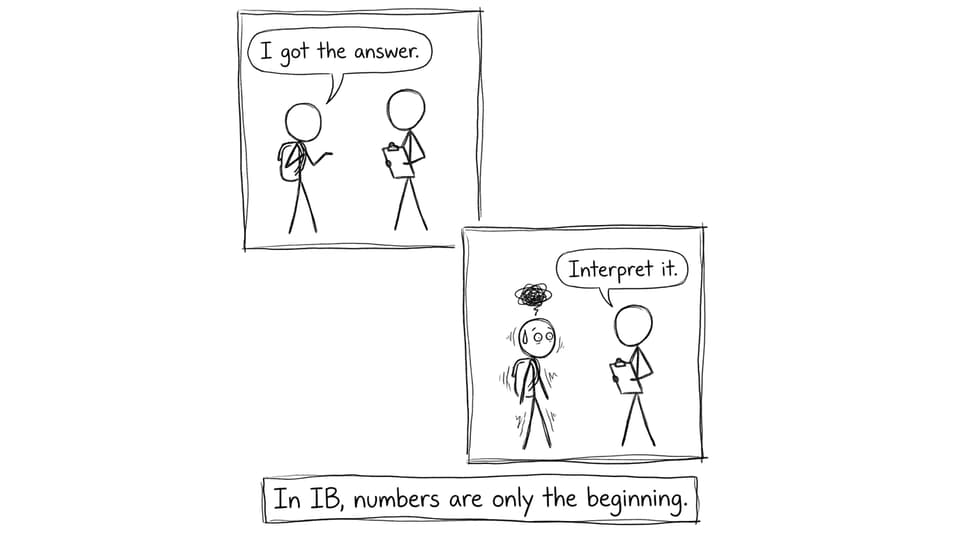
That gap between calculation and meaning is exactly where IB Math Applications and Interpretation (AI) lives. And it’s why building real-world connections isn’t an extra flourish. It’s the core skill that separates “I got an answer” from “I earned the marks.”
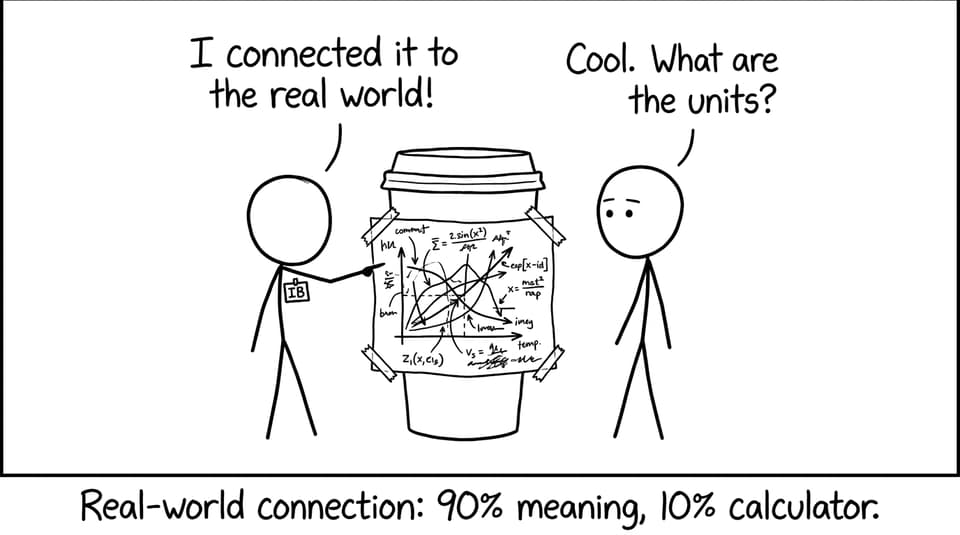
The IB real-world connection checklist (use this every time)
When you practice IB Math AI, run this short loop. It keeps you aligned with what examiners reward in application, interpretation, and communication.
-
Start with a real situation (finance, health, environment, sport, school data).
-
Name the variables with units and constraints.
-
Choose a model and justify why it fits the context.
-
Calculate using technology, but sanity-check the output.
-
Interpret parameters in plain language.
-
Evaluate limitations and assumptions.
-
Conclude with what your result means for the real situation.
A great place to anchor your revision is the Math AI hub on RevisionDojo: IB Mathematics Applications & Interpretation Resources. It’s built around the same “context first, math second” rhythm that the IB expects.
Start with the situation, not the technique
Here’s a quiet truth about the IB: the exam rarely asks, “Can you do this method?” It more often asks, “Can you decide what method makes sense here?”
So train the decision.
Before you touch an equation, write two sentences:
-
What is happening in the real world?
-
What would a useful answer help someone decide?
That tiny habit changes everything. It stops you from throwing random tools at a problem. And it makes your final interpretation feel inevitable rather than bolted-on.
When you need structured guidance to build that habit, pair your practice with How to Use RevisionDojo Notes to Simplify IB Math AI Concepts. It’s one of the fastest ways to turn messy topics into a clean workflow.
Translate context into variables (and don’t skip units)
Real-world connection in IB Math AI is basically translation.
A problem about fuel use becomes variables like distance (km) and fuel (L). A problem about screen time becomes minutes per day and reported sleep quality. A population scenario becomes time and number of organisms.
What examiners love is when you define these cleanly:
-
Let x be time in days (0 ≤ x ≤ 30).
-
Let y be the number of sign-ups per day.
Those constraints show you understand the real world is not infinite. It has boundaries.
Then you can practice these translations at scale with targeted topic drills, like Functions - IB Questionbank or Number and Algebra - IB Questionbank. The point isn’t just volume; it’s repetition of the translation step until it becomes automatic.
Use technology like a partner, not a vending machine
IB Math AI rewards technology use, but only when you remain intellectually in charge.
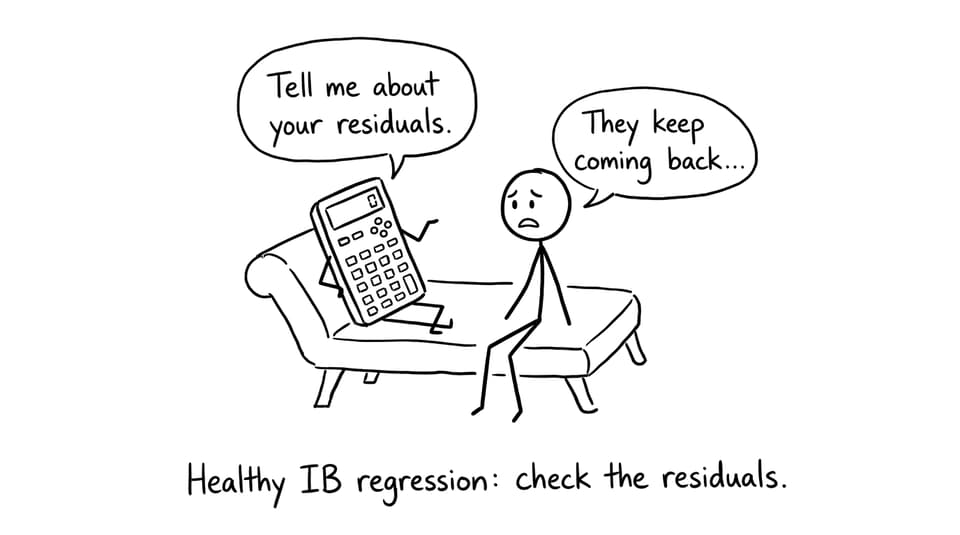
That means when your calculator gives a regression model, you don’t treat it like a final answer. You treat it like a draft.
Ask:
-
Does the shape match the story (linear vs exponential vs logistic)?
-
Are the parameter values reasonable in context?
-
Are there obvious outliers pulling the model?
That last question is where many students lose easy marks.
To build this skill under exam conditions, practice with timed sets and feedback loops. RevisionDojo’s Questionbank plus AI Chat is ideal here: you attempt, you submit, and you immediately learn what your interpretation missed.
If you want the system behind it, use How to Use the Questionbank for Targeted Math Revision as your training plan.
Interpret like a storyteller (numbers are characters)
In IB Math AI, your interpretation should sound like you’re explaining results to a smart friend who wasn’t in your class.
Instead of:
- “The gradient is 2.3.”
Try:
- “For each additional hour of study, the model predicts an average increase of 2.3 points, within the range of the dataset.”
The second version earns more marks because it includes:
-
parameter meaning
-
units or context
-
boundaries (what range makes sense)
If you struggle to write this way, build “interpretation sentences” as flashcards. That’s where RevisionDojo’s IB Flashcards with Spaced Repetition (SRS) and the Flashcards feature quietly become a secret weapon: you can train communication the same way you train formulas.
Connect topics the way real problems do
Real situations don’t respect chapter boundaries. The IB knows that.
A single scenario can involve:
-
a function model (to describe the relationship)
-
statistics (to fit and test)
-
finance math (to interpret costs)
So your revision should occasionally be mixed, not always topic-isolated. One clean way is:
-
2 focused sessions per week (single topic)
-
1 mixed session per week (cross-topic set)
RevisionDojo supports this naturally because you can move from Study Notes to Questionbank to Mock Exams without changing platforms, and you can use Grading tools to diagnose what type of mark you’re losing (setup vs method vs interpretation).
Evaluate assumptions and limitations (this is where top marks hide)
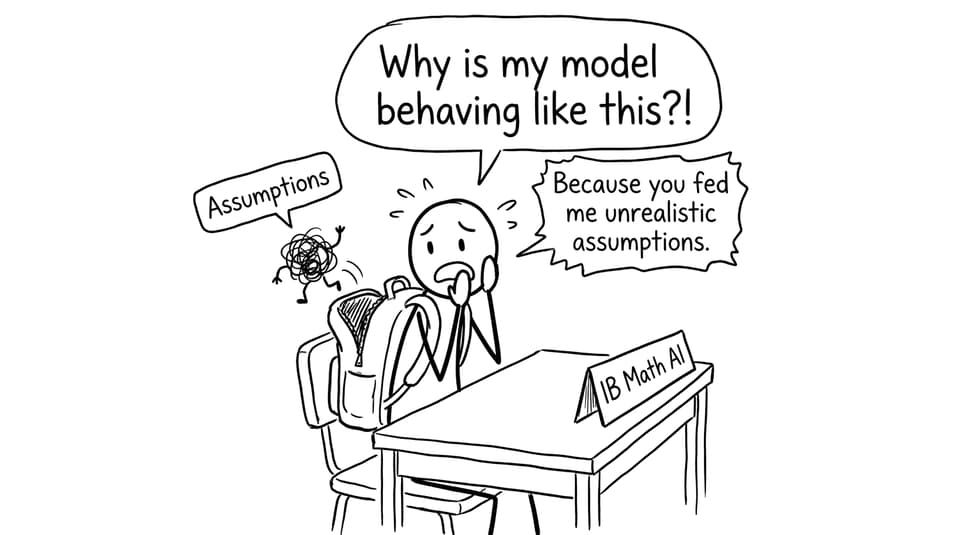
Every model is a simplification. Examiners don’t punish you for simplifying; they reward you for noticing what you simplified.
A strong IB limitation section usually includes:
-
an assumption you made
-
how it could be false
-
what that would do to your conclusion
Example:
- “The model assumes a constant growth rate. If the growth rate changes seasonally, the exponential model will overestimate long-term values.”
That’s not extra writing. That’s evidence of understanding.
For longer-form work like your IA, this skill becomes even more valuable. Use A Step-by-Step Guide to IB Math AI Internal Assessment and Using IA/EE Exemplars to Improve Your IB Math IA to see what examiner-level reflection actually looks like.
Train exam performance: practice applied questions under time
Real-world connections are easiest when you’re calm. Under time pressure, students revert to “do math fast” and forget “explain math well.”
So simulate pressure on purpose.
-
Do short timed blocks.
-
Review errors for patterns.
-
Retest the same skill 48 hours later.
If Paper 2 is your stress point (it is for many IB students), use Ace IB Math Applications and Interpretation Paper 2 to focus on the most common applied question types and technology-driven marks.
Then, in the final stretch, build stamina with: Mathematics Applications & Interpretation Predicted Papers (Free) and the broader hub IB Predicted Papers by IB Examiners (Free). If you study with friends, Collaborative IB Mock Exams: Study with Friends Online shows how to do it without turning into chaos.
Closing: make IB Math AI feel real, and marks follow
The best way to think about IB Math AI is simple: you’re not studying math as a museum piece. You’re learning math as a tool you can actually hold.
So each time you practice, don’t stop at the answer. Ask what it means, what it assumes, and what it would change in the real world.
If you want a single place to build that habit daily, use RevisionDojo as your loop: learn with Study Notes, drill with the Questionbank, retain with Flashcards, clarify with AI Chat, then pressure-test your progress with Predicted Papers, Mock Exams, and the Coursework Library when IA season arrives. That’s how IB math becomes less about stress and more about proof.