



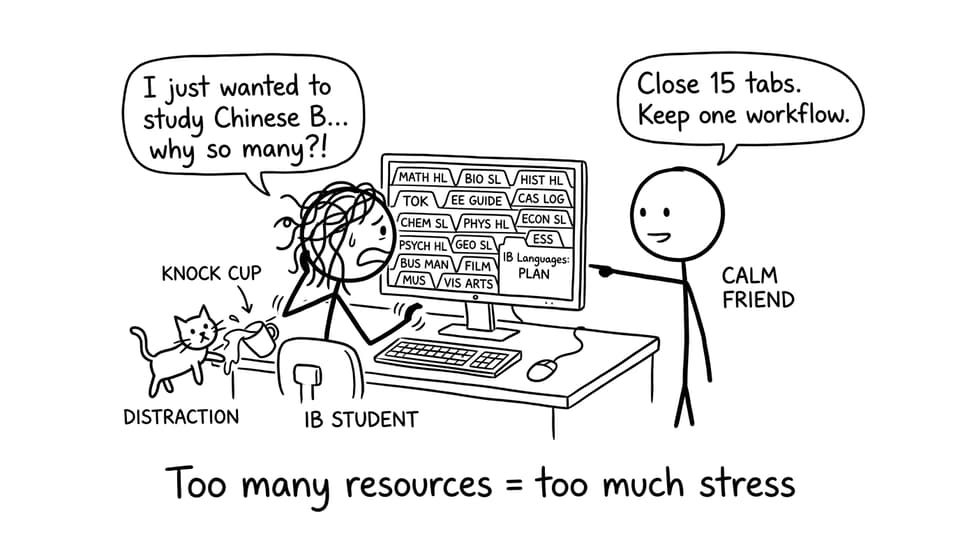
If you’ve ever opened your laptop to study IB Chinese B and somehow ended up reorganizing your pen case, watching one “quick” video, and rewriting your to-do list three times, you’re not lazy. You’re overloaded.
IB Chinese B has a special talent for making stress feel logical. There’s always more vocabulary, one more text type to master, one more listening you should do, one more oral practice you’re not “ready” for yet. For many IB Languages students, the stress isn’t fear of the language; it’s fear of never catching up.
This article is a calm reset: a practical way to avoid stress when studying IB Chinese B, while still improving fast (and feeling that improvement).
A quick stress-proof checklist for IB Chinese B
Use this as your default plan when your brain starts spiraling:
-
Choose one weekly routine you can repeat for 4 weeks.
-
Study in short blocks (25-50 minutes) with real breaks.
-
Keep vocabulary small and useful: 10-20 words, then use them.
-
Do active recall daily: Flashcards + mini questions.
-
Practice each skill weekly: writing, reading, listening, speaking.
-
Simulate exam pressure early, but gently: short timed sets first.
-
Get feedback fast (so you stop guessing).
If you want one hub for all of this, start with IB Chinese B Resources and build your routine from there.
Why IB Chinese B stress happens (and why it’s not your fault)
Stress usually isn’t caused by “too much work.” It’s caused by unclear work.
In IB Chinese B, uncertainty hides everywhere: What vocabulary matters most? What counts as a good Paper 1 response? How fluent do you need to be for the oral? When students don’t have a clear answer, the brain does something predictable: it tries to prepare for everything. That’s when revision becomes endless, and stress becomes the background music.
For IB Languages students, the fix is not more hustle. It’s a narrower target.
A helpful starting point is to understand how marks are actually awarded. Read IB Chinese B Grading Explained: What Students Need to Know and you’ll feel the pressure drop a notch because the game becomes readable.
Build a simple study loop (so your brain can relax)
Here’s a loop that keeps stress low because every session ends with proof you improved.
Learn (short)
Use a tight set of notes, not an internet scavenger hunt. If you need an exam-focused structure, How to Revise Effectively for IB Chinese B Exams lays out exactly what to practice for Paper 1, Paper 2, and the Individual Oral.
Test (short)
Testing is calming because it replaces vague worry with data. On RevisionDojo, the Questionbank lets you practice in small sets, then fix mistakes immediately: Questionbank.
Fix (short)
After each set, write 2-3 “error rules.” Example: “If the prompt asks for a blog, I must include a title and direct audience tone.” These tiny rules reduce repeated mistakes, which reduces stress.
This loop is the heart of high-scoring IB Languages revision: learn a little, test quickly, fix specifically.
Vocabulary without the panic: fewer words, more usage
Vocabulary overload is one of the biggest stress triggers in IB Chinese B because it feels infinite. The trick is to make vocabulary finite.
Try this approach:
-
Pick one theme per week (identities, experiences, etc.). If you need a clean map, use The Five Core Themes of IB Chinese B Explained.
-
Learn 10-15 words for that theme.
-
Use them the same day in:
-
3 sentences spoken aloud
-
a 120-150 character mini paragraph
-
one short listening where you try to “catch” your new words
-
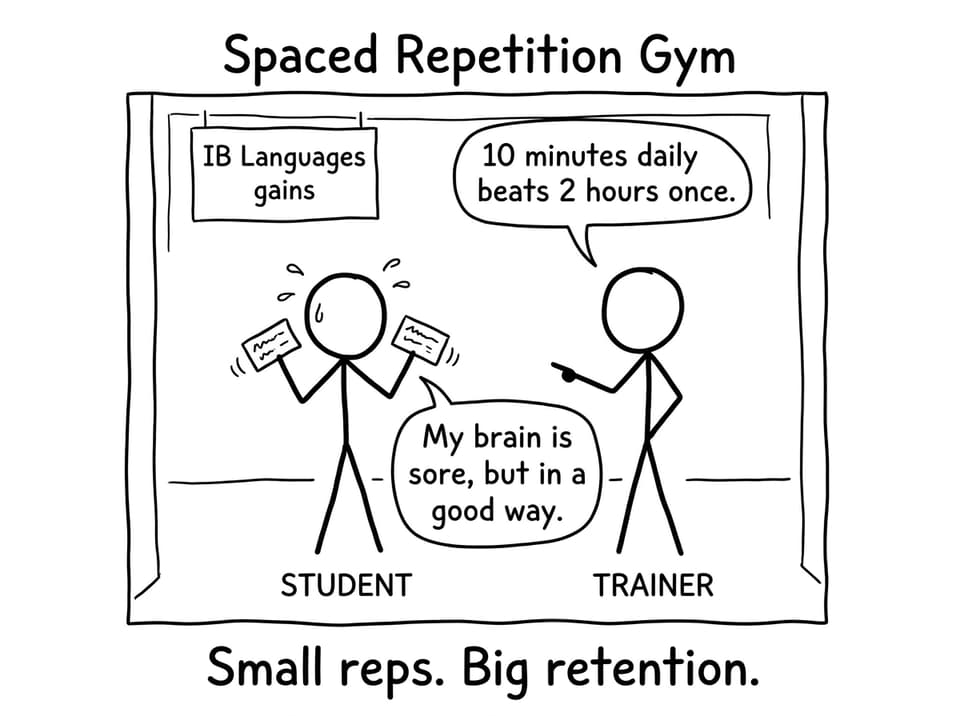
Then lock it in with spaced repetition. RevisionDojo’s IB Flashcards with Spaced Repetition (SRS) are built for daily recall that doesn’t eat your life.
Paper 1 stress: stop trying to write “perfect Chinese”
Paper 1 pressure often comes from a hidden belief: “If my Chinese isn’t perfect, I’ll fail.” But IB marking rewards communication and control, not native-level perfection.
A lower-stress Paper 1 method:
-
Collect 3-4 reliable structures per text type (email, speech, blog, diary).
-
Practice planning in 5 minutes: audience, purpose, 3 points, one cultural reference.
-
Write under gentle time limits at first (half time), then build up.
When you want feedback without waiting a week, RevisionDojo’s AI Chat can help you understand grammar choices and phrasing, and Grading tools can help you tighten responses toward the criteria. That “tight feedback loop” is how stress turns into momentum.
Paper 2 stress: train your attention, not your bravery
Listening and reading stress usually isn’t about difficulty. It’s about time pressure.
So train the skill that time pressure attacks: attention.
Try this once a week:
-
Do one short timed reading set.
-
Mark what went wrong in categories:
-
Misread question
-
Didn’t locate evidence
-
Ran out of time
-
Vocabulary gap
-
-
Drill that category next.
If you want to anchor your Paper 2 practice in a dedicated area, use RevisionDojo’s IB Chinese B reading practice page: Paper 2 - IB Chinese B Reading.
Oral exam stress: make speaking feel boring (in the best way)
The oral becomes stressful when it feels like a performance. The goal is to make it feel like a routine.
A calm oral routine for IB Languages students:
-
3 times a week, record 90 seconds on one theme.
-
Use a simple structure: point, example, opinion, link to culture.
-
Re-record once, but only to fix one thing (pronunciation, connectors, or tense control).
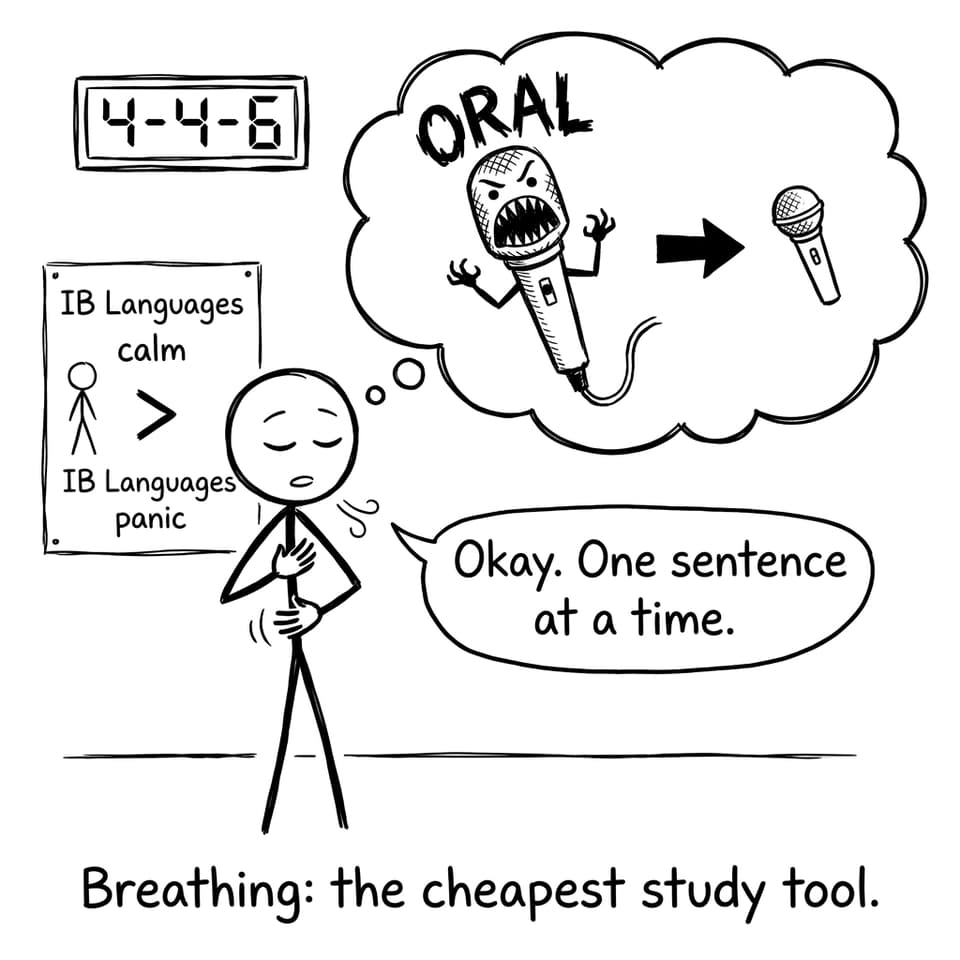
Before you start, do a 20-second breathing reset: inhale 4, hold 4, exhale 6. It sounds small, but it signals to your nervous system that you’re safe.
If exam anxiety is a constant companion, you’ll also benefit from these broader strategies: Tips for Managing Exam Stress and Health and IB Stress: How to Stay Motivated Without Burning Out.
A sample low-stress week for IB Chinese B
Keep it realistic. The best plan is the one you can repeat.
-
Mon (25-35 min): Flashcards + 5 Questionbank items
-
Tue (45 min): Paper 1 plan + short write
-
Wed (25 min): Listening set + error rules
-
Thu (30 min): Oral recording (90 sec) + one re-record
-
Fri (45 min): Reading practice + review mistakes
-
Weekend (60-90 min): Mixed skill session + light review
The hidden benefit: this schedule spreads cognitive load. Your brain stops associating Chinese with exhaustion.
A calmer finish line (and a smarter way to get there)
IB Chinese B will never be “easy,” but it can be steady. And steady is what lowers stress.
Build one repeatable loop. Keep vocabulary small and used. Practice each skill weekly. Get feedback quickly. Then let time do what it always does: turn unfamiliar things into familiar ones.
If you want an all-in-one system built for IB Languages students, RevisionDojo brings the full workflow together: Study Notes, Flashcards, Questionbank, AI Chat, Grading tools, Predicted Papers, Mock Exams, a Coursework Library, and Tutors. Start with IB Chinese B Resources, and make your next study session small enough to feel calm, and clear enough to feel like progress.