



A week before mocks, one student told me they were “waiting to feel motivated” to start IB Math.
They weren’t lazy. They were overloaded. And motivation is a terrible employee: it shows up late, takes long breaks, and disappears the moment you open a hard question.
A daily IB math study routine solves a quieter problem: it removes negotiation. You sit down, you run the same small loop, you leave with proof you did the work. Over time, that proof turns into confidence.
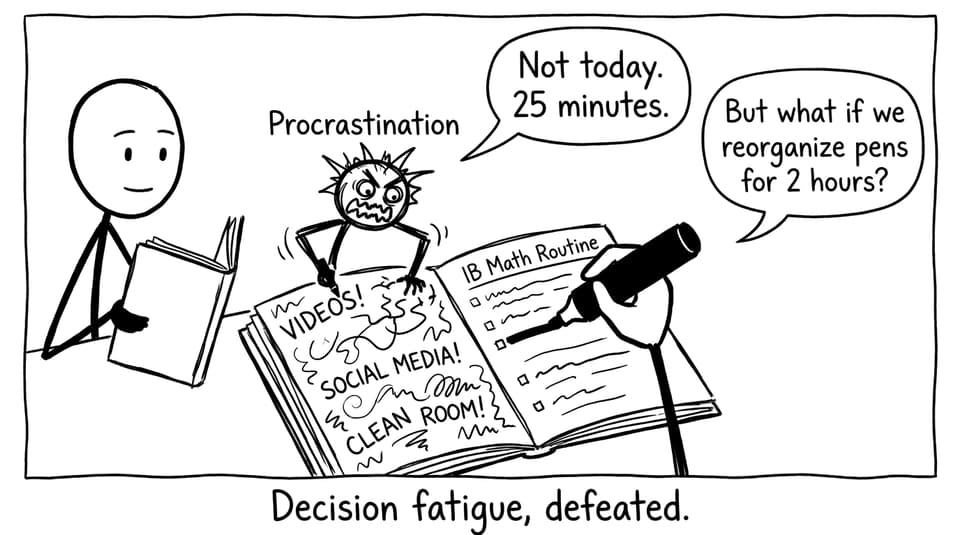
The IB daily routine checklist (keep it boring)
If you want a daily IB routine that lasts, keep the setup simple enough for tired days.
-
Pick a fixed time window (30-60 minutes)
-
Choose 2-3 math focus areas for the week (not 12)
-
Use one “core loop” every session: Notes -> Questions -> Recall
-
Track one metric: accuracy, streak, or weak-topic list
-
Add one weekly pressure session (timed)
RevisionDojo is built to make that loop frictionless: Study Notes when you’re unclear, Questionbank when you need reps, Flashcards when you need memory, plus AI Chat and Grading tools to explain where marks leak.
Why daily routine beats occasional motivation (especially in IB)
IB Math doesn’t punish you for being unintelligent. It punishes you for being inconsistent.
If you study only when you feel ready, you practice the easy topics and avoid the ones that cost marks. A routine forces contact with discomfort in small doses. That’s the real secret: five manageable sessions beat one heroic session that you never repeat.
When you want a wider view of how high performers structure exam prep, borrow ideas from How 45-Point IB Students Prepare for Exams.
Choose the right daily time slot (protect it like a class)
A sustainable IB routine starts with honesty about your energy.
-
Morning (20-30 min): best for flashcards, formula recall, one warm-up set
-
After school (40-60 min): best for focused Questionbank practice
-
Evening (25-40 min): best for review, error logs, and calm consolidation
Pick one slot you can repeat. The goal is not perfect timing; it’s fewer decisions. If you’re balancing multiple subjects, this “less thinking” matters more than you expect.
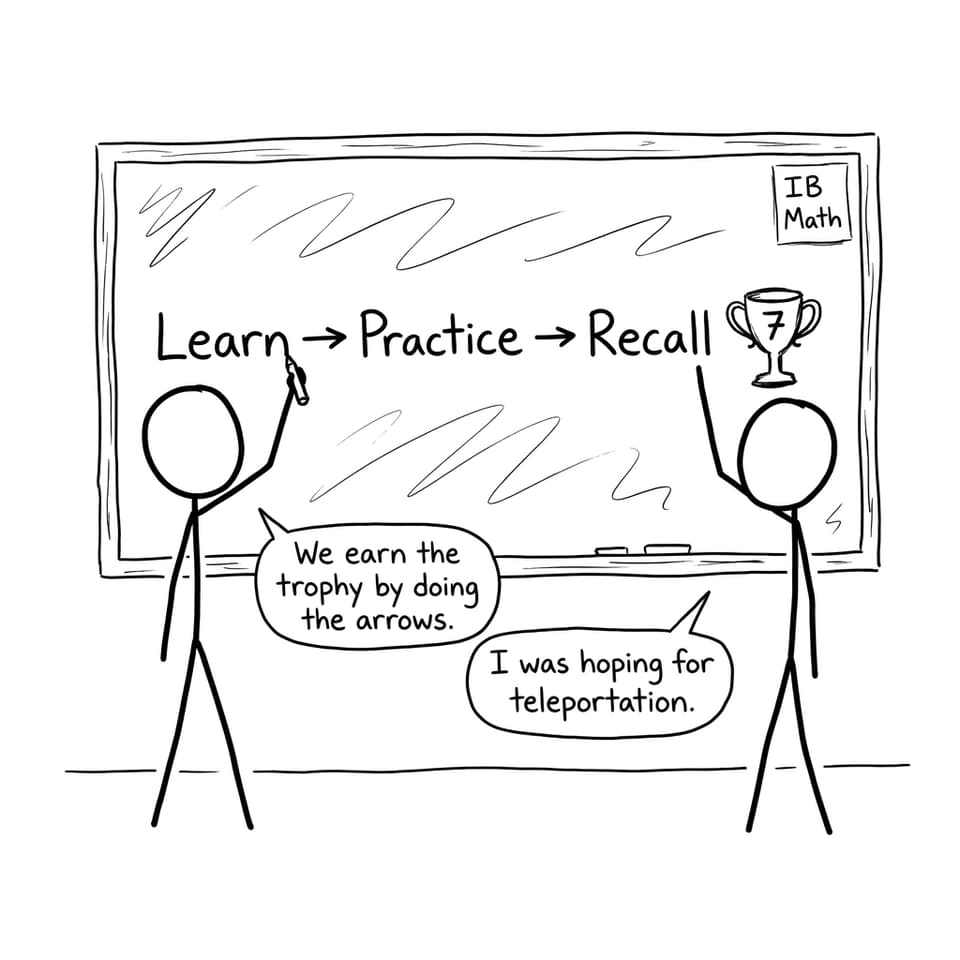
Structure each session with the Learn, Practice, Recall loop
Most IB students waste time by doing the steps in the wrong order: reread notes for 45 minutes, then do two questions, then feel disappointed.
Flip it into a repeatable loop:
Learn (10-15 minutes)
Use notes to clarify one specific micro-topic. Not “calculus,” something like chain rule with trig, or interpreting residual plots.
Start with your syllabus-aligned hub (AA or AI) and stay narrow:
Practice (20-35 minutes)
Do exam-style questions immediately while the idea is fresh. This is where the grade changes.
If you need a bigger system for mixing targeted practice with timed work, adapt the workflow from How to Study for IB Mocks (Without Burning Out).
Recall (5-10 minutes)
End with flashcards: formulas, definitions, command-term phrasing, and the exact mistakes you keep repeating. That last category is gold.
For note organization that supports recall, steal a format from Effective Note-Taking Strategies for IB Math Students.
Use the 25/5 focus cycle to stay consistent
Burnout usually looks like this: you plan a two-hour session, delay starting, panic, then quit early.
Instead, run 25 minutes focused + 5 minutes break. Repeat once or twice. On busy days, one cycle is still a win.
Your break is part of the routine: stand up, water, short walk. No “quick scroll” that turns into a new life.

Rotate topics strategically (so IB doesn’t surprise you)
A daily IB routine fails when it becomes repetitive. You get good at one area and rusty everywhere else.
Try a simple weekly rotation:
-
Day 1: Algebra and functions
-
Day 2: Calculus
-
Day 3: Statistics and probability
-
Day 4: Geometry and trigonometry
-
Day 5: Mixed set + error review
If you’re AI, lean harder into modeling and data interpretation. If you’re AA, protect algebra fluency like it’s your phone battery.
To improve memory of formulas without endless rereading, build a tight sheet and review it with recall methods from How to Create a Formula Sheet You Actually Remember.
Track progress with one simple signal
You don’t need a complicated dashboard. You need something your brain can’t argue with.
Pick one:
-
Accuracy by topic (best)
-
A “weak list” of recurring errors (fastest)
-
A study streak (most motivating)
RevisionDojo’s ecosystem helps here because your Questionbank practice, Flashcards, and Mock Exams can feed the same improvement loop, with AI Chat for instant clarification and Tutors when you want a human to pressure-test your method.
Add a weekly timed session (pressure is a skill)
Routine builds knowledge. Timed work builds execution.
Once a week, sit a timed section that feels like IB conditions, then review the same day. If you want a realistic exam-week structure, borrow the pacing rules from How to Revise Effectively During IB Math Exam Week.
When you need more full-paper realism, RevisionDojo’s Mock Exams and Predicted Papers are designed for rehearsal, not hype. Pair them with Grading tools so you understand how marks are awarded, not just whether you were “right.”
Conclusion: make IB math automatic
A daily IB math study routine works when it feels almost boring: same time, same loop, small proof of progress.
If you want that routine to run smoothly, RevisionDojo gives you the whole system in one place: Study Notes for clarity, Flashcards for recall, Questionbank for daily practice, AI Chat for fast explanations, Mock Exams and Predicted Papers for timed realism, plus Grading tools, a Coursework Library, and Tutors when you need deeper feedback.
Set your next seven days now: pick a time slot, choose two topics, and run one 25/5 cycle today. That’s how IB confidence is built quietly, daily, and on purpose.