
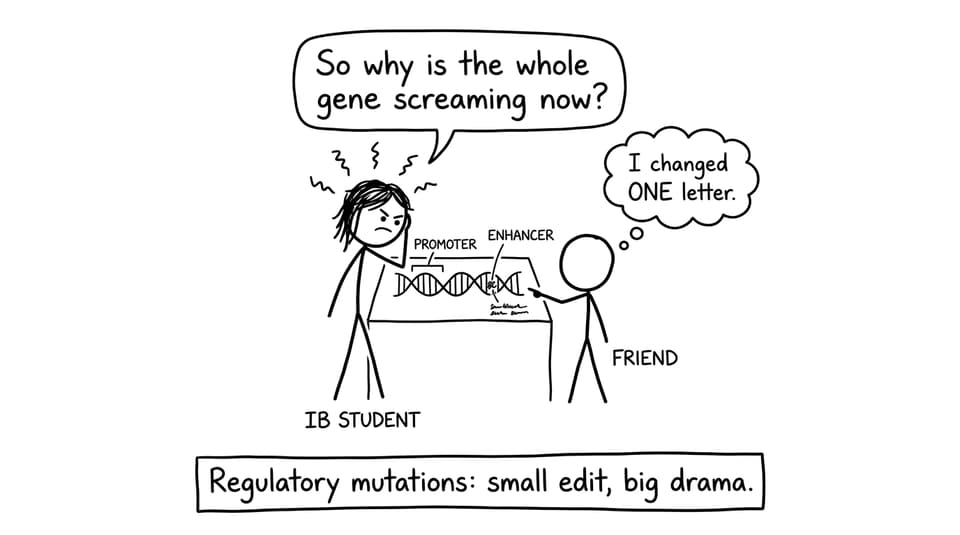
In IB Biology, it’s tempting to imagine mutations like typos that only matter when they change an amino acid. But some of the biggest biological plot twists happen before a protein is even written. They happen in the “directors’ notes” of the genome: regulatory DNA. One tiny base change in a promoter or enhancer can turn a quiet gene into a loud one, or mute it at the exact moment a cell needed it most.
For exam prep, this topic is gold because it connects molecular biology to development, disease, and evolution. If you can explain why regulatory DNA mutations affect expression, you can handle a surprising number of data-based questions in IB Biology.
Quick checklist: what to say in IB Biology answers
Use this as a fast, reliable structure when a question mentions “regulation” or “expression level”:
-
Name the regulatory element (promoter/enhancer/silencer/operator)
-
State what normally binds there (RNA polymerase, activator, repressor)
-
Explain how the mutation changes binding affinity
-
Link to transcription rate (increases/decreases)
-
Link to phenotype (too much/too little protein, wrong tissue, wrong time)
If you want the syllabus-aligned base content first, start with IB Biology Topic D2.2: Gene Expression.
Promoter mutations: changing the “start line” for transcription
A promoter is the region where RNA polymerase (and transcription factors in eukaryotes) assembles to start transcription. In IB Biology terms, promoter strength matters because it affects how often transcription begins.
A mutation in the promoter can:
-
Reduce binding (weaker promoter): fewer mRNA transcripts made, resulting in less protein produced.
-
Increase binding (stronger promoter): more transcription initiation, resulting in overexpression.
-
Disrupt recognition entirely; transcription may fail to start.
This is a clean cause-and-effect chain for exam responses: mutation alters promoter sequence leads to binding changes, which lead to transcription rate changes and then protein level changes.
To reinforce the promoter logic, pair this with How Activators & Repressors Control Genes.
Enhancer mutations: when the “volume dial” is rewired
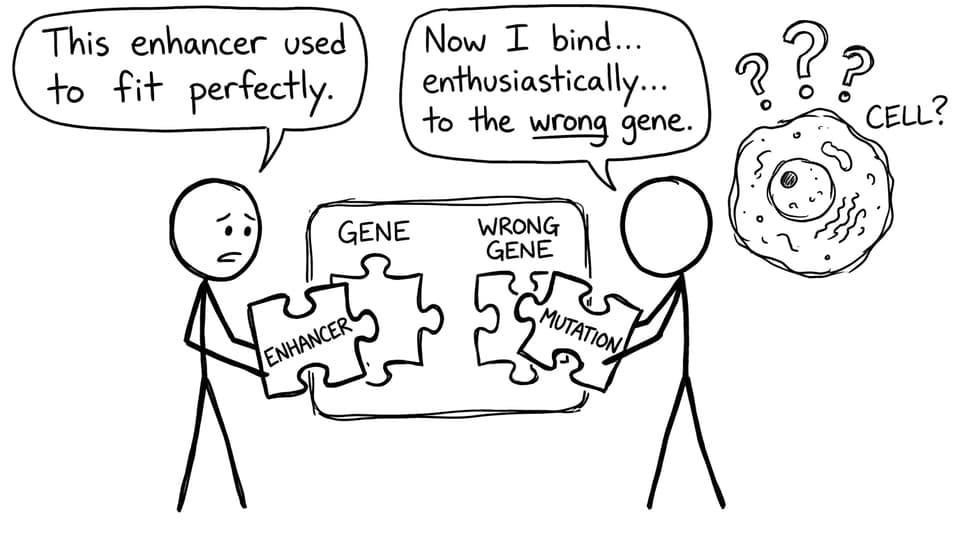
Enhancers are binding sites for activators. The key idea for IB Biology is that enhancers help recruit or stabilize the transcription machinery, often through DNA looping in eukaryotes.
A mutation in an enhancer can do two opposite things:
-
Break an activator binding site: the activator can’t bind, so transcription drops or fails in a specific tissue/time.
-
Create a new binding site: an activator binds when it shouldn’t, turning a gene on in the wrong place.
That second case is what makes regulatory DNA feel like a story: the protein-coding region didn’t change, but the context did. Same “actors,” different stage directions.
For broader context on what cells use to control expression, connect this topic to Regulation of Gene Expression.
Silencer mutations: losing the brakes
Silencers are regulatory sequences where repressors bind. In a well-regulated system, repressors help keep genes off when expression would be wasteful or harmful.
A silencer mutation often means:
-
The repressor binds poorly or not at all
-
Transcription becomes inappropriately active
-
Expression happens at the wrong developmental time or in the wrong cell type
In IB Biology exam language, call this “loss of repression” or “constitutive expression” (expression that’s effectively stuck on). For the protein players behind this, revisit D2.2.2 Regulation of transcription by proteins Notes.
Operator mutations in prokaryotes: the operon stuck on
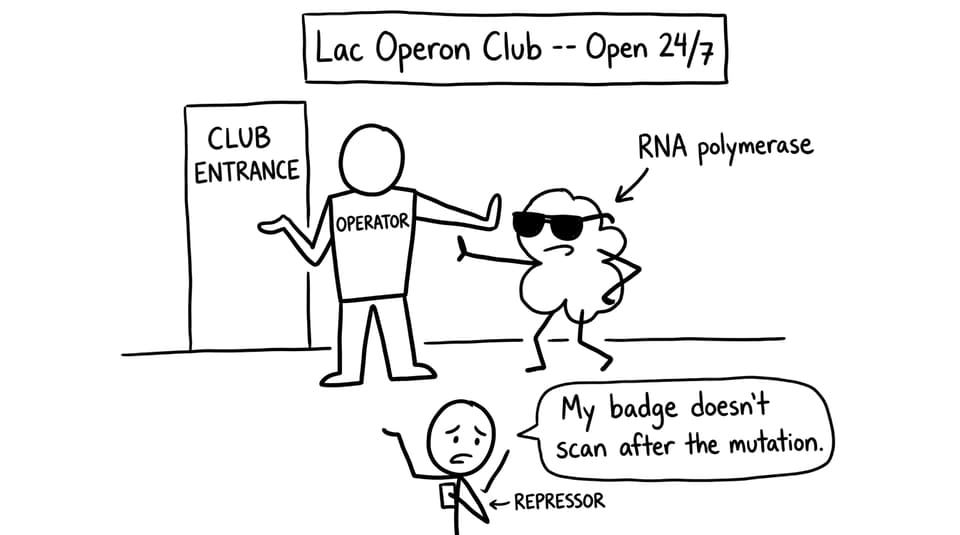
In prokaryotes, the operator is a DNA sequence where a repressor binds to block transcription of an operon.
A classic IB Biology example is the lac operon. If an operator mutates so the repressor can’t bind, the operon may be transcribed even when it’s not useful. That wastes energy, and the cell’s efficiency drops.
To lock this in with an exam-ready model, study How the Lac Operon Shows Inducible Expression and compare it with How the trp Operon Shows Repressible Control.
Why regulatory mutations are an evolution shortcut
A useful framing for IB Biology: changing a protein can be risky because it may break multiple functions. Changing where and when the protein is made can be subtler, and sometimes more adaptable.
Regulatory DNA mutations can shift:
-
timing (earlier vs later expression)
-
location (which tissue expresses the gene)
-
dosage (how much mRNA/protein is produced)
That’s why regulatory changes often show up in explanations of development and species differences: the “hardware” stays similar, but the “settings” evolve.
Study smarter for IB Biology with RevisionDojo
If regulatory DNA mutations feel abstract, turn them into practice patterns. RevisionDojo helps you train the exact explanation style IB Biology examiners reward: concise mechanisms, correct keywords, and clear cause-and-effect.
Use the D2.2 Gene Expression Questionbank (HL) to drill promoter/enhancer/operator scenarios, then reinforce definitions with Flashcards for D2.2 Gene expression (HL). When you want a faster overview before mocks, lean on D2.2 Gene expression (HL) Cheatsheets.
In IB Biology, small changes can create big outcomes. Regulatory DNA mutations are the proof, and RevisionDojo is where you practice explaining that proof with confidence.