



German has a reputation. It walks into the room wearing four cases, a toolbox of verb endings, and the confidence of a language that expects you to earn every sentence.
So when you start IB German Ab Initio, it’s normal to wonder whether success means memorising every rule until your brain declines the responsibility.
Here’s the calmer truth: IB Languages courses reward communication first. In IB German Ab Initio, grammar matters because it makes you understandable. But you’re not being assessed like a mini linguist. You’re being assessed like a beginner who can express real ideas, with control of the essentials.
This post breaks down how much grammar you actually need, what to prioritise for exams, and how to revise it without drowning in tables.
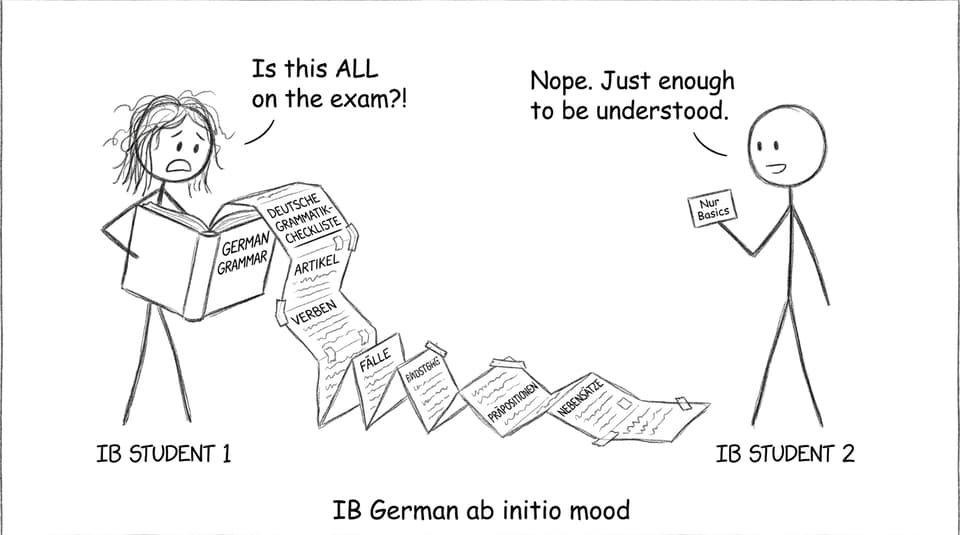
A quick checklist: “enough grammar” for IB German Ab Initio
If you can do the following reliably, you have enough grammar to score strongly in IB Languages at Ab Initio level:
-
Write 200-250 words with mostly correct sentence structure
-
Use present tense confidently, and narrate past events using Perfekt
-
Keep word order stable in main clauses and with key connectors (weil, dass, wenn)
-
Use nominative + accusative + dative in common patterns (no need to obsess over rare edge cases)
-
Negate accurately with nicht and kein
-
Use modal verbs to express ability, obligation, and plans
-
Speak for several minutes with understandable grammar, even if not perfect
For exam structure context, keep this bookmarked: IB German Ab Initio Exam Format (2025 Guide).
Why grammar matters in IB Languages (but not the way you fear)
Grammar is like the frame of a bicycle. Nobody praises the frame. They praise the ride. But if the frame is broken, you don’t get far.
In IB Languages, examiners aren’t hunting for “advanced grammar.” They’re looking for whether your grammar supports your message:
-
In writing, grammar affects clarity and helps your ideas land.
-
In reading and listening, grammar helps you decode relationships: who did what, when, and to whom.
-
In the oral, grammar supports flow, but intelligibility is the real prize.
A useful companion read here is: How Can I Prepare for IB German Ab Initio Paper 1? (2025 Guide).
The essential grammar that pays the biggest dividends
There’s a special kind of stress that comes from trying to learn German grammar “in order.” IB German Ab Initio doesn’t reward that approach.
Instead, learn grammar by frequency and exam usefulness.
Articles, gender, and plurals (the slow-burn foundation)
You don’t need to get every noun gender correct forever. But you do need to control the common ones you use repeatedly (family, school, hobbies, technology, environment).
Prioritise:
-
der/die/das and ein/eine
-
plural patterns you meet often
-
article changes in basic case patterns (especially with common prepositions)
Present tense + the verbs you can’t avoid
If you can handle present tense, you can communicate. That’s why it’s the heartbeat of IB Languages Ab Initio.
Focus on:
-
regular conjugations
-
high-frequency irregulars: sein, haben, gehen, kommen, werden
-
separable verbs that appear in daily-life topics (aufstehen, einkaufen)
Word order: the most “expensive” mistake
Word order errors can make even correct vocabulary feel confusing.
Learn these patterns until they feel boring:
-
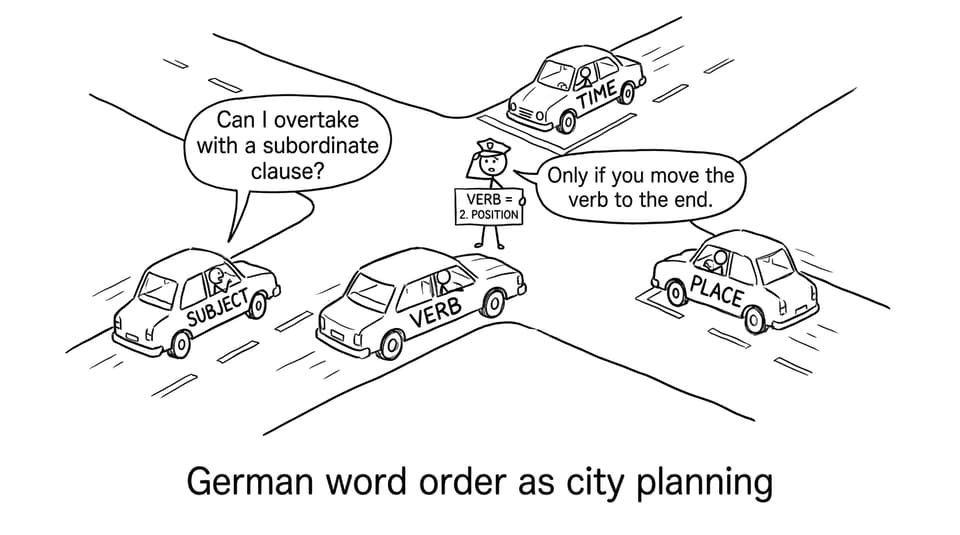
verb in second position in main clauses
-
questions with verb first
-
subordinate clauses with verb at the end (weil, dass, wenn, obwohl)
Negation: nicht vs kein
This is a tiny topic with a big mark impact, because it shows control.
Rule of thumb:
-
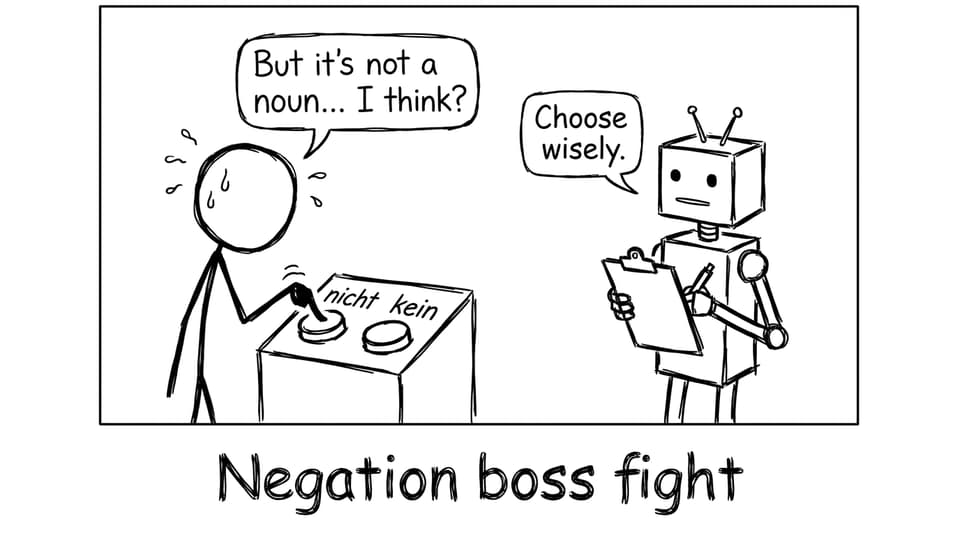
kein negates a noun with an article idea (ein/eine)
-
nicht negates everything else
Practice with short pairs:
-
Ich habe einen Hund. → Ich habe keinen Hund.
-
Ich spiele Tennis. → Ich spiele nicht Tennis.
Cases (only what IB German Ab Initio actually uses)
Yes, German has four cases. No, you don’t have to master all four equally.
For IB German Ab Initio, prioritise:
-
Nominative (subject)
-
Accusative (direct object)
-
Dative (after key verbs and prepositions)
Genitive is helpful for recognition, but rarely essential for high marks at this level.
Prepositions you’ll meet every week
Prepositions quietly force case choices. That’s why they matter.
Start with the most common:
-
accusative: für, durch, ohne
-
dative: mit, zu, bei, nach
-
two-way: in, auf, an (learn them with movement vs location examples)
Past tense with Perfekt
Most Ab Initio storytelling happens in the Perfekt.
You need:
-
haben vs sein in common situations
-
past participles for frequent verbs
Not perfect. Just controlled.
For a fuller “what to cover” map, see: What Grammar Topics Are Most Important in IB German Ab Initio? (2025 Guide).
Helpful grammar (nice-to-have, not required)
Some topics look impressive, but they’re not the best use of limited revision time in IB Languages Ab Initio:
-
Genitive case production
-
Passive voice
-
Indirect speech
-
Konjunktiv II beyond a few set phrases (ich würde gern…)
If these show up in reading/listening, you should recognise them. But your writing and speaking marks won’t depend on mastering them.
How examiners “feel” grammar across the papers
Grammar marks often reflect a simple idea: Do you control the language you choose?
-
Paper 1 (Writing): A shorter sentence that’s accurate can outscore a longer sentence that collapses. Clean verb placement and reliable tense control matter.
-
Paper 2 (Reading & Listening): Grammar is comprehension support. Word order and case clues help you identify meaning faster.
-
Oral: Examiners expect mistakes. What they want is the ability to keep going, repair errors, and stay understandable.
If your oral feels intimidating, use: How to Succeed in the IB German Ab Initio Oral Exam (2025 Edition).
How to revise grammar without turning it into a second subject
Grammar improves fastest when it’s attached to output.
Try this rhythm:
-
10 minutes: one micro-topic (word order, Perfekt, dative prepositions)
-
10 minutes: write 6-8 exam-style sentences using that micro-topic
-
5 minutes: speak those sentences aloud, then extend them with one extra detail
You’ll also revise faster when your grammar matches the five themes you’ll actually be assessed on. This guide helps you connect language to the syllabus: What Themes Are Most Challenging in IB German Ab Initio? (2025 Guide).
Using RevisionDojo to make grammar feel manageable
Most students don’t struggle because they “don’t understand grammar.” They struggle because they don’t get enough targeted repetitions with feedback.
RevisionDojo is built for that reality. You can:
-
Drill patterns through the Questionbank
-
Lock in forms with Flashcards
-
Clarify rules instantly with AI Chat (especially word order and cases)
-
Practice under pressure with Mock Exams and Predicted Papers
-
Fix writing with Grading tools and model strong responses with Study Notes
-
Use the Coursework Library for exemplars and expectations: IB German ab initio Exemplars
-
Get personalised support from Tutors when a topic keeps looping
For a central hub, start here: German ab initio - IB Resources.
Conclusion: the grammar you need is the grammar that carries meaning
You don’t need to “finish German grammar” to succeed. You need to build a reliable toolkit: articles, present tense, Perfekt, word order, negation, modal verbs, core cases, and common prepositions. That’s the grammar that makes you understood, and in IB Languages, being understood is the foundation of high marks.
If you want a structured path, use RevisionDojo to turn grammar into repetitions you can measure: start with German ab initio - IB Resources, then practise exam tasks with feedback until the basics feel automatic. When that happens, German stops being “grammar-heavy” and starts being a language you can actually use.