
If you are an IB parent wondering whether three Higher Level subjects are enough, the reassuring answer is yes. Three HL subjects is the normal and standard choice for an IB Diploma student. The International Baccalaureate requires students to take at least three and permits a maximum of four, with their remaining subjects studied at Standard Level.
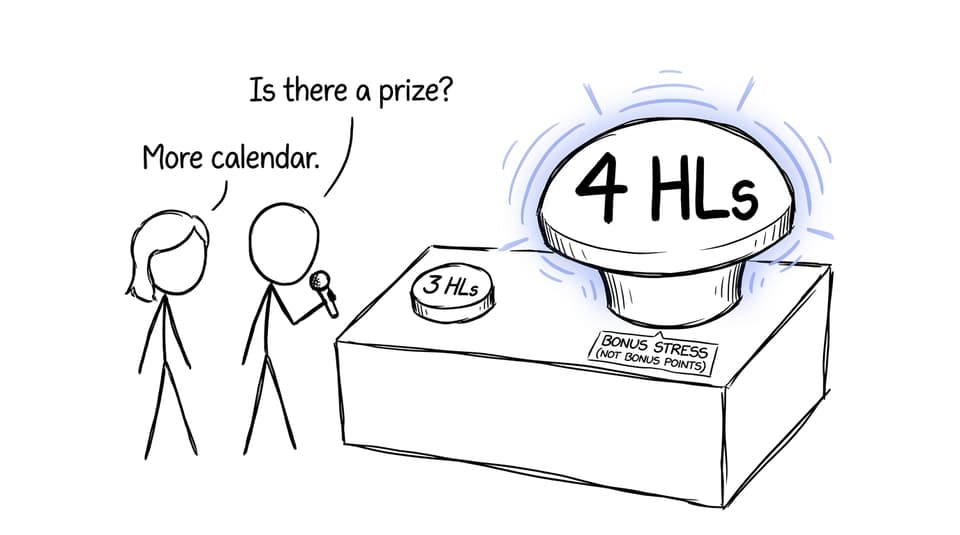
Four HLs can be appropriate in limited circumstances, but it is not the expected route, a hidden requirement for strong university applications, or an automatic academic advantage. For most students, three carefully selected HLs provide the best balance between university preparation, performance, and a sustainable two-year workload.
That matters because subject selection can look like a competition from the outside. One student takes four HLs, another chooses an intimidating combination, and suddenly a sensible programme can feel insufficient. Yet the IB rewards results, not theatrical difficulty. The right question is not simply how many HLs a student could take. It is which three give them the strongest foundation without weakening everything else.
The short answer for parents
Here is the decision in plain language:
- Three HL subjects: Normal, fully sufficient for the IB Diploma, and suitable for the large majority of students.
- Four HL subjects: Permitted, but usually worthwhile only when there is a clear academic reason and the school approves the combination.
- Two HL subjects: Not enough for a full IB Diploma Programme registration, although other IB pathways may follow different structures.
- The remaining subjects: Normally taken at SL, alongside Theory of Knowledge, the Extended Essay, and Creativity, Activity, Service.
- The priority: Choose the HL subjects needed for possible university courses, then judge whether the complete workload is realistic.
For a clearer comparison of the two levels, parents can begin with this guide to the difference between HL and SL in IB.
Why three HL subjects is normal
The standard IB Diploma consists of six academic subjects. Students normally study three at HL and three at SL. According to the IB's current curriculum information, HL courses represent 240 recommended teaching hours each, compared with 150 hours for an SL course.
That difference is substantial. Across three subjects, the recommended HL teaching time totals 720 hours. Adding a fourth HL means replacing an SL course with another course carrying roughly 90 additional recommended teaching hours, before considering independent revision, assessment preparation, or differences between subjects.
HL is also more than extra classroom time. Students are expected to demonstrate a greater body of knowledge, understanding, and skill. Depending on the subject, that may mean additional content, more demanding applications, greater analytical depth, or different assessment components. The precise distinction varies, so families should examine each subject rather than treating every HL as equally demanding.
A student considering English, for example, can review the specific differences between IB English SL and HL. Subject-level detail is more useful than broad claims about which courses are supposedly easy.
Three HLs is not the easy option
It is tempting to interpret the minimum as the least ambitious choice. In the IB, that is misleading.
A three-HL student is still completing six subjects and the Diploma Programme core. The Extended Essay requires sustained independent work. Theory of Knowledge introduces its own assessments. CAS requires ongoing participation and reflection. Internal assessment deadlines can converge even when a school plans them carefully.
The real challenge is therefore not surviving three isolated courses. It is coordinating several forms of work over two years. A student may be preparing a laboratory investigation while drafting an essay, practising an oral, and revising for a timed mathematics assessment. The number of HL labels does not capture that overlap.
This is why a balanced combination often produces a stronger academic outcome than an overloaded one. Three HLs leave more room to reach the required depth, protect performance across SL subjects, and complete the core thoughtfully. Parents who want to see how this translates into daily habits may find a balanced IB study schedule more revealing than a simple subject count.
When taking four HL subjects may make sense
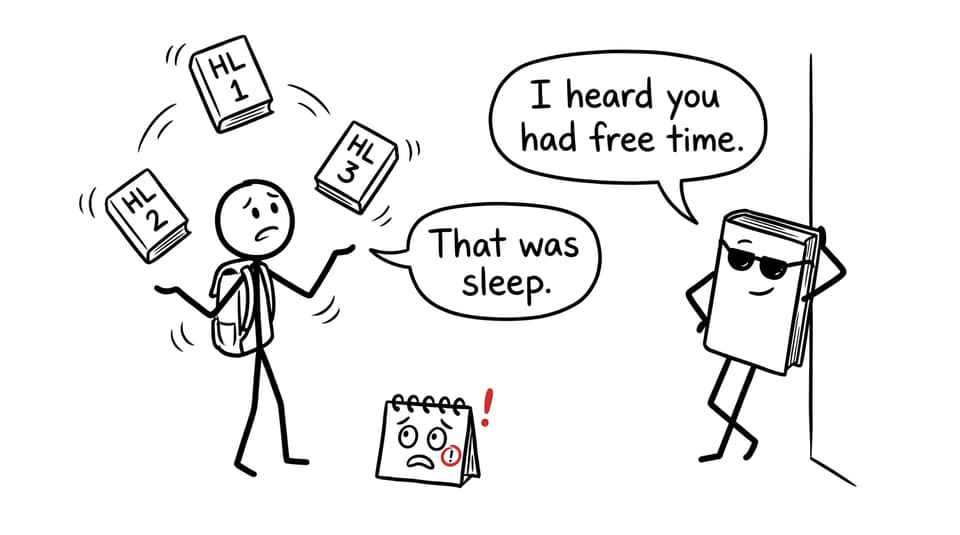
Four HLs should solve a specific problem. It should not be chosen merely because a capable student feels that three looks ordinary.
University options are genuinely uncertain
Some university programmes require particular subjects at HL. Requirements vary by institution, country, and degree, and they can change. A student divided between two fields might temporarily keep four HLs if doing so preserves necessary prerequisites while they investigate their options.
Before making that decision, check the official course pages of several realistic universities. Look for required subjects, required levels, and minimum grades. Many universities frame IB offers around an overall score plus grades in three HL subjects. That does not mean every institution follows the same policy, but it does show why adding a fourth HL should never be based on assumption alone.
The fourth subject matches an established strength
A fourth HL is more plausible when the student already performs strongly in the subject, enjoys the way it is assessed, and can handle it without repeatedly sacrificing sleep or other courses. Interest helps, but evidence matters more. Current grades, teacher feedback, speed of completing assignments, and recovery after busy weeks offer better signals than confidence in September.
The school allows a trial period
Some schools may let students begin with four HLs and later reduce one to SL, subject to school policy, scheduling, and syllabus timing. If that option exists, families should establish the decision date and criteria in advance. A trial is useful only when it produces an honest decision, not when dropping a level becomes emotionally framed as failure.
When the fourth HL is probably unnecessary
Several common reasons sound persuasive but do not survive close inspection.
“It will impress universities” is too vague. Universities usually publish what they require. If a programme asks for a particular subject at HL and grades across three HLs, taking four without improving eligibility may add risk rather than value.
“Other strong students are doing it” confuses comparison with planning. Students differ in subject strengths, language background, extracurricular commitments, health, and university direction.
“The student can always work harder” treats time as infinitely expandable. The IB already contains deadlines that cannot all become the top priority at once. More hours do not automatically create better judgment, memory, or writing.
“Dropping to SL looks weak” misunderstands the programme. SL subjects are integral to the Diploma and contribute to the final total. A well-chosen SL can preserve breadth while allowing deeper work in the subjects that matter most.
The more useful principle is simple: do not add difficulty without adding purpose.
How to choose the right three HL subjects
The best selection sits where three considerations overlap: university eligibility, academic strength, and manageable workload.
| Question | What parents and students should check |
|---|---|
| Is the subject required? | Verify current requirements on official university course pages. |
| Is the student suited to it? | Review grades, teacher feedback, interest, and assessment style. |
| Does the combination balance skills? | Consider how many courses require heavy reading, writing, calculations, practical work, or portfolios. |
| Can the student sustain it? | Account for the Extended Essay, TOK, CAS, activities, travel, health, and sleep. |
| Is the choice based on evidence? | Avoid relying on rumours about prestige or supposedly easy subjects. |
Subject combinations matter because workloads can peak in different ways. Three essay-heavy HLs may create clusters of reading and drafting. A mathematics-and-science combination may involve frequent problem practice and practical work. An arts subject can carry substantial portfolio or performance demands.
Rather than asking whether one combination is universally hardest, ask whether it fits the student's actual working style. The honest guide to whether HL versus SL matters provides a useful framework for that conversation.
Warning signs that the HL load needs reviewing
One difficult week does not prove that a subject choice is wrong. A repeated pattern is more meaningful.
Watch for:
- deadlines being met only through regular late nights;
- one subject consistently consuming time needed by the other five;
- falling performance across several courses rather than one temporary dip;
- revision being postponed until immediately before assessments;
- coursework and the Diploma core remaining permanently behind schedule;
- persistent stress that does not improve after planning changes or teacher support.
These signs should start a conversation with the school's IB coordinator and subject teachers. The first response may be to improve planning, clarify expectations, or obtain targeted help. If the underlying load remains unsustainable, changing a level can be a strategic correction rather than a retreat.
A practical IB exam timetable that prioritises weakness and urgency can help distinguish a planning problem from a deeper workload mismatch.
Managing three HL subjects without relying on cramming
Three HLs are normal, but they still need a system. The most reliable approach is repeated contact with each subject across the week: retrieve knowledge, apply it, inspect errors, and return after a delay. This is more sustainable than allowing one HL to disappear from view until its next test.
RevisionDojo helps students manage three HL subjects simultaneously through structured spaced practice, not cramming. A student can use concise Study Notes to repair a concept, Flashcards to revisit it over time, and the RevisionDojo Questionbank to apply it in exam-style questions. The guide to spaced repetition for IB revision explains how delayed retrieval can become part of a manageable routine.
As exams approach, Mock Exams and Predicted Papers help build timing and stamina. AI Chat can clarify a misconception while it is still small, while Grading tools and the Coursework Library support more deliberate improvement outside exam revision. Tutors can provide focused human guidance when a student has plateaued or cannot identify the cause of repeated errors.
The goal is not to use every tool every day. It is to give each problem the right response. Notes address understanding. Flashcards strengthen recall. Questions build application. Timed work reveals whether knowledge survives pressure.
Students who feel stretched can also use this guide to studying for IB exams without burning out to build a smaller, repeatable cycle.
The sensible next step
For most IB Diploma students, three HL subjects is not merely acceptable. It is the intended, normal structure of the programme. A fourth may be justified, but only when it protects a real university pathway or reflects exceptional capacity supported by evidence.
Parents can help most by moving the conversation away from prestige and toward fit. Confirm university prerequisites, ask teachers for candid feedback, examine the combined assessment load, and protect the student's ability to work consistently.
Once the three HLs are chosen, the focus should shift from counting courses to building mastery. RevisionDojo gives students one place to understand, remember, practise, receive feedback, and prepare under realistic conditions. That steady process is what makes a demanding IB combination manageable, one well-spaced session at a time.


