

It usually starts with a neat-looking ranking.
One number. One list. One comforting sense that the world is measurable.
Then your IB Geography course quietly pulls the rug out: development isn’t a single thing, so it can’t be captured by a single statistic. Human development is about people’s lives -- health, education, opportunity, dignity -- not just how much money moves through an economy.
If you’re revising for exams, the goal isn’t to memorise a definition of HDI and move on. The goal is to show you understand how human development is measured, and why every method is incomplete on its own.
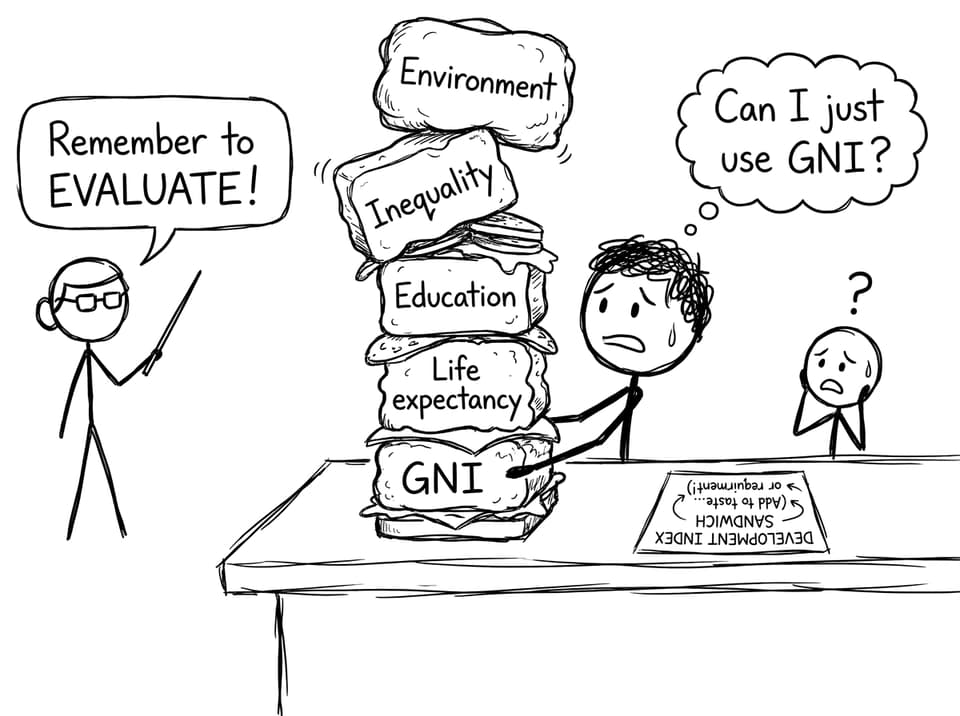
A quick exam-ready checklist (IB Geography)
Use this as your mental structure in IB Geography short and essay responses:
-
Use at least two measures (e.g., GNI + a social indicator, or HDI + an inequality measure).
-
Explain what each measure shows.
-
Evaluate limitations (averages, data reliability, missing sustainability, missing inequality).
-
Link back to the question: “So what does this mean for development in this place?”
For a syllabus-aligned overview, start with Human Development and Diversity.
Economic indicators: what income can (and can’t) tell you
Economic indicators are often the first stop in IB Geography because they’re easy to compare.
A classic example is GNI per capita, which estimates average income. Higher GNI per capita often correlates with better housing, more consumer choice, and stronger tax capacity for public services.
But examiners love the next sentence: income alone doesn’t tell you who benefits. A high national average can sit alongside major inequality, informal work, or regional neglect. So if you use an economic indicator, pair it with something that captures lived outcomes.
To go deeper on the exact indicators and phrasing, see Measuring Human Development Notes (5.1.1).
Social indicators: measuring outcomes people actually feel
Social indicators track quality of life more directly, which is why they’re central to IB Geography development essays.
Examples include:
-
Life expectancy (a proxy for healthcare access, nutrition, stability)
-
Infant mortality rate (sensitive to sanitation, maternal health, inequality)
-
Literacy rate and schooling measures (access, gender gaps, long-run opportunity)
-
Access to clean water (basic infrastructure and governance)
The catch is that social indicators are frequently national averages. They can hide internal disparities by region, ethnicity, or gender. In evaluation, that’s your opening: “This measure is useful, but it conceals spatial variation.”
If you want strong terminology for your answers, use the IB Geography Key Definitions.
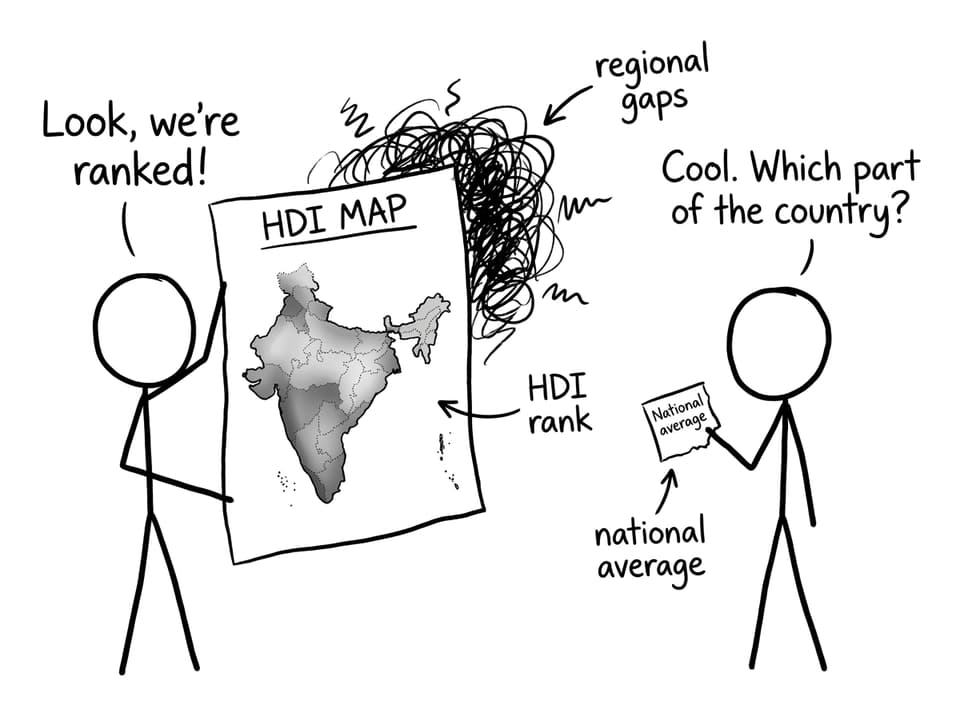
HDI in IB Geography: the composite index you must know
The Human Development Index (HDI) is the flagship composite measure in IB Geography because it blends multiple dimensions into a single score.
HDI combines:
-
Health (life expectancy)
-
Education (mean and expected years of schooling)
-
Income (GNI per capita, adjusted for purchasing power)
In exams, treat HDI as a conversation starter, not a final verdict. It’s powerful because it reduces over-focus on income alone and makes cross-country comparison easier.
For extra clarity and examples, connect your revision to What Is the Human Development Index (HDI)?.
Limitations and extensions: how to score evaluation marks
High-scoring IB Geography answers show you can critique the tool.
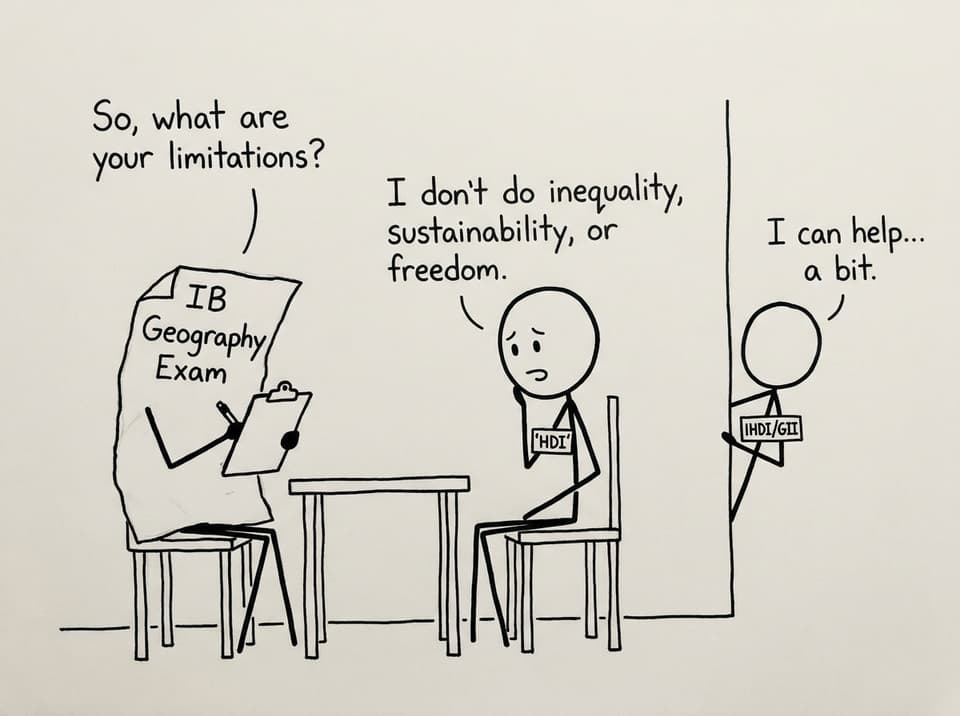
HDI’s key limitations include:
-
It doesn’t fully capture inequality within countries.
-
It doesn’t measure environmental sustainability.
-
It can’t directly show political freedom, safety, or rights.
-
Data quality can be weaker in some low-income contexts.
That’s why related measures matter. For example, inequality-adjusted measures and gender-focused indices can reveal development gaps that HDI smooths over.
How RevisionDojo turns measures into marks
Knowing definitions is one thing. Using them under time pressure is another.
RevisionDojo helps IB Geography students practise development measurement the way it appears in exams:
-
Build speed with the Human Development and Diversity Questionbank and get targeted practice.
-
Lock in terminology using Human Development and Diversity Flashcards.
-
Learn the logic step-by-step in Human Development and Diversity Lessons.
-
Pull everything together from the main IB Geography hub.
Behind the scenes, tools like AI Chat, Grading tools, Predicted Papers, Mock Exams, Study Notes, and the Coursework Library help you move from “I’ve heard of HDI” to “I can evaluate it in a 10-mark response.”
Closing: measure people, not just money (IB Geography)
The quiet lesson behind every development index is that measurement reflects values. When IB Geography asks how human development is measured, it’s also asking what you think “progress” should mean.
So revise like a geographer: combine indicators, question averages, and evaluate what’s missing. Then practise turning that thinking into marks using RevisionDojo’s Questionbank, Study Notes, Flashcards, AI Chat, Mock Exams, and Grading tools -- so your next development essay feels less like guesswork and more like a clear argument.