This site uses cookie tracking technologies. Learn more in our Cookie Policy.
IB Geography: Environmental Impacts of Coastal… | RevisionDojo
Join 600k+ Students Already Crushing Their Exams
Coasts don’t fail loudly. They fail quietly -- one storm takes a little more beach than the last, one defence nudges currents into a new habit, one habitat gets pinned between rising seas and hard concrete.
That’s why IB Geography treats the environmental impacts of coastal management as an evaluation topic, not a definition topic. Anyone can list groynes or sea walls. The exam rewards students who can explain how these choices reshape sediment cells, ecosystems, and water quality over time.
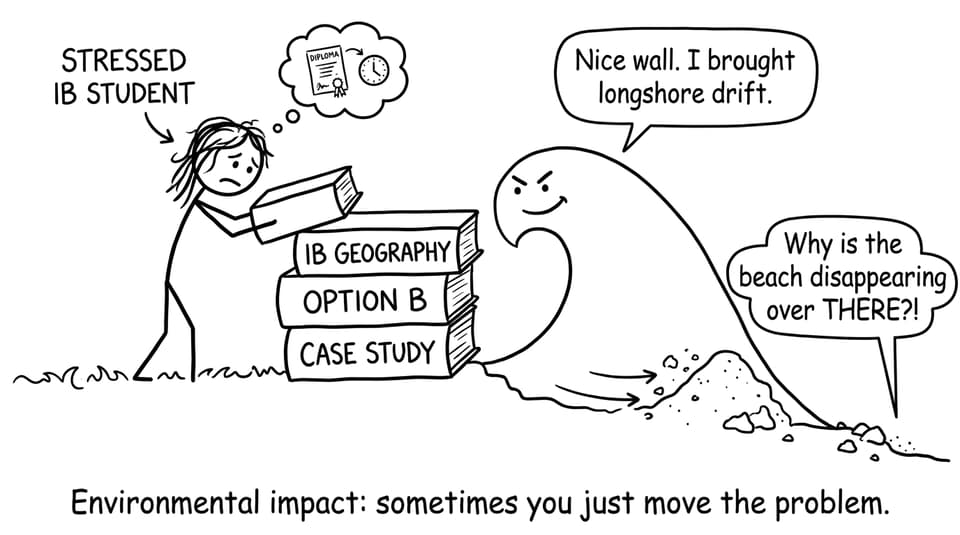
IB student sea wall vs longshore drift
IB Geography quick checklist: what to evaluate
Use this fast structure in IB Geography 6-, 10-, and essay responses:
What coastal process is being changed? (erosion, deposition, longshore drift)
Which ecosystem is affected? (salt marsh, mudflat, dunes, nearshore seabed)
Are impacts local or transferred downdrift?
Are impacts short-term (construction) or long-term (system change)?
IB Geography: sediment disruption and “risk transfer”
Hard engineering often interrupts the coast’s natural sediment budget. Groynes and breakwaters trap sand, which can widen one beach but starve another section downdrift. In , this is an easy evaluation line: the strategy reduces risk in one location, but relocates it within the sediment cell.
If you need the strategy overview first, use Coastal Management Strategies, then link consequences back to processes like longshore drift.
IB Geography: habitat loss, coastal squeeze, and artificial shorelines
Sea walls and embankments replace diverse intertidal habitats with steep, hard surfaces. The biggest ecological issue is often not one dramatic event, but a slow reduction in living space. With sea-level rise, salt marshes and mudflats try to migrate landward. Fixed defences can block that migration, creating coastal squeeze and shrinking biodiversity-rich zones.
To connect this to the bigger systems story in IB Geography, revise the underlying physical setting using Coastal Processes and Landforms.
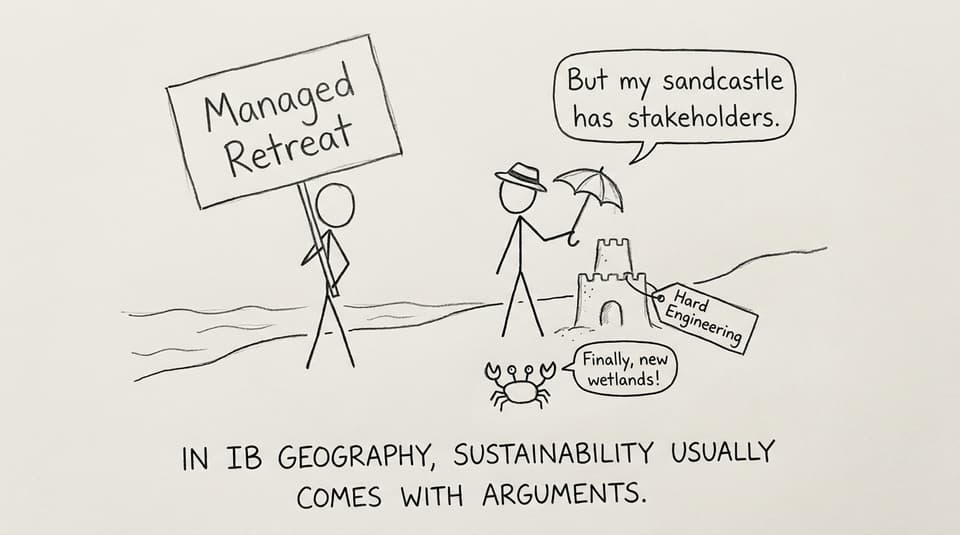
Managed retreat vs hard engineering stakeholders
IB Geography: managed retreat and “new nature” trade-offs
Managed retreat (realignment) can look like giving up, but environmentally it often creates new wetlands and salt marshes. Those habitats can increase biodiversity, store carbon, and reduce wave energy naturally. In IB Geography, it’s a strong sustainability argument: a strategy that restores buffers instead of constantly repairing barriers.
But don’t write it as a perfect solution. The evaluation comes from tension: environmental gains can conflict with farmland, housing, and local politics. If you want stakeholder language for this, revise with B.3.1 Stakeholders in Coastal Margin Management (Notes).
IB Geography: beach nourishment and hidden marine impacts
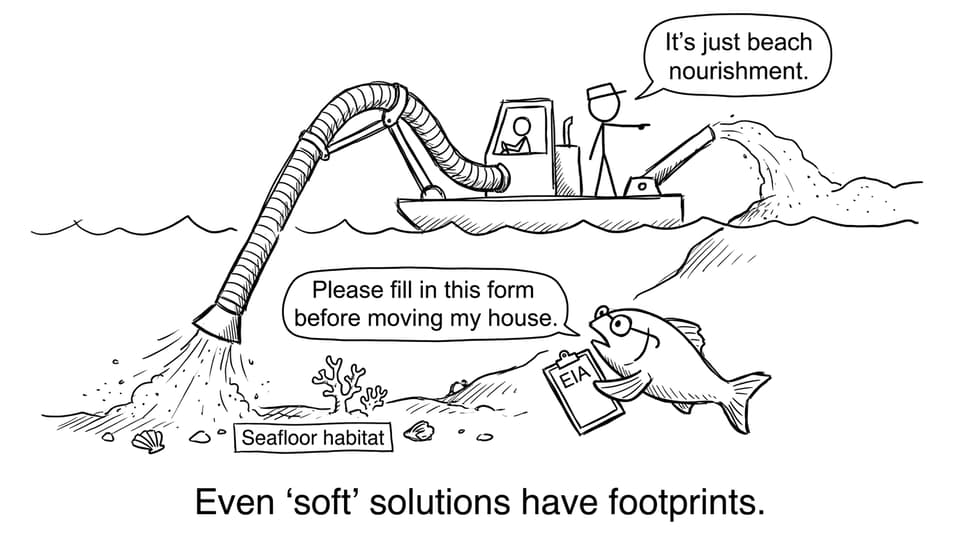
Beach nourishment is usually labelled “soft engineering,” but it still has environmental costs. Dredging can disturb seabed habitats and marine food webs; imported sediment can alter grain size, affecting organisms that live in or feed on the beach.
Beach nourishment fish EIA joke
To keep your IB Geography answer sharp, split your impacts:
IB Geography: water quality and long-run maintenance pressure
Coastal construction can increase turbidity and change how pollutants disperse. Defences may also reduce natural flushing in enclosed areas, increasing pollution build-up risk. And because many defences need maintenance, environmental pressure can become continuous rather than one-off.
Conclusion: the IB Geography “big idea” to remember
Coastal management is rarely a pure win. It’s a trade -- protection in one place, pressure somewhere else, and ecosystems forced to adapt to human geometry.
If you can explain that clearly, you’re already thinking like an IB Geography examiner. Use RevisionDojo’s Questionbank for Managing Coastal Margins to practise writing those evaluations under time pressure, then lock in the vocabulary with Flashcards and concise Study Notes.