
A quick hook for IB Geography students
The first time a city announces “Day Zero,” it sounds like a movie title. But in IB Geography, water scarcity is quieter than disaster films: it begins with small mismatches between supply and demand, then grows until everyday life has to renegotiate what “normal” means. If you can explain why that mismatch happens, you can usually handle the exam question that follows.
Water scarcity occurs when water demand exceeds available supply. In IB Geography, you also need to show you understand two types: physical water scarcity (not enough water in the system) and economic water scarcity (water exists, but access is limited by infrastructure, investment, or governance).
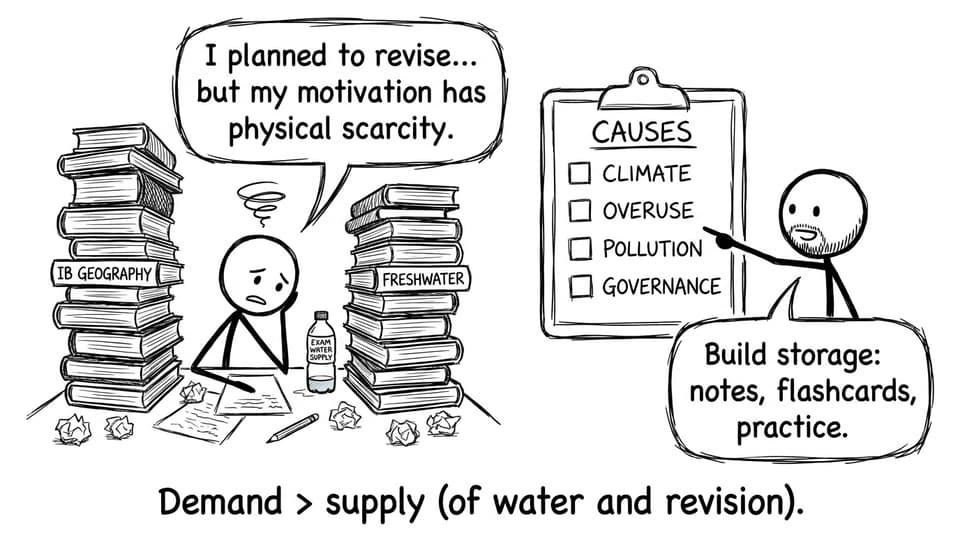
Exam checklist: the main causes of water scarcity
Use this as a fast plan for 6- to 10-mark responses in IB Geography:
-
Climate (aridity, drought, evapotranspiration)
-
Seasonal variability and limited storage
-
Over-extraction (especially agriculture and irrigation)
-
Population growth and urbanisation
-
Pollution reducing usable supply
-
Governance issues (inequality, weak regulation, conflict)
For syllabus-aligned practice, start with A.3 Water scarcity and water quality and then test yourself using the A.3 Flashcards.
Physical causes of water scarcity in IB Geography
Climate, drought, and rising evapotranspiration
In arid and semi-arid climates, precipitation is low and unreliable, so rivers, lakes, and aquifers recharge slowly. Extended drought reduces river discharge and groundwater replenishment, while higher temperatures increase evapotranspiration, shrinking effective water supply. Climate change can intensify this by shifting rainfall patterns and making extremes more frequent, which is a clean way to add evaluation in IB Geography.
Seasonal variability and “storage failure”
Some places get most of their rainfall in a short wet season. If storage (reservoirs, aquifer recharge, water transfers) is limited, the wet-season surplus can’t buffer the long dry season. In exam terms: variability increases risk, and lack of storage increases vulnerability.
To anchor your understanding in systems thinking, revise How Do Drainage Basins Function as Systems? and connect inputs, stores, flows, and outputs to scarcity.
Human causes of water scarcity in IB Geography
Over-extraction: when demand outpaces recharge
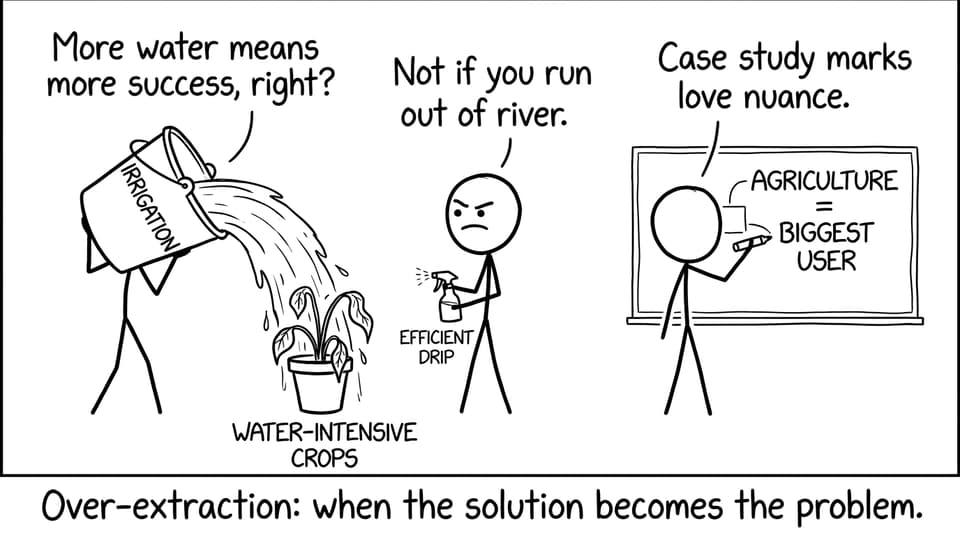
Human use can drain water faster than nature replaces it. Agriculture is often the largest freshwater user because irrigation demand rises precisely when rainfall is lowest. Water-intensive crops and inefficient irrigation (losses to evaporation and runoff) accelerate scarcity, especially in already dry regions.
If you want exam-style practice on this wider resource theme, try the Water-Food-Energy nexus Questionbank.
Population growth and urbanisation
More people means more domestic water use, more food production, more energy demand, and more industrial consumption. Rapid urbanisation can outpace pipes, treatment facilities, and maintenance, turning scarcity into an infrastructure story as much as a climate story.
Pollution: scarcity by contamination
Water can exist but be unusable. Industrial discharge, agricultural runoff (fertilisers, pesticides), and untreated sewage can contaminate rivers and groundwater. In IB Geography, it helps to phrase this as “pollution reduces available supply,” effectively creating scarcity even where physical supply looks adequate.
Physical vs economic water scarcity (the distinction examiners love)
Physical scarcity is about limits in the hydrological system: too little precipitation, too much evapotranspiration, depleted aquifers. Economic scarcity is about access: weak infrastructure, lack of investment, unequal distribution, or poor governance.
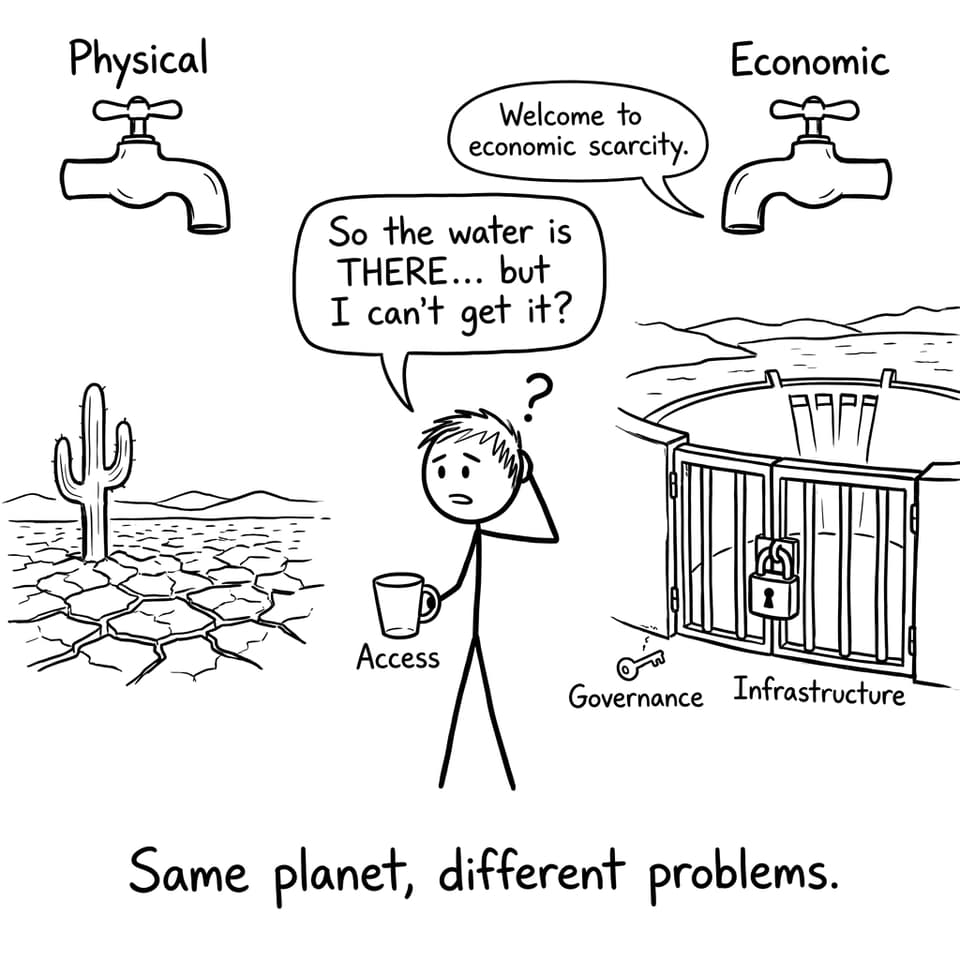
A strong IB Geography answer often shows both are happening at once: physical constraints raise baseline risk, while governance determines who feels the shortage first and worst.
Closing: turn causes into marks with IB Geography practice
Water scarcity isn’t caused by one villain. In IB Geography, it’s the interaction between climate and seasonality, human demand and pollution, and the often-invisible layer of governance that decides who gets access first. If you can explain those links clearly, you’re not just revising content -- you’re building the kind of answer examiners can reward.
Next step: revise the core content in Option A: Freshwater -- Drainage Basins, then practise with the IB Geography resources hub to turn understanding into confident exam performance.


