

The HDI question that quietly boosts your marks
In IB Global Politics, the Human Development Index (HDI) shows up in a sneaky way: not as a math problem, but as a values problem. You might be staring at a stimulus about growth, poverty, or “progress,” and then realize the examiner is really asking: progress for whom? IB Global Politics rewards students who can move past “the economy grew” and into “people’s lives improved (or didn’t).” HDI is one of the fastest tools for making that shift.
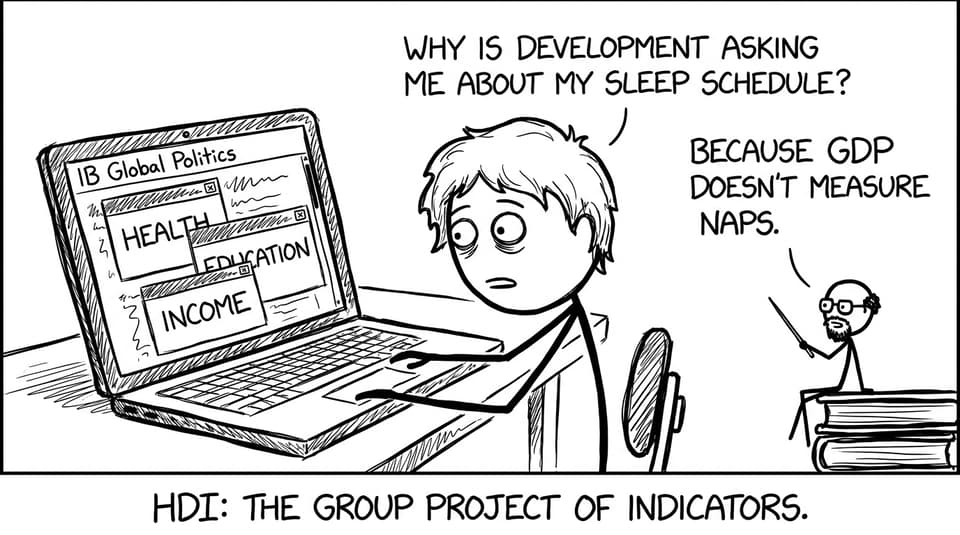
What the Human Development Index (HDI) is
The Human Development Index (HDI) is a composite indicator published by the United Nations Development Programme (UNDP). Instead of ranking countries only by economic output, HDI estimates how well people can live by combining three dimensions:
-
Health: life expectancy at birth
-
Education: years of schooling (mean and expected)
-
Standard of living: income per capita (GNI per capita, adjusted)
In IB Global Politics, this matters because HDI makes an argument: development is more than money. If you want a broader map of development debates, pair HDI with RevisionDojo’s overview of IB Global Politics Development and Sustainability.
A quick HDI checklist for exam answers
Use this micro-structure in IB Global Politics responses:
-
Define HDI as a composite measure (health, education, income)
-
Explain why it exists: challenges GDP-only thinking
-
Apply it: compare countries or identify gaps (high income, low outcomes)
-
Evaluate it: what it misses (inequality, sustainability, rights)
For clean definitions you can drop into Paper 1 or Paper 2, keep the IB Global Politics Key Definitions open while you revise.
Why HDI is useful in IB Global Politics
A core habit in IB Global Politics is noticing that measurements are political. HDI shifts attention from production to lived experience: longevity, schooling, and income as capability. That opens better analysis of equality, justice, and policy.
It also helps you avoid shallow comparisons. Two states can have similar economic strength but very different human outcomes. HDI makes those differences visible and gives you language to explain them with precision.
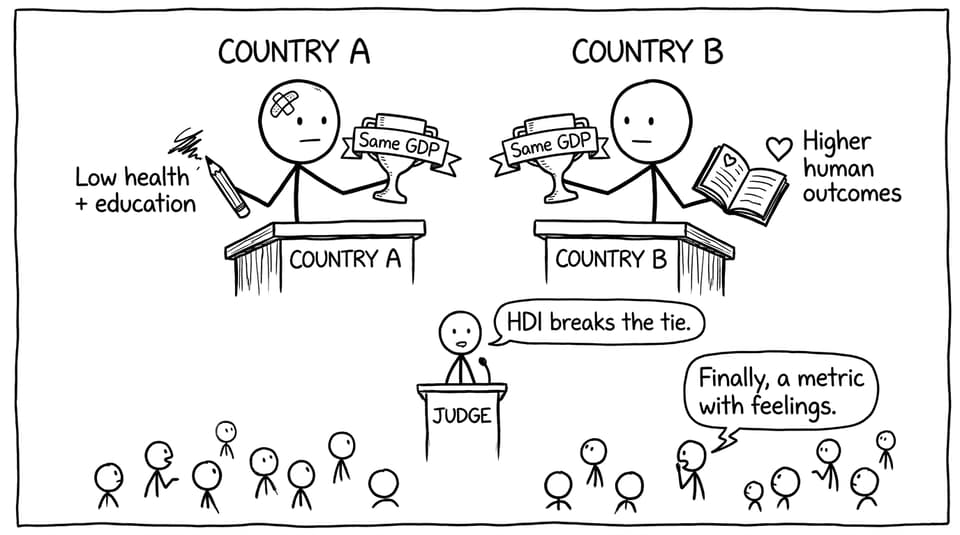
If you’re building wider context, connect HDI to the bigger question of what development even means using What Is Development in Global Politics?.
The limits of HDI (and how to evaluate them)
HDI is powerful, but it is not the final word. In IB Global Politics, evaluation is often where marks are hiding.
Key limitations to mention:
-
It doesn’t show inequality inside a country (two regions can live totally different realities)
-
It underplays sustainability (a high HDI can be built on environmentally damaging growth)
-
It doesn’t measure political freedom or rights in a detailed way
-
It can’t capture gender disparities deeply on its own
This is why HDI should be framed as a starting point: a useful headline indicator, followed by deeper measures and case study context. For a bigger comparison toolbox, see How Is Development Measured in Global Politics?.
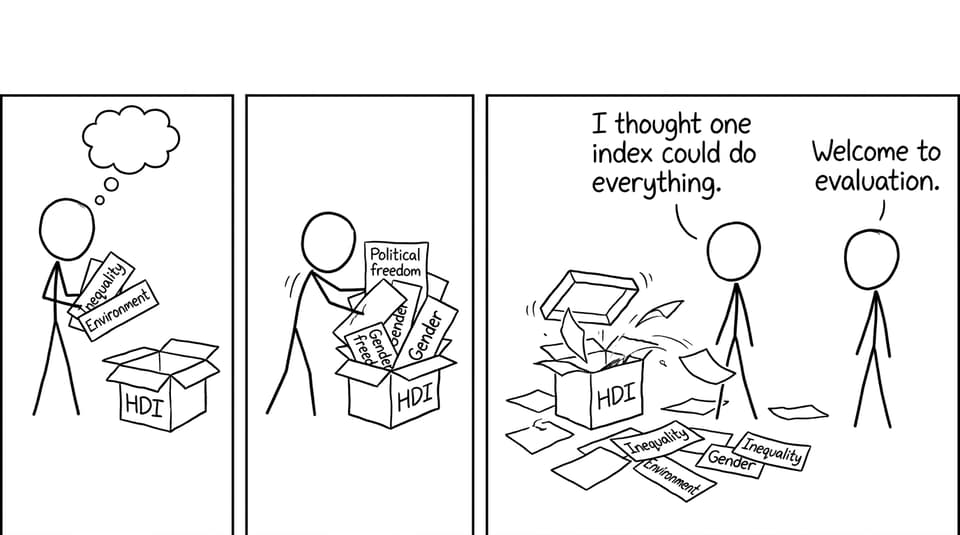
To push evaluation further, link HDI to inequality debates with IB Global Politics: Does Development Always Lead to Inequality?.
How to use HDI in RevisionDojo (fast)
If HDI is a recurring weak spot, treat it like a mini-skill:
-
Use the Study Notes for clean definitions and comparisons: IB Global Politics Revision Notes (SL/HL)
-
Drill HDI-style prompts in the Questionbank: Debates on development and sustainability Questionbank
-
Turn the three dimensions into Flashcards and test yourself in 90 seconds a day
-
Paste a paragraph into the Grading tools for exam-style feedback
-
Build timed sets with Mock Exams and Predicted Papers to practice using HDI under pressure
-
When you get stuck, use AI Chat to generate counterclaims and evaluation lines
-
For stronger examples, pull one from the Coursework Library or ask Tutors to check your structure
A good home base for all tools is IB Global Politics Resources.
Closing: the examiner’s hidden question
When you mention HDI in IB Global Politics, you’re not just adding a statistic. You’re answering the deeper question: what counts as a good society? Use HDI to define development, then evaluate it with what it misses, and your analysis immediately becomes more sophisticated. If you want that skill to feel automatic, build it with RevisionDojo’s Questionbank, Study Notes, Flashcards, AI Chat, and Grading tools--then lock it in with Mock Exams and Predicted Papers before exam day.