

Climate change is the kind of problem that politely ignores borders. Your country can recycle, electrify, and regulate--and still get hit by storms driven by emissions from everywhere else. That tension sits right at the center of IB Geography: to what extent can international agreements actually address climate change? The exam wants more than a list of treaties. It wants judgement: what agreements do well, where they fail, and what has to happen alongside them.
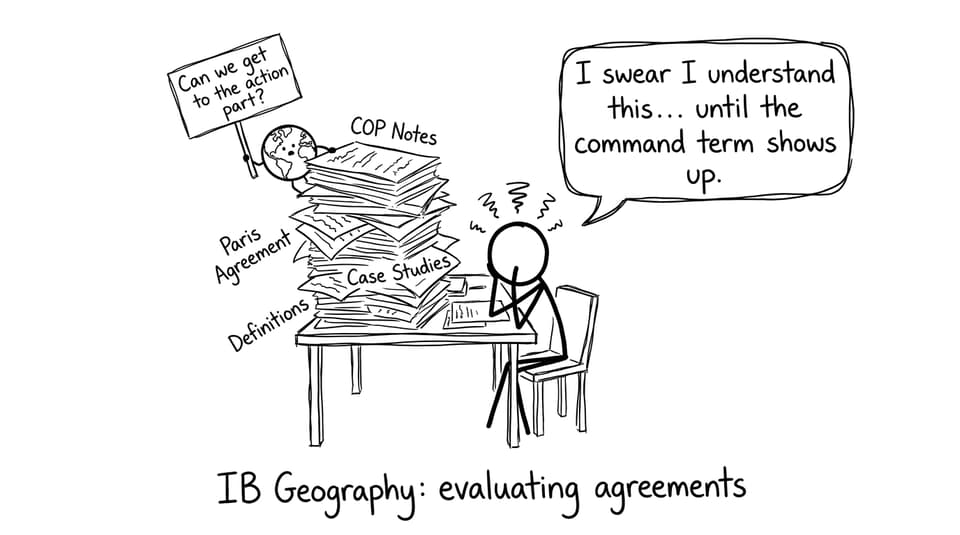
IB Geography quick checklist for a top evaluation
-
Define what an international agreement does (shared targets, cooperation, finance, reporting).
-
Use at least one named example (UNFCCC process, Kyoto Protocol, Paris Agreement).
-
Evaluate collective action, climate justice, enforcement, unequal ambition, and time lags.
-
Finish with a balanced judgement: necessary, but not sufficient.
For syllabus-aligned revision, start with the Global Climate: Vulnerability and Resilience hub and keep your definitions tight using Geography Flashcards.
How international agreements help (and why IB Geography cares)
In IB Geography, agreements matter because they create a global framework for mitigation and adaptation. Through the UNFCCC process, countries meet at COP summits, compare progress, and coordinate policies rather than acting in isolation. The Paris Agreement is often used to show broad participation: countries submit Nationally Determined Contributions (NDCs) and progress is reviewed through regular “stocktakes.”
The biggest strength is collective action. Agreements keep climate change on political agendas, encourage shared reporting systems, and can speed up technology transfer and collaboration. They also create a language of accountability: even when targets are voluntary, public commitments make it harder to pretend nothing was promised.
To connect this to your unit content, revise the bigger impacts story using C.4.4 Climate Change Impacts and Adaptation and the deeper topic overview in Notes for C.4.4.

The limits: enforcement, ambition gaps, and slow timelines
The hard truth--and the heart of strong IB Geography evaluation--is that many agreements rely on voluntary compliance. Paris, for example, does not impose legally binding emissions cuts on individual countries. Without strong enforcement, missed targets can become “future promises,” especially when governments change or economic priorities shift.
There’s also unequal participation and unequal ambition. Countries differ in historical responsibility, current emissions, and capacity to pay. That creates negotiation trade-offs: some states fear strict limits could slow growth or deepen poverty, while vulnerable states push for faster cuts and more finance. The result can be lowest-common-denominator outcomes that look impressive on paper while global emissions keep rising.
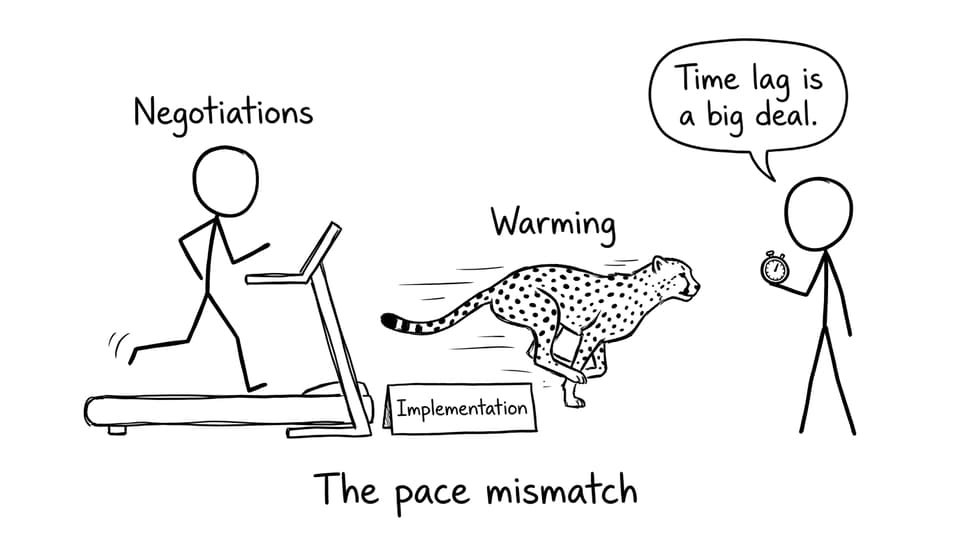
Finally, agreements face time pressure. Negotiations take years, and implementation takes longer. Climate systems respond slowly, but not slowly enough to wait for endless rounds of compromise.
If you want extra exam-ready angles, pair this with IB Geography 2.3.2 Government Adaptation and Mitigation Strategies and practise evaluation prompts in the 2.2 Consequences of Global Climate Change Questionbank.
So, to what extent? A strong IB Geography judgement
International agreements can address climate change to a moderate extent: they set direction, coordinate reporting, and create momentum for mitigation and climate finance. But alone, they rarely guarantee emissions cuts at the speed and scale needed. The best evaluation line for IB Geography is that agreements work most effectively when they trigger domestic policy shifts, investment, and local action--because real-world change still happens inside national borders.
To build that balanced conclusion quickly in timed conditions, use the IB Geography Resources hub and pressure-test your arguments with RevisionDojo’s Questionbank, Study Notes, Flashcards, AI Chat, Grading tools, Predicted Papers, Mock Exams, Coursework Library, and Tutors.
Final takeaway for IB Geography revision
If your IB Geography answer treats international agreements as either “the solution” or “a failure,” it will sound incomplete. The better truth is quieter: agreements build the stage, but countries still have to perform. Use RevisionDojo to practise that balanced judgement until it feels automatic--because in exams, the extent question is really asking whether you can think like a geographer under pressure.