


There’s a particular kind of silence an IB teacher notices right before an exam.
It’s not the calm, focused kind. It’s the kind where a student who can explain the topic perfectly in class suddenly looks like they’ve forgotten their own name. The knowledge is still there. But stress steps in and grabs the steering wheel.
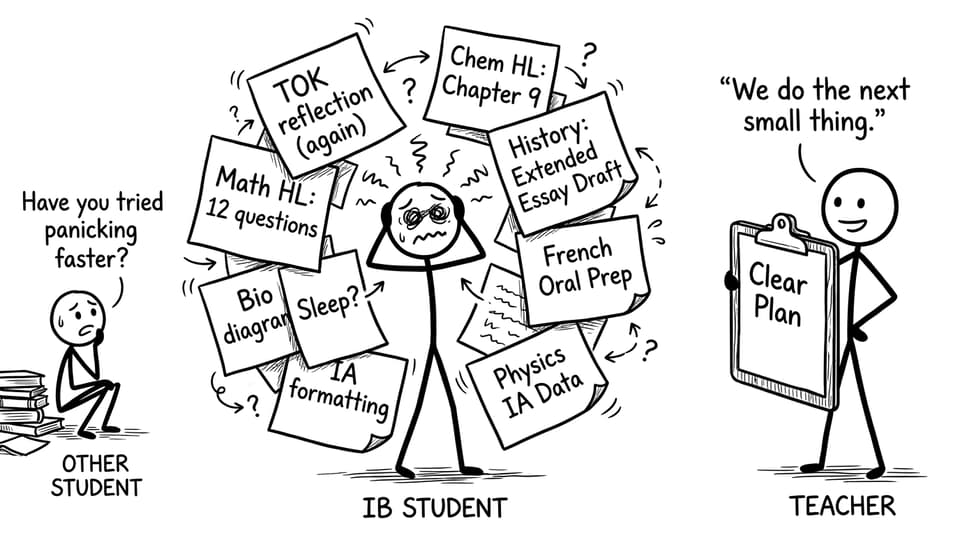
If you’re an IB student preparing for exams, you don’t need teachers to “remove pressure.” You need them to reduce uncertainty. Because uncertainty is what turns revision into panic, and panic into blank pages.
The good news: small teaching moves can change the emotional temperature of a class quickly. When those moves are paired with a clear system (like RevisionDojo), exam season stops feeling like chaos and starts feeling like a plan.
Quick checklist: what actually reduces IB exam stress
If your classroom could use a calmer baseline, these are the highest-return habits:
-
Make exam stress discussable (not dramatic, just normal)
-
Replace vague revision with specific next steps (topic + skill + time)
-
Use low-stakes timed practice weekly (small doses)
-
Give fast feedback loops (so students don’t guess what “good” is)
-
Track progress visually (so improvement feels real)
RevisionDojo supports every step of this through Study Notes, Flashcards, Questionbank, AI Chat, Grading tools, Predicted Papers, Mock Exams, the Coursework Library, and Tutors.
Why IB exam stress hits so hard
Stress in IB isn’t just “students being nervous.” It’s a predictable outcome of how the programme feels from the inside:
The workload is wide, not just heavy
Six subjects means switching mental gears constantly. Add TOK, EE, and internal deadlines, and it’s easy to feel like revision never truly begins.
The stakes feel personal
Even when universities look at more than final exams, many students experience IB results as a judgement of their intelligence, not just performance.
Revision is often invisible
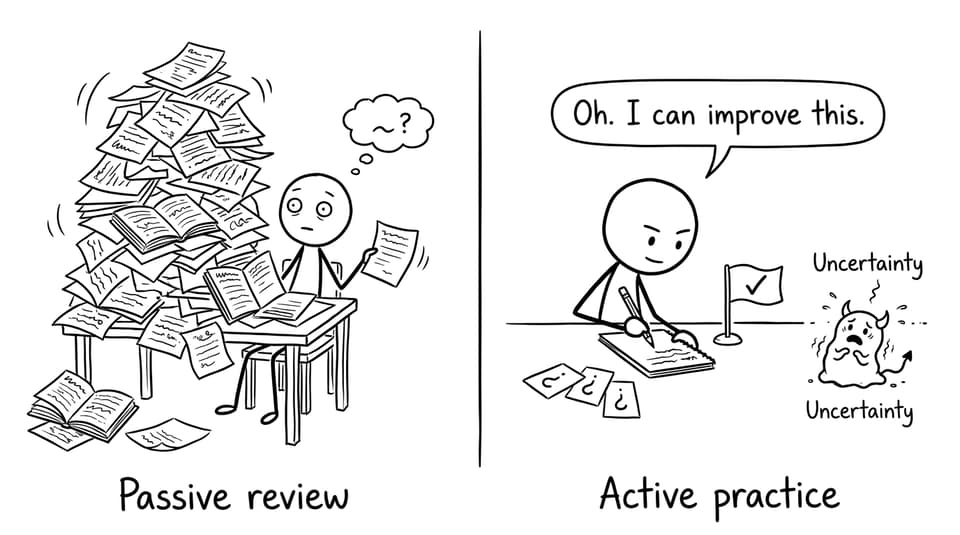
If a student rereads notes for three hours, they can feel “busy” while getting no proof they’re improving. That gap between effort and evidence creates anxiety.
For a deeper look at the emotional side, see Fear of Falling Behind in IB (And Why It’s Normal).
The teacher moves that reduce IB stress (without lowering standards)
Turn “study more” into “study next”
The fastest way to calm an IB student is to remove decision fatigue. Teachers can do this by naming the next step in a way that can be started immediately.
Example:
-
Not: “Revise Topic 4.”
-
Yes: “Do 12 Topic 4 questions, review mistakes, write 2 error rules.”
This is exactly where a structured platform helps. With RevisionDojo’s Questionbank, students can practice by topic and stop guessing what to do.
If you want the student version of this strategy, share: How to Study for IB Exams Without Burning Out.
Make active practice the default (not rereading)
Most IB stress is amplified by passive revision. It feels safe, but it doesn’t build exam confidence.
Instead, teachers can build a simple rule into class culture: understanding is proven by retrieval.
-
Use Study Notes to clarify quickly
-
Then use questions to test memory and technique
-
Then review mistakes immediately
That loop is what RevisionDojo is designed for, and it’s why its all-in-one approach matters: IB Revision Made Easy With RevisionDojo All-in-One.
Use timed exposure to make exams feel familiar
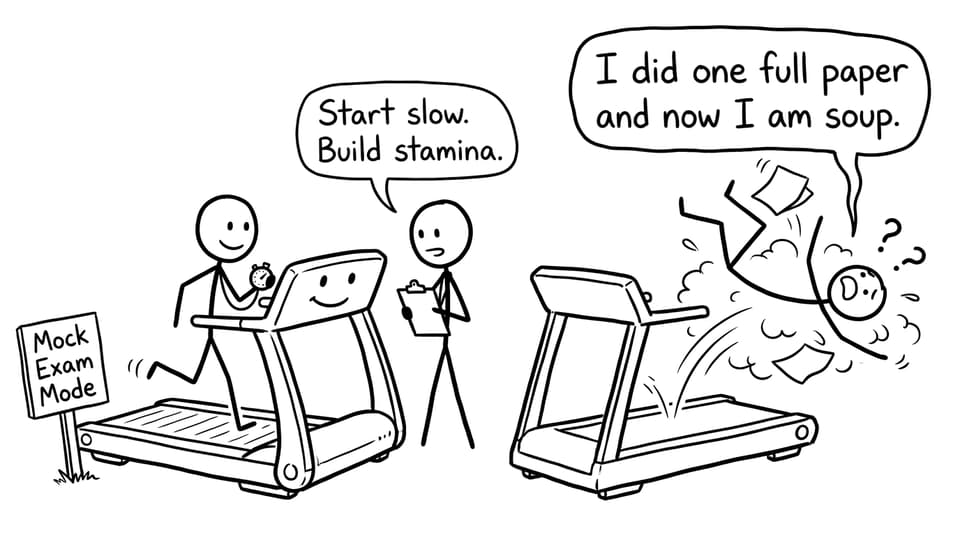
Students don’t panic because they’re weak. They panic because the exam environment feels rare.
Teachers can reduce IB exam stress by making “exam conditions” normal in tiny doses:
-
10 minutes timed, once per week
-
One question set, strict timing
-
Quick reflection: What cost marks? What will change next time?
RevisionDojo supports this with Mock Exams and realistic Predicted Papers for rehearsal (without needing to build everything from scratch). Helpful reading: Best IB Mock Exam Platform: Why Students Pick RevisionDojo and IB Predicted vs Specimen Papers: What They Mean.
Teach a reset protocol for “blank moments”
A calm class isn’t a class that never panics. It’s a class that knows what to do when panic shows up.
Teachers can explicitly teach a short reset routine (and rehearse it during timed practice):
-
Exhale slowly
-
Scan the question and underline the command term
-
Write three keywords you know are true
-
Start with the easiest available mark
Students can read more here: Why Your Brain Freezes During IB Exams and How to Stay Calm During IB Exams.
Reduce background stress from coursework uncertainty
Many IB students carry silent stress from IAs, EE, and TOK, even while revising for exams. When that uncertainty sits in the background, it drains focus.
This is where RevisionDojo’s Grading tools and Coursework Library are more than “extras”; they reduce the mental noise of not knowing what quality looks like.
A simple classroom routine teachers can run with RevisionDojo
If you’re an IB student, you can suggest this to your teacher (or run it yourself):
-
10 minutes: targeted RevisionDojo Study Notes (one subtopic)
-
20 minutes: Questionbank practice on that same subtopic
-
10 minutes: review mistakes + create 3 Flashcards from errors
-
Optional: ask AI Chat to explain one confusing step in simpler language
This is the kind of routine that builds calm because it produces evidence.
FAQ
How can IB teachers help students who “know it” but panic in exams?
Panic is often a context problem, not a knowledge problem. The brain can retrieve information in a calm classroom, then fail under time pressure and silence. Teachers help most by making exam conditions less rare through short, frequent timed tasks. They also help by normalising the physical reality of stress: fast heart rate, shaky hands, blank moments. Once students expect those sensations, they stop interpreting them as failure. Tools like RevisionDojo make this easier because timed practice, instant feedback, and progress tracking create familiarity and control. Over time, the student learns: “I’ve felt this before, and I still performed.”
What should an IB teacher do if students revise hard but don’t improve?
First, the teacher should separate effort from strategy. Many IB students work intensely but spend too much time rereading and rewriting rather than retrieving and applying. The next step is to demand measurable proof each session: questions attempted, accuracy, and specific mistake patterns. When feedback is delayed, students keep repeating the same errors, which feels like being stuck in mud. A faster loop changes everything: practice, check, correct, reattempt. Using a structured Questionbank plus Flashcards and quick concept repair through Study Notes gives students a clearer path to improvement. Improvement reduces stress because it restores trust in the process.
Can a platform really reduce IB exam stress, or does it just add more work?
A platform adds stress when it adds choices. It reduces stress when it removes choices and builds a routine. RevisionDojo is most useful when teachers use it as a shared system: one place for practice, feedback, and next steps. Students stop spending energy hunting for resources or guessing what matters. They also get quicker proof of progress through instant feedback and progress tracking. Features like AI Chat and Tutors reduce the “stuck spiral,” where one confusing concept derails an entire evening. When the system is clear, students can work less frantically and still improve.
A calmer IB exam season is built, not wished for
The secret is not motivation. It’s predictability.
When IB teachers replace vague pressure with clear routines, when practice becomes frequent and feedback becomes fast, stress stops being a fog and becomes a signal: “Here’s what we train next.”
If you want that structure in one place, explore RevisionDojo for Schools and build a shared revision system using Questionbank, Study Notes, Flashcards, AI Chat, Grading tools, Predicted Papers, Mock Exams, the Coursework Library, and Tutors.