



In the final stretch before IB exams, a strange thing happens to otherwise rational students.
You start treating learning like packing a suitcase five minutes before leaving: shove in as much as possible, sit on it, hope the zip holds.
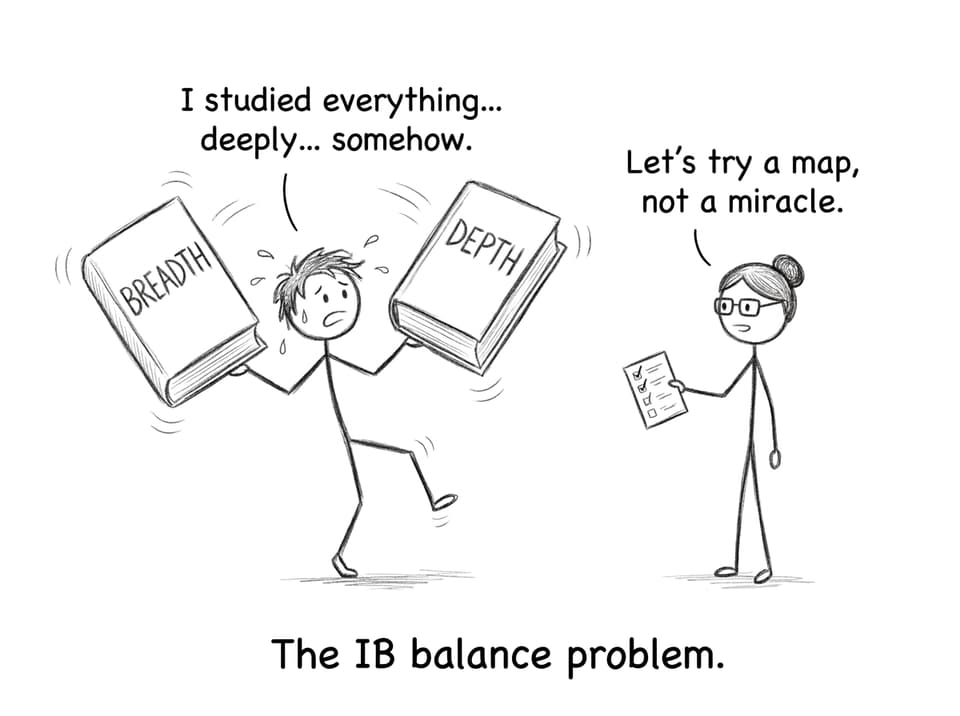
That’s the IB breadth problem. And if you react by obsessing over one gorgeous, tiny corner of the syllabus until you can write a dissertation on it, that’s the IB depth problem.
Great IB teachers don’t pick sides. They help you build a mind that can move between coverage and understanding on command, because that’s what the IB exams reward.
Below are practical ways teachers can help you balance breadth and depth, plus how you can mirror those moves using RevisionDojo so your revision feels structured instead of heroic.
A quick IB checklist: breadth and depth without burnout
If you want the “do this first” version, use this short loop. It keeps IB learning balanced week after week.
-
Get a clear syllabus map (topics, subtopics, command terms).
-
For each topic, learn the “core story” in 5-8 sentences.
-
Practice mixed-topic questions to protect breadth.
-
Do one deep dive per week (a hard concept, case study, or essay plan).
-
Use fast feedback to correct misunderstandings immediately.
-
Track what you can recall under time pressure, not what you recognize.
A lot of students build this system inside RevisionDojo using Study Notes, Flashcards, and the Questionbank (plus AI Chat when confusion hits at 9:47 pm).
What “breadth vs depth” really means in IB exams
Breadth is syllabus coverage: you can answer questions across the full range of what the IB can ask.
Depth is transfer: you can explain, justify, compare, evaluate, and apply ideas when the question is unfamiliar.
In most IB subjects, your exam experience silently demands both:
-
Breadth shows up when questions jump topics quickly, or when papers sample widely.
-
Depth shows up when you must build an argument, interpret data, evaluate sources, or sustain analysis.
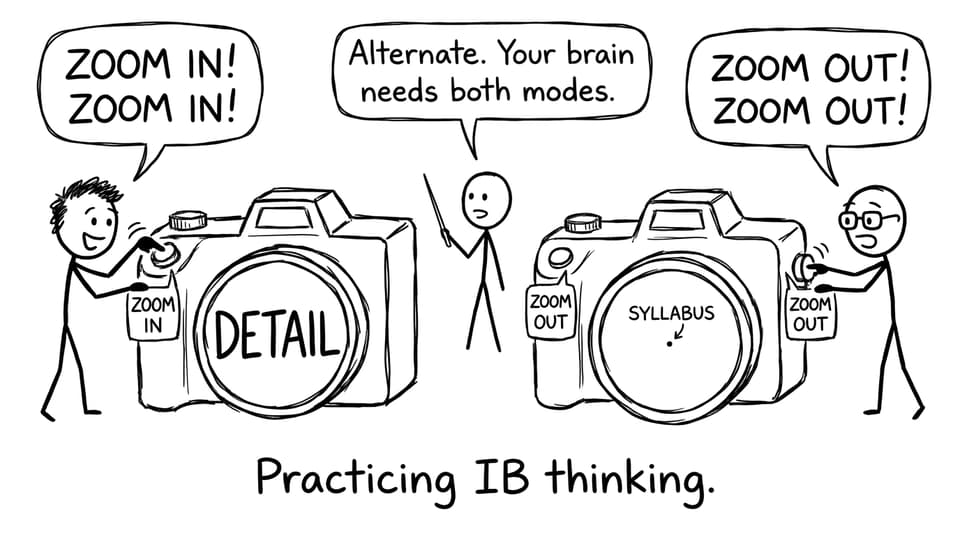
The trap is thinking you have to choose. The better move is rhythm: zoom in, zoom out, repeat.
How IB teachers help you balance breadth and depth (and how you can copy it)
They teach you to “map the syllabus,” not just memorize it
Strong IB teachers make the syllabus feel like a connected landscape rather than isolated chapters. They cluster concepts, reuse big themes, and point out recurring command terms.
As a student, you can replicate this by making your revision “topic-connected”:
-
Start with a clean topic overview using RevisionDojo for IB.
-
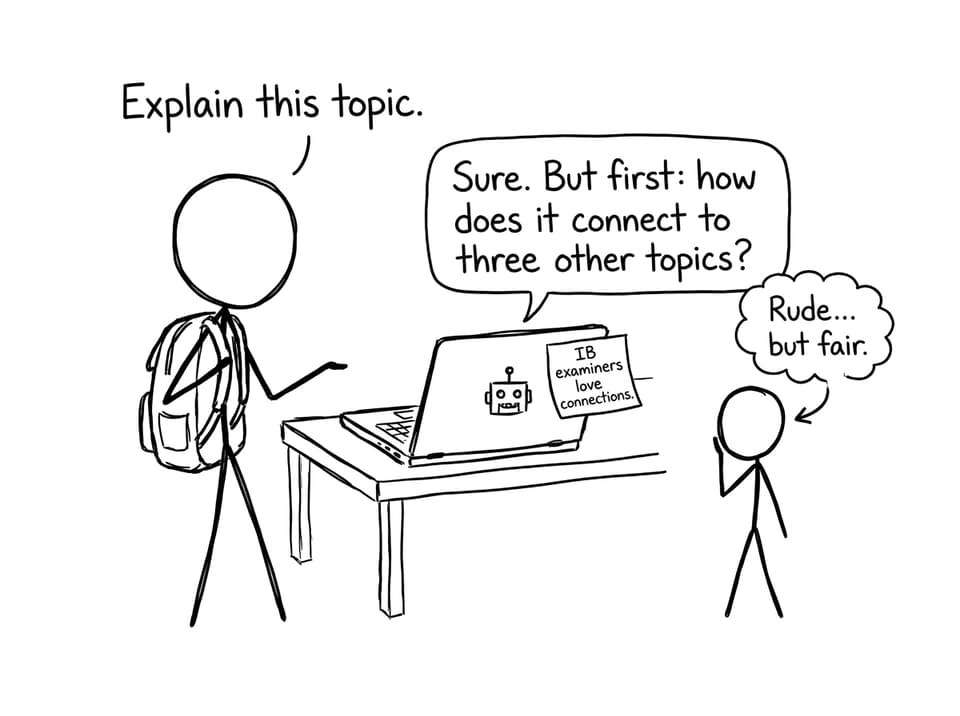
Read one section of notes, then write: “This connects to ____ because ____.”
-
Build a mini set of mixed questions to force cross-topic thinking.
If you want a notes workflow that supports that style, see Use RevisionDojo Notes to Boost IB Retention.
They ask layered questions that pull you from recall into reasoning
In the best classrooms, teachers don’t stop at “what is it?” They push you up the ladder:
-
What is it?
-
Why does it work?
-
When does it fail?
-
What would you predict if the conditions changed?
-
How would you evaluate two explanations?
That’s depth built on top of breadth.
You can practice the same ladder at home using the Questionbank and marking your own answers honestly: did you just state, or did you explain and justify?
For a practical workflow, read IB Question Bank | How to Use It Effectively.
They alternate “coverage lessons” with “deep practice” on purpose
Some weeks need coverage: you can’t analyze what you haven’t met yet.
Other weeks need depth: you can’t earn top marks if everything stays surface-level.
A good IB teacher deliberately alternates:
-
A broad sweep lesson (key definitions, frameworks, and typical question styles)
-
A deep practice lesson (one hard prompt, careful feedback, rewrite)
At home, you can mimic this by pairing:
-
Short, structured reading from Study Notes
-
A tight daily recall habit using IB Flashcards with Spaced Repetition (SRS)
-
Then one timed set weekly using Mock Exams and Predicted Papers inside the RevisionDojo app
If you want the full “one platform” workflow, see RevisionDojo App: The Smarter Way to Prep for IB Exams.
They use comparisons to create depth quickly
Comparison is a cheat code for depth because it forces you to define criteria and make judgments.
Teachers do this with:
-
two case studies
-
two interpretations
-
two models
-
two texts
-
two policies
You can do the same in revision by making “either/or” prompts:
-
“Which explanation is stronger, and under what assumptions?”
-
“Where does this model break down?”
-
“What changes if I switch context?”
This is where AI Chat becomes genuinely useful: not for answers, but for better questions. You can ask Jojo to generate comparison prompts and then grade your reasoning.
Explore it here: Jojo AI.
They make feedback visible, specific, and fast
Depth doesn’t come from “study harder.” It comes from finding the exact place your thinking goes wrong and repairing it.
Good IB teachers:
-
name the misunderstanding
-
show what the markscheme rewards
-
ask you to try again while it’s still fresh
You can build a similar loop with RevisionDojo’s Grading tools (for written responses and diagrams), plus the Coursework Library when you need exemplars that model what “depth” looks like.
If you’re studying in a school context, your teachers can also use RevisionDojo for Schools to assign targeted practice, track coverage, and spot gaps early.
A simple weekly structure IB teachers would approve of
Borrow this as your default IB routine (and adjust based on your subjects and energy).
-
2 sessions (breadth): mixed-topic recall + short Questionbank sets
-
2 sessions (depth): one hard prompt, one essay plan, one data response, or one extended problem
-
1 session (integration): timed practice + review mistakes by pattern
-
Daily (10 minutes): flashcards, no exceptions
If you need more technique ideas to plug into that structure, see 10 Proven Study Techniques for IB Students and Revision Tips: Build a Study Routine That Works.
FAQ
How can IB teachers help if I’m stuck in memorization mode?
In the IB, memorization is sometimes necessary, but it’s rarely sufficient. A good teacher will notice when your answers sound correct yet stay shallow, then push you toward explanation and justification. They might change the question type, add a counterexample, or ask you to apply the idea in a new context so you can’t rely on rehearsed phrases. They will also model what “enough” detail looks like, because many students over-memorize trivia and under-practice reasoning. You can mirror this by doing Questionbank sets and forcing yourself to write one extra sentence: “This matters because…” or “This happens when…”. Over time, that extra sentence becomes your default, and your IB answers start sounding like thinking, not copying.
What if I go too deep into one topic and ignore the rest of the IB syllabus?
This is common, especially if one unit feels interesting or safe. Teachers fix it by building routines that include “breadth checks”: short, mixed-topic quizzes that make gaps obvious without shame. They also help by showing you the opportunity cost: depth in one topic does not compensate for blank pages elsewhere in the IB exam. Practically, you can protect breadth with a rotating schedule and by using flashcards that mix topics rather than staying in neat chapter order. RevisionDojo helps here because the Questionbank and Flashcards make it easy to keep multiple topics alive at once. The goal is not to abandon depth, but to earn the right to go deep by keeping the whole syllabus within reach.
How do I know whether I need more breadth or more depth for my IB exams?
A teacher will usually diagnose this by looking at your performance patterns. If you miss many short questions across many topics, you likely need breadth: clearer baseline knowledge and more coverage. If you score decently on recall but stall on evaluation, unfamiliar contexts, or extended responses, you likely need depth: better reasoning, structure, and flexibility. You can self-diagnose with timed practice: breadth problems feel like “I never learned this,” while depth problems feel like “I learned it, but I can’t use it.” Using RevisionDojo, you can test quickly with a mixed Questionbank set, then zoom in on the topics where your explanations collapse. That loop gives you a calm answer to a stressful question: what to do next in IB revision.
Closing: the IB balance is a skill, not a personality trait
Some students are naturally broad. Some are naturally deep. The IB asks you to become both, on purpose.
The best teachers don’t just deliver content; they teach the rhythm: map the syllabus, zoom in, zoom out, practice under time, fix the exact mistake, repeat.
If you want that rhythm outside the classroom, build your system inside RevisionDojo: learn with Study Notes, retain with Flashcards, prove it with the Questionbank, get unstuck with AI Chat, sharpen with Grading tools, and train confidence with Mock Exams and Predicted Papers. Your goal isn’t to study everything. It’s to study like the IB tests: wide, deep, and connected.