
A quick hook: the “99% the same” problem
In IB Biology, you hear it early: humans share more than 99% of their DNA. That sounds like a nightmare for identification. If we’re all basically the same, how can scientists compare two people with confidence?
The answer is quietly elegant. DNA profiling doesn’t try to read your whole genome. It focuses on a few places where people naturally differ a lot, then turns those differences into a pattern you can compare like a barcode. Once you see the workflow, many exam questions start feeling predictable.
DNA profiling in one exam-ready checklist (IB Biology)
For IB Biology exam answers, think in this order:
-
Choose variable regions: short tandem repeats (STRs)
-
Collect and extract DNA (blood, saliva, hair root, skin cells)
-
Use PCR to amplify STR loci
-
Separate fragments by size using gel electrophoresis (or capillary electrophoresis)
-
Compare banding patterns (or peaks) across multiple STR loci
If you can explain that chain clearly, you can pick up easy method marks.
Why STRs are perfect for comparing individuals
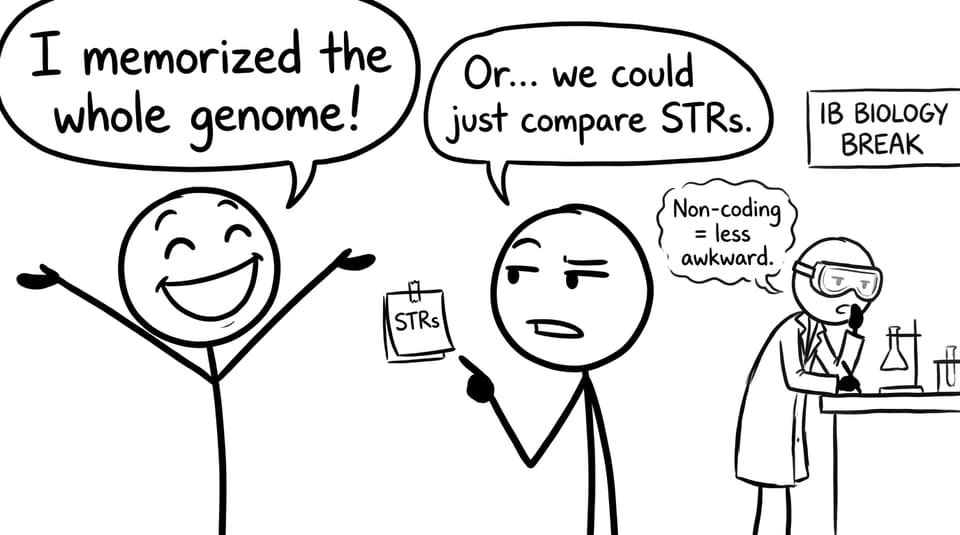
STRs are short DNA sequences repeated back-to-back (for example, “GATA” repeated many times). Two unrelated people usually have different numbers of repeats at the same STR location, which means they produce DNA fragments of different lengths.
In IB Biology, this matters because it connects genotype variation to a measurable lab result. Scientists don’t need to know what the STR “does” (it’s often non-coding). They just need it to vary a lot between individuals and be easy to measure.
To build a convincing comparison, scientists analyze many STR loci. A match across many loci makes the probability of a random match extremely low.
PCR: making enough DNA to actually test
Real samples are often tiny or degraded. That’s where PCR becomes the workhorse.
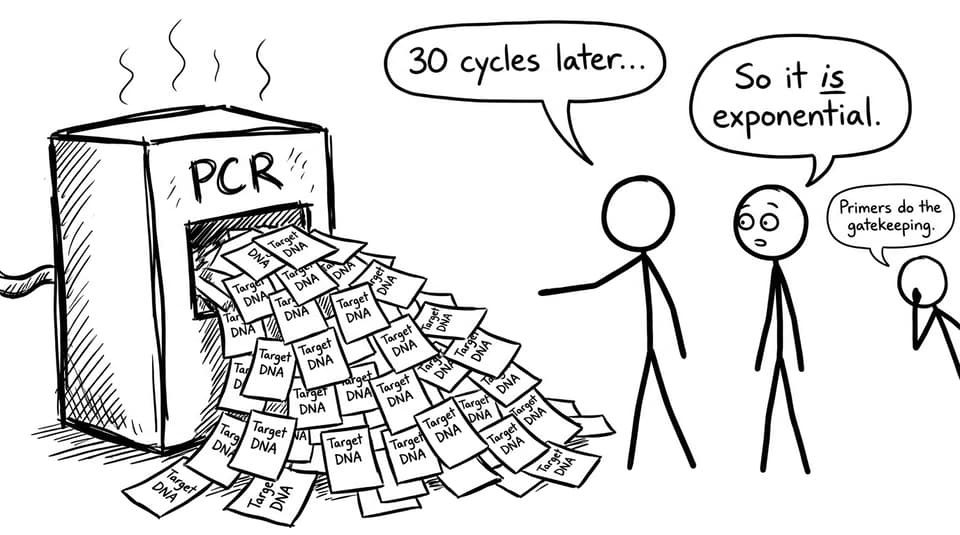
PCR uses primers that flank the STR region you care about. Through repeated cycles (denaturation, annealing, extension), PCR produces millions to billions of copies of those STR fragments. In IB Biology, exam questions often reward you for emphasizing that primers provide specificity: only the target loci are amplified.
If you want a crisp refresher before drilling questions, use How PCR Amplifies Specific DNA Sequences and the matching PCR and Gel Electrophoresis Flashcards.
Gel electrophoresis: turning STR lengths into a visible pattern
After PCR, you have a mixture of amplified STR fragments. Gel electrophoresis separates those fragments by size.
Key IB Biology points:
-
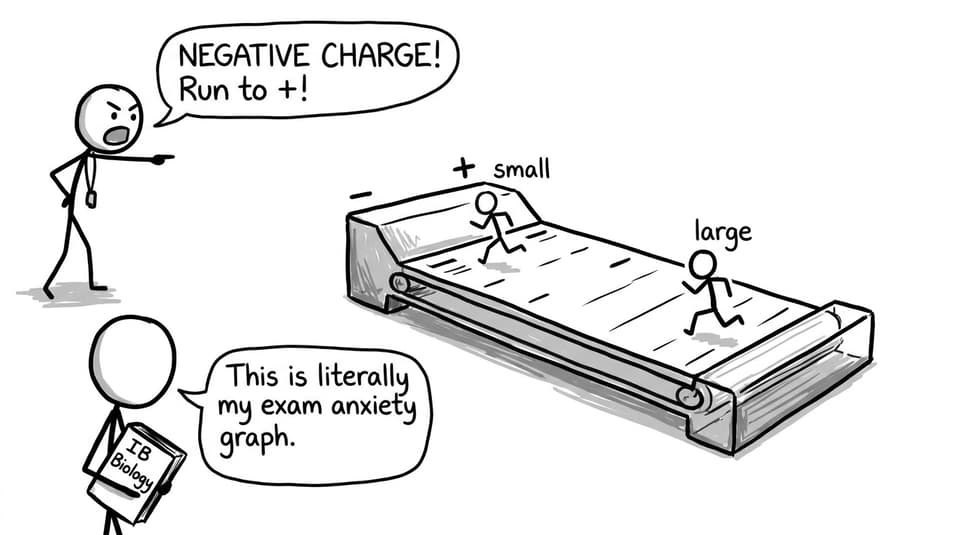
DNA is negatively charged (phosphate backbone)
-
It moves toward the positive electrode
-
Smaller fragments move faster/further through the gel matrix
The result is a banding pattern. That pattern is what scientists compare between samples.
For a deeper explanation you can borrow phrasing from in extended responses, see How Gel Electrophoresis Separates DNA Fragments and the supporting notes: PCR and Gel Electrophoresis Notes.
How scientists compare two individuals (what to say in IB Biology)
Comparison is straightforward: do the profiles align at each STR locus tested?
-
If bands (or peaks) match across many STR loci, the samples are extremely likely from the same individual.
-
If there are mismatches, the samples are from different individuals (or the sample is mixed/contaminated).
DNA profiling is used in forensics and family relationship testing, but a frequent IB Biology discussion point is privacy: STR profiling generally targets non-coding regions, so it identifies without directly revealing traits or disease risks.
Want to practice typical data-handling? Try the IB Biology Questionbank and DNA Replication Questionbank to build speed with gel tables and fragment logic.
Bringing it home: revise DNA profiling like a scientist
DNA profiling is powerful because it’s focused: STR variation, amplified by PCR, separated by electrophoresis, compared across many loci. That’s the story IB Biology examiners want you to tell.
To make it stick, use RevisionDojo as your lab bench: drill method questions in the Questionbank, tighten definitions with the IB Biology Glossary, and reinforce the workflow using Biology Cheatsheets. When you need instant clarity, RevisionDojo’s AI Chat, Study Notes, Flashcards, Grading tools, Predicted Papers, Mock Exams, Coursework Library, and Tutors help turn one confusing diagram into a confident, mark-scoring explanation.
If you’re revising IB Biology under time pressure, this is one topic where a clean process beats memorizing extra detail: method first, then meaning.