
IB Biology: Molecular clocks, and why time is hiding in your DNA
The night before an exam, time feels personal. Seconds sprint. Pages multiply. And yet evolution runs on a different schedule: quiet, enormous, and mostly invisible. In IB Biology, molecular clocks are the tool that lets you hear that long timescale again, not by staring at fossils, but by reading the tiny “tick marks” written into DNA.
A molecular clock doesn’t give perfect dates. It gives good estimates when fossils are patchy or missing. And that’s exactly why exam questions love it: it connects genetics, mutation, and evolution in one clean method.
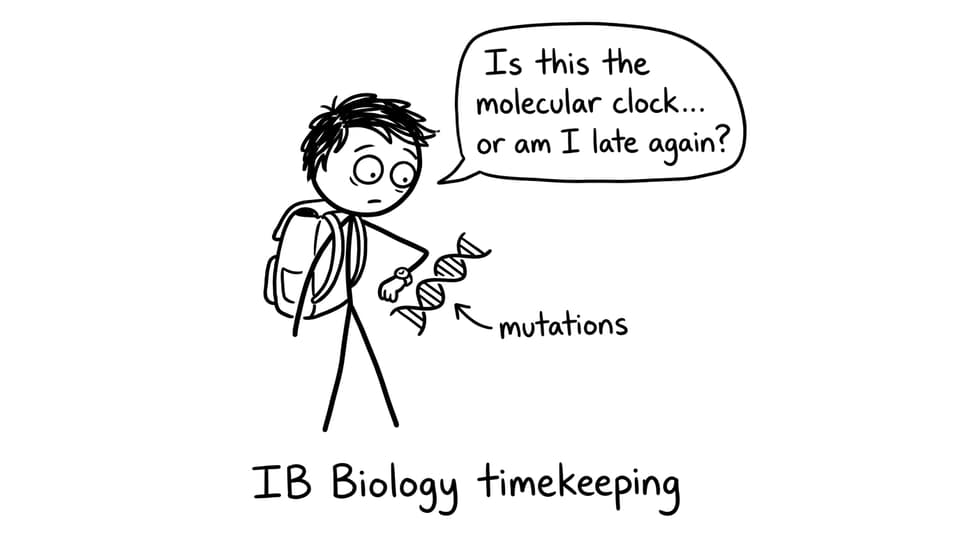
Quick checklist: how a molecular clock works (exam-ready)
For IB Biology responses, keep the method tight:
-
Choose a gene or protein that accumulates mutations at a reasonably steady rate.
-
Compare homologous sequences between two species.
-
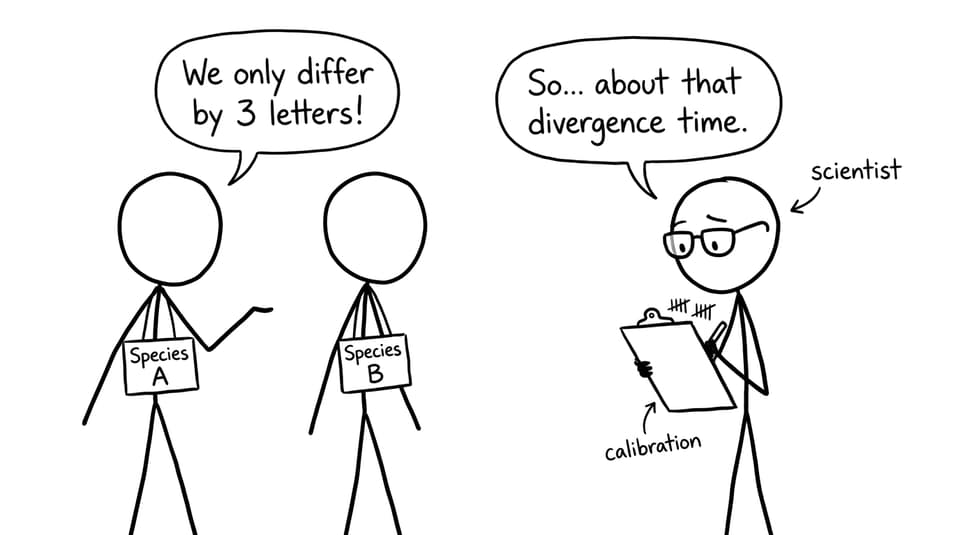
Count sequence differences (base substitutions or amino acid changes).
-
Calibrate the clock using fossils or a known divergence event.
-
Convert “differences” into an estimated time since divergence.
If you need syllabus-aligned evolution context, start with A4.1 Evolution and speciation, then reinforce with exam practice in the A4.1 Questionbank.
What molecular clocks are really measuring in IB Biology
At the center of IB Biology molecular clocks is a simple claim: mutations accumulate over time. Not every gene changes at the same pace, and not every lineage has the same “speed,” but many sequences change predictably enough to act like a clock.
That’s why slow-changing sequences (like rRNA genes) help with ancient splits, while faster-changing regions help with recent divergences. If two species have very similar sequences, they likely split relatively recently. If they have many differences, they likely split longer ago.
To tighten your understanding of mutation itself (the “ticks” of the clock), pair this topic with D1.3 Mutations and gene editing and the clearer breakdown in How DNA Mutation Creates New Alleles.
Calibration: the part students forget (and examiners reward)
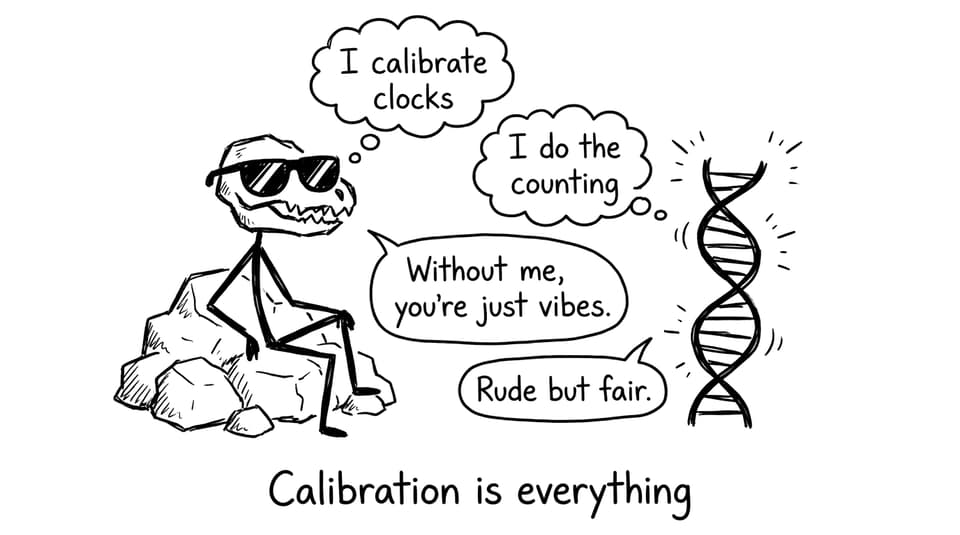
A molecular clock can count differences, but it can’t translate them into years unless you calibrate it.
Calibration means anchoring the clock to something with a known date: a fossil boundary, a geological event, or a well-supported divergence time from the fossil record. Once scientists know (for example) that two lineages diverged around a certain time, they can estimate a mutation rate for that gene. Then they apply that rate to other comparisons.
This is also where IB Biology questions often ask for evaluation: molecular clocks are powerful because fossils can be incomplete, but clocks also depend on fossil calibration to turn “differences” into “time.”
If you want an evolution evidence refresher that links fossils and molecular data, use 5.1 Evidence for evolution Notes.
Limits of molecular clocks (how to write the evaluation point)
In IB Biology, you don’t just describe tools; you judge them.
Molecular clocks can be thrown off because mutation rates are not perfectly constant. Generation time, selection pressures, and DNA repair efficiency can all shift rates across lineages. That’s why researchers often compare multiple genes and apply statistical models to reduce error.
A strong exam-style line sounds like: “Molecular clocks provide estimates rather than exact dates; reliability increases with calibration points and multiple independent genes.”
For quick terminology checks before you write, the IB Biology Key Definitions page helps you stay precise.
Bring molecular clocks into your RevisionDojo routine
If molecular clocks feel abstract, treat them like a skill: describe the steps, explain calibration, then evaluate reliability. RevisionDojo makes that practice systematic with Study Notes, Flashcards, and the Questionbank for timed exam-style application. When you want feedback on your phrasing, AI Chat helps you refine definitions and evaluation points, and Grading tools can show what an examiner would reward. For full-topic confidence, combine Mock Exams, Predicted Papers, and the Coursework Library so your IB Biology knowledge stays connected, not memorized in fragments. When you’re ready, a RevisionDojo Tutor can turn weak spots into predictable marks.