


A quick story about “profit” that usually gets missed
You can feel a business slipping into panic long before the numbers show it. A cafe looks busy, the queue is real, and the espresso machine never stops hissing. But at the end of the month, the owner still says, “We’re not making profit.”
In IB Business Management, that moment is a gift. It reminds you that profit is not only about selling more. It is about what happens underneath sales: fixed costs that sit there like a monthly subscription to reality, and variable costs that quietly multiply with every unit you produce.
Fixed and variable costs: the exam-ready definitions
In IB Business Management, keep the definitions clean:
-
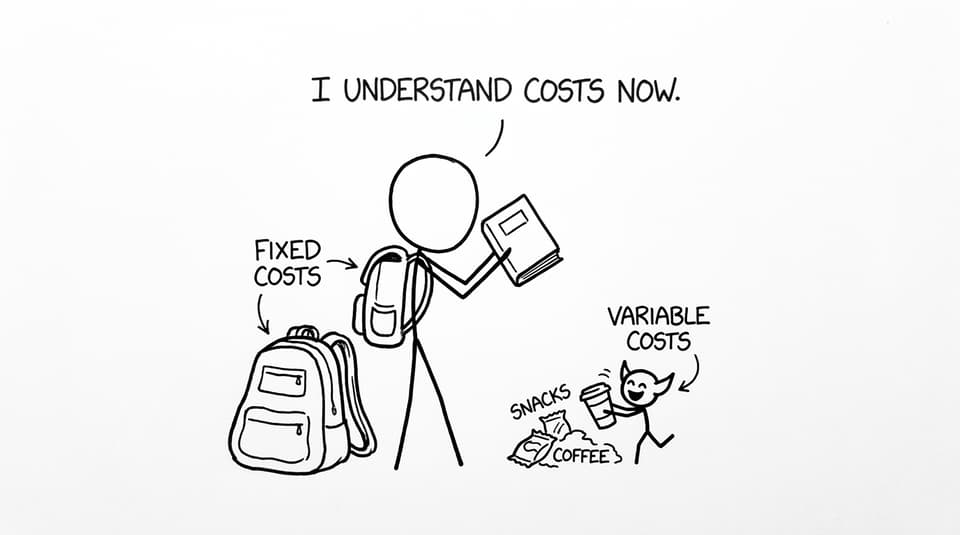
Fixed costs stay the same (in the short run) regardless of output. Think rent, insurance, salaried staff.
-
Variable costs change with output. Think raw materials, packaging, hourly wages, sales commission.
If you want a crisp comparison with examples, use this as your anchor: Fixed and variable costs explained.
How costs decide whether you can make profit
Fixed costs create the “baseline” you must cover
Fixed costs set the minimum revenue a business needs just to survive the month. High fixed costs increase operating leverage: once you cover them, extra sales can boost profit quickly, but until then, every slow week feels dangerous.
This is why firms with heavy machinery leases or premium locations often obsess over sales volume. They are not being dramatic. They are responding to their cost structure.
Variable costs shrink (or protect) profit per unit
Variable costs affect contribution: how much each unit contributes toward paying fixed costs and then generating profit.
When variable costs rise, contribution per unit falls. That can force a business to:
-
increase price,
-
find cheaper inputs/suppliers,
-
redesign the product to reduce waste,
-
accept lower margins.
To connect this to how IB marks calculations, review the formulas inside: Aspects of a break-even chart notes.
Break-even point: where fixed and variable costs meet revenue
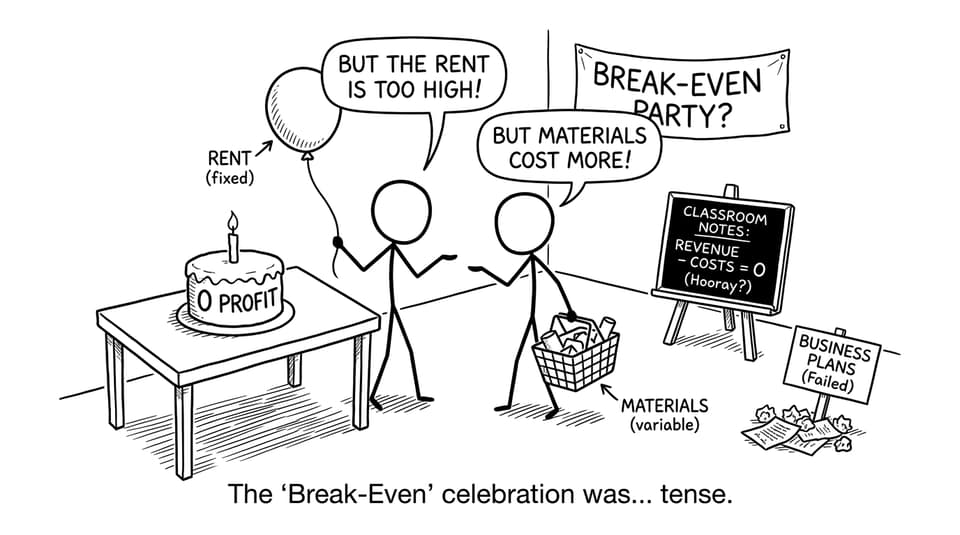
Break-even is the point where total revenue = total costs. That is why it sits at the center of IB Business Management finance questions.
A useful memory structure:
-
Higher fixed costs == higher break-even output.
-
Higher variable costs == lower contribution == higher break-even output.
-
Higher price (if demand allows) == higher contribution == lower break-even output.
If you want a sharp explanation of how managers actually use this tool, see: How businesses use break-even analysis and the topic hub: 5.5 Break-even analysis.
What to write in evaluation: pricing, risk, and real-world messiness
Pricing decisions
Costs shape the “floor” under your price. In IB Business Management, you can evaluate price changes using break-even logic: changing price changes contribution, which changes the break-even quantity. This is exactly what this resource practices: Effects of changes in price or cost on break-even.
Risk exposure
-
High fixed costs == higher risk in a downturn (you still pay rent).
-
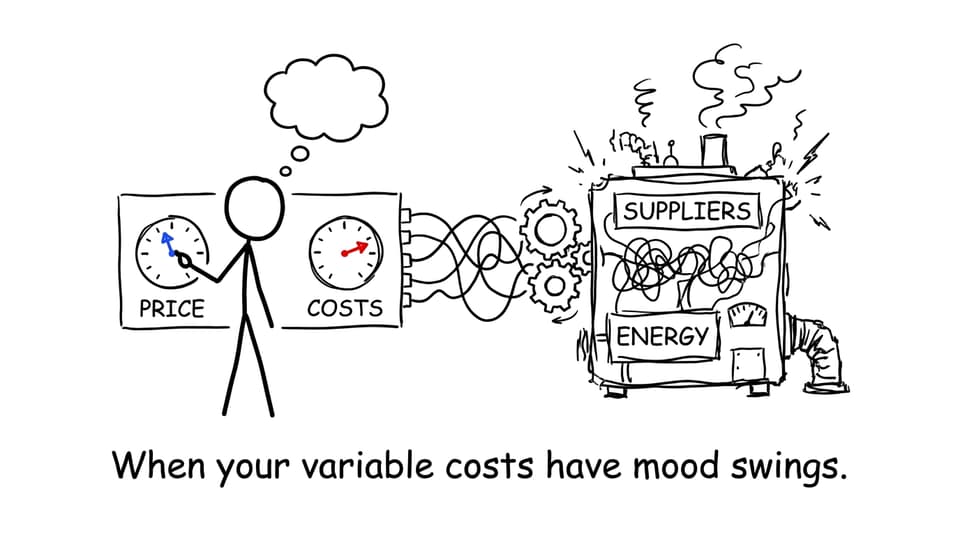
High variable costs == higher sensitivity to input price swings (materials jump, margins collapse).
For top-band evaluation, mention assumptions and limitations: Limitations of break-even analysis.
A fast revision checklist (before you attempt questions)
-
Can you classify costs correctly (fixed vs variable vs semi-variable)?
-
Can you write the total cost relationship: Fixed costs + (variable cost per unit × output)?
-
Can you explain contribution and link it to break-even?
-
Can you evaluate how a change in costs affects profit and risk?
Then go practice in exam style: Break-even analysis Questionbank and strengthen fundamentals in Unit 3: Costs and revenues Questionbank.
Your next step (and the fastest way to improve)
In IB Business Management, fixed and variable costs are not just definitions. They are the logic behind break-even, pricing, and risk, which is why they keep showing up in exam questions.
If you want this to feel automatic, use RevisionDojo to cycle the skill properly: learn with Study Notes and Flashcards, test with the Questionbank, then tighten exam technique with AI Chat feedback, Grading tools, Predicted Papers, and Mock Exams. When costs finally “click,” profit stops being a mystery and becomes a method.