


When the price rises but the factory can’t
In IB Economics, we love the neat story: price rises, firms produce more, the market settles. But real firms are not graphs. They’re rooms, machines, people, suppliers, and schedules. And sometimes they’re already running at 99% capacity, which means a higher price doesn’t create more output--it creates stress.
That tension is exactly what capacity constraints are: limits on how much a firm can produce in a given time period. For exam questions on supply, elasticity, and the price mechanism, capacity constraints are often the hidden reason a market doesn’t respond “smoothly” to price changes.

Quick exam checklist (what to mention)
When you see “firm response to price changes” in IB Economics, scan for these capacity constraints:
-
Physical limits (machines, factory space, equipment)
-
Labour limits (hiring, training, skill shortages)
-
Input bottlenecks (raw materials, components, energy)
-
Fixed capital (time needed to expand big assets)
-
Operational risk (quality drops, breakdowns, overtime costs)
To anchor definitions, revise the law of supply in The law of supply notes and how diagrams should look in The supply curve notes.
Capacity constraints and price elasticity of supply (PES)
Capacity constraints are a core reason PES is often inelastic in the short run. In IB Economics, short run means at least one factor of production is fixed. If the factory size or key machinery is fixed, a price increase cannot instantly create more supply.
That’s why in many markets, price changes lead to bigger price swings and smaller quantity adjustments. The price signal is loud, but the firm’s ability to answer it is quiet.
If you want a PES refresher with exam-style practice, use Price elasticity of supply (PES) questionbank alongside RevisionDojo’s Grading tools to see what examiners reward.

The main ways capacity constraints block supply responses
Physical production limits
A factory can only run so many units per hour. Even if price jumps, the production line might already be running full shifts. In IB Economics essays, this is a clean explanation for why supply can be steep (inelastic) in the short run.
Tie this to market outcomes: limited output growth can cause shortages if demand rises. For equilibrium framing, connect to Understanding market equilibrium in IB Economics.
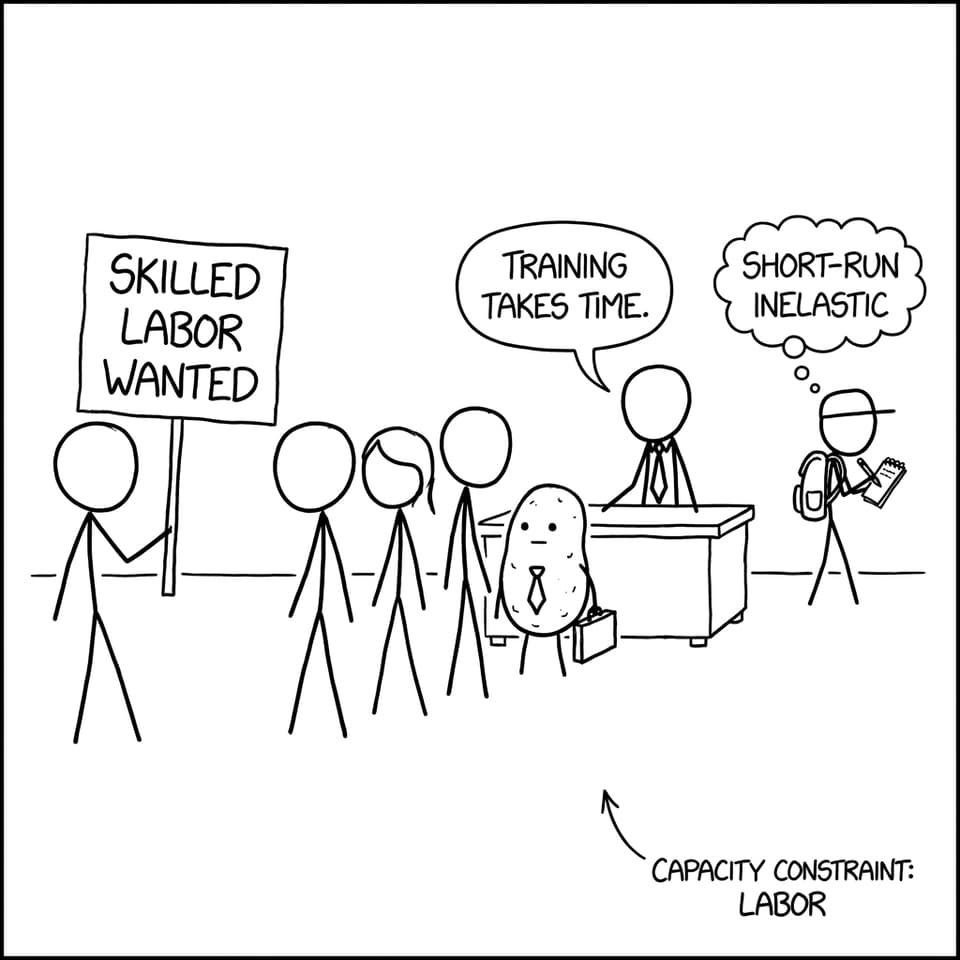
Labour constraints (the slowest “quick fix”)
Firms can’t conjure skilled workers instantly. Recruitment takes time. Training takes longer. And in tight labour markets, higher wages may raise costs before output rises.
In IB Economics, this is a great evaluation point: higher prices can increase revenue incentives, but labour scarcity means quantity supplied changes only slightly.
Input bottlenecks and supply chain constraints
Even if a firm has space and workers, it still needs inputs. If suppliers can’t scale up metals, microchips, packaging, or energy fast enough, the firm’s output is capped.
This is a strong “chain reaction” explanation in IB Economics: capacity constraints can sit upstream and still make downstream supply inelastic.
Fixed capital and time-to-build
Capital-intensive industries (airlines, shipping, heavy manufacturing) face slow expansion. New planes, ships, and machines take planning, investment, and delivery time.
This links perfectly to the short run vs long run discussion. For a tight long-run contrast, see Why does production time affect the elasticity of supply?.
Operational risk: why “just work harder” backfires
Running machines longer, pushing overtime, or skipping maintenance can raise output briefly, but it increases breakdown risk and quality issues. In IB Economics evaluation, this explains why firms might choose not to expand much even when prices rise: the marginal cost (and risk) climbs fast.
How to write this in an exam (a simple structure)
For Paper 1-style explanations in IB Economics, use:
-
Define capacity constraints and PES.
-
Explain short-run fixed factors.
-
Give 2–3 constraint channels (physical, labour, inputs).
-
Add evaluation: long run investment, tech, training, spare capacity.
To strengthen your micro foundations, revisit Define supply and demand (microeconomics essentials) and practice price-signal explanations with Functions of the price mechanism.
Closing: turn the “limit” into an exam advantage
Capacity constraints are the quiet reason many markets don’t behave like the simplest IB Economics diagrams. When price changes, firms don’t respond with instant quantity changes--they respond within the limits of machines, labour, inputs, and time.
If you want to turn this into marks, practice writing it with real exam phrasing using RevisionDojo’s Questionbank, check your structure with AI Chat, and sharpen evaluation using Tutors, Grading tools, and timed Mock Exams. Capacity constraints may limit firms--but they don’t have to limit your score.
