When you first learn price controls, they sound like a tidy fix. Make rent cheaper. Make wages fairer. Protect farmers from collapsing prices. In IB Economics, though, the story rarely ends where the intention begins. The moment a government tells a market “you may not go above” or “you may not go below,” the quiet information inside prices gets muffled. And markets respond the only way they know how: through incentives.
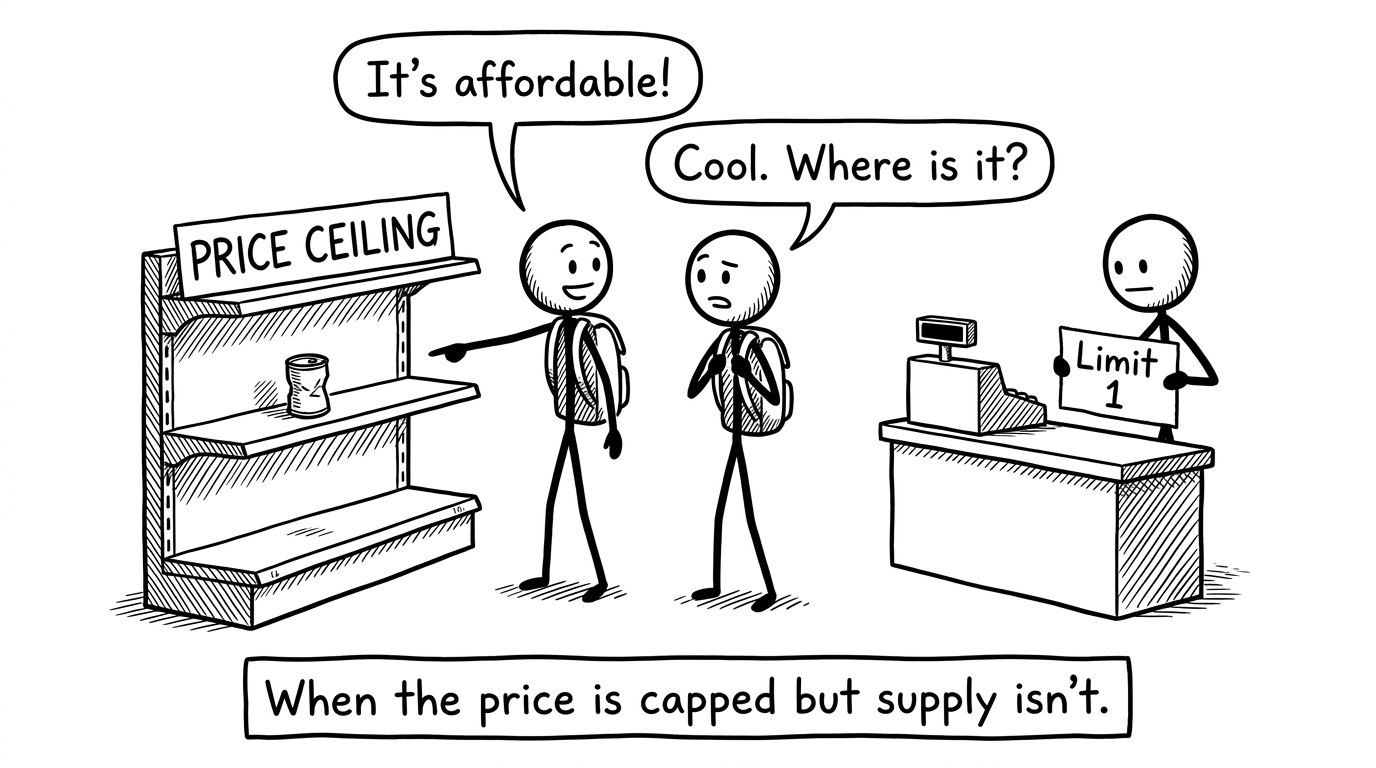
Empty shelf under a price ceiling
The quick exam checklist (what to look for)
For IB Economics essays and data response, train your brain to scan for these patterns:
Is the control set below equilibrium (price ceiling) or above equilibrium (price floor)?
Does it create a shortage (excess demand) or a surplus (excess supply)?
What “second-order effects” appear: black markets, non-price rationing, lower quality, government spending, or unemployment?
A price ceiling (maximum price) is typically set below the market equilibrium to improve affordability. In IB Economics, the unintended consequence is almost always the same starting point: shortage.
At the lower legal price, consumers want to buy more, but firms supply less because profit margins shrink or costs aren’t covered. That gap between quantity demanded and quantity supplied is where the real drama begins.
When the official price can’t rise, markets ration in other ways: time, connections, paperwork, or luck. Some sellers also start charging “off-the-books” prices, creating a black market that undermines the policy goal.
A ceiling can also lower quality. If landlords can’t charge market rent, they may delay repairs. If firms can’t price to reflect costs, they may cut corners or stop investing in capacity. In exam terms: allocative efficiency worsens, and dynamic efficiency can weaken too.
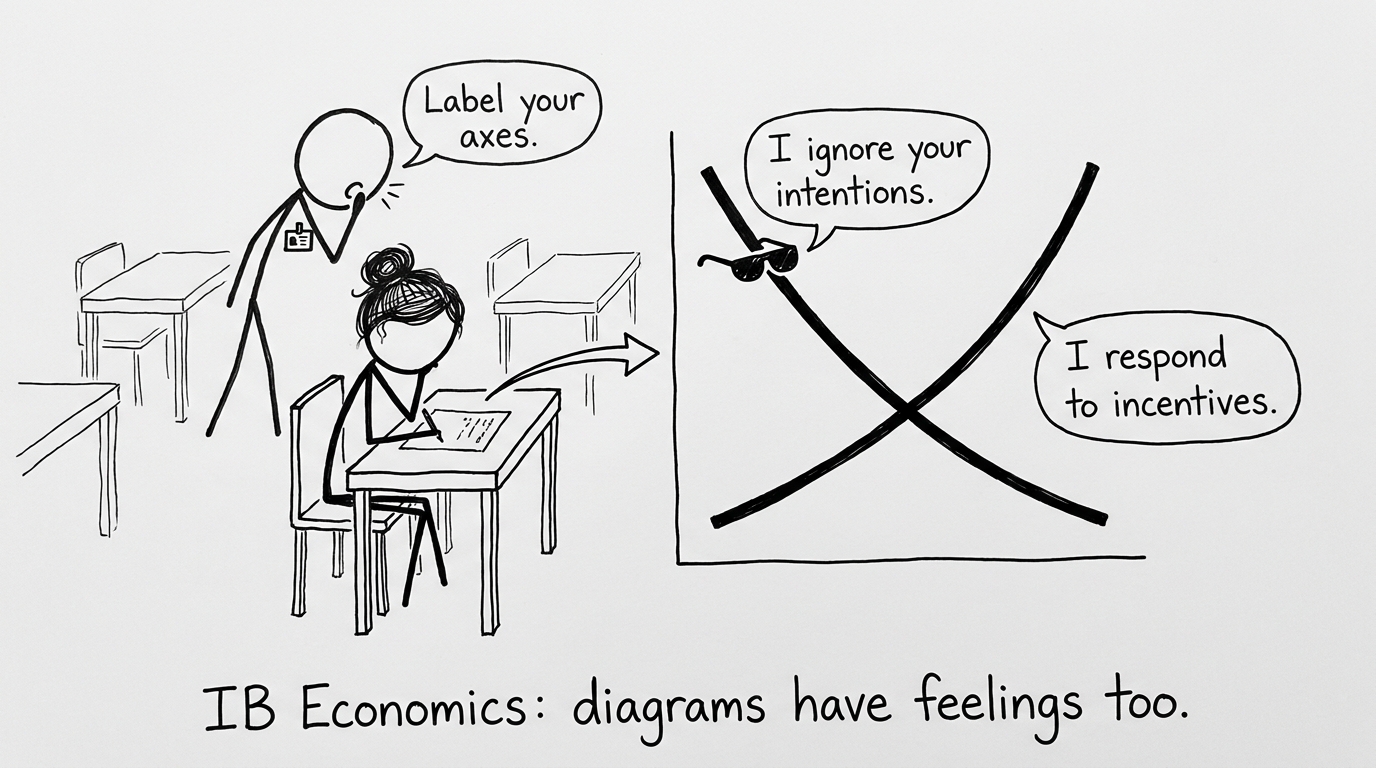
Student draws graph with moody curves
Why price floors create unintended consequences
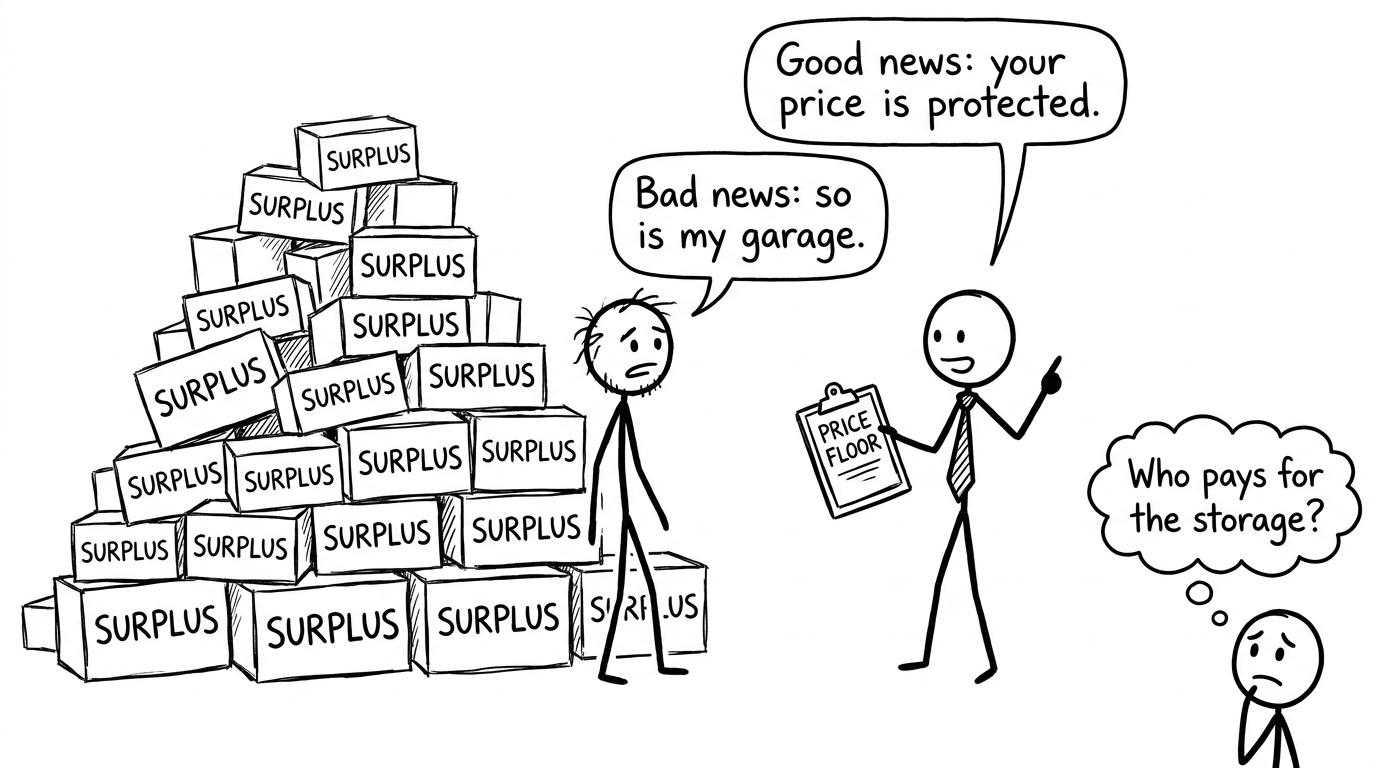
A price floor (minimum price) is usually set above equilibrium to protect producers or workers. In IB Economics, that often produces a surplus.
At the higher price, producers increase supply, but consumers reduce demand. Unsold output piles up, and the policy’s costs don’t stay hidden for long.
Surpluses can become taxpayer costs
Governments may purchase, store, or dispose of excess supply to maintain the floor. That means budgetary pressure and opportunity cost: money spent managing surplus can’t be spent elsewhere.
A labour market price floor (minimum wage) can raise incomes for some workers, but if set above equilibrium it may reduce the quantity of labour demanded, creating unemployment for others. In IB Economics, your evaluation should discuss size of the effect, elasticities, and complementary policies.
Farmer with surplus under price floor
How to turn this into top-mark answers
Unintended consequences happen because price controls stop prices from doing their core job: signalling scarcity and coordinating choices. If you can explain that clearly, your diagrams and analysis become much easier.
For targeted practice, use the Competitive Market Equilibrium Questionbank and the Microeconomics hub. Then tighten your definitions and evaluation with RevisionDojo’s Study Notes and Flashcards, and pressure-test your explanations using AI Chat and the Grading tools.
FAQ
Why do price controls still exist if IB Economics predicts problems?
Because politics values visible relief. A price ceiling feels like immediate help when prices spike, and a price floor feels like protection when incomes collapse. Those benefits are concentrated and easy to explain in a speech. The costs are often delayed or dispersed: longer waiting lists, lower quality, shortages, or higher taxes. In IB Economics, that gap between intention and outcome is exactly what examiners want you to discuss. Your evaluation should acknowledge the social goal, then explain the efficiency trade-offs.
Are price ceilings always bad in IB Economics terms?
Not always, but they are risky when supply can’t adjust. If a government pairs a ceiling with measures that increase supply (for example, subsidies, building incentives, or improved market access), the shortage can be reduced. In the short run, a ceiling can also prevent sudden hardship for low-income households. However, you still need to watch for non-price rationing and reduced investment incentives. In IB Economics essays, the best answers separate short-run benefits from long-run distortions. That balance is what earns evaluation marks.
Do price floors always create surpluses and unemployment?
They often do when set significantly above equilibrium, but the magnitude depends on elasticity and market conditions. If demand is relatively inelastic, the fall in quantity demanded might be small, limiting surplus. If the floor is only slightly above equilibrium, the distortion can be modest. Labour markets also differ: firms might absorb higher wages via productivity gains, smaller profits, or higher prices. In IB Economics, you can score higher by discussing these “it depends” factors rather than treating outcomes as automatic. Use clear diagrams, then evaluate with real-world constraints.
Conclusion: control the diagram, then evaluate the story
Price ceilings and price floors create unintended consequences because they replace a flexible signal with a fixed rule. In IB Economics, your advantage is learning to predict what happens next: shortages, surpluses, black markets, quality declines, and government costs.
If you want to revise this topic fast and properly, use RevisionDojo’s Questionbank, Study Notes, Flashcards, Predicted Papers, and Mock Exams, then sharpen your explanations with AI Chat and the Grading tools. The goal isn’t just to memorise definitions. It’s to learn how markets react when incentives change -- because that’s where the exam marks live.
· 6 min read
IB Economics: Why Governments Run Budget Deficits
IB Economics guide to why governments run budget deficits: stabilisation, investment, automatic stabilisers, politics, and shocks with exam tips.