This site uses cookie tracking technologies. Learn more in our Cookie Policy.
IB Economics: How Production Time Shapes Supply… | RevisionDojo
Join 600k+ students breezing through the IBReady to breeze through the IB?
A quick story: the price rises, but the factory clock doesn’t
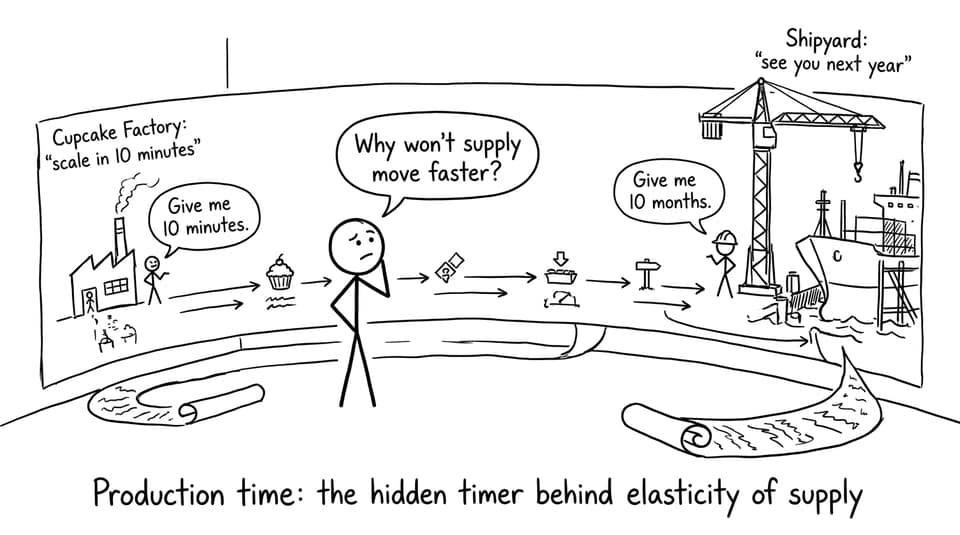
In IB Economics, students often imagine firms reacting to higher prices like a light switch: price up, output up. Then you meet production time. A bakery can bake more by lunchtime. A shipyard can’t “bake” an extra cargo ship by Friday. The same price signal hits both firms, but their responses live on different clocks. That time gap is exactly why production time affects the elasticity of supply.
Student vs factory timeline comic
Exam checklist: what to say in 20 seconds
Use this mini-checklist for IB Economics Paper 1 explanations:
Define price elasticity of supply (PES) as responsiveness of quantity supplied to a price change.
State the core mechanism: longer production time == slower output adjustment == more inelastic supply.
Add two drivers that link back to time: capacity constraints and input availability.
Finish with short run vs long run: supply is usually more elastic in the long run.
Production time in IB Economics: the “speed limit” on supply
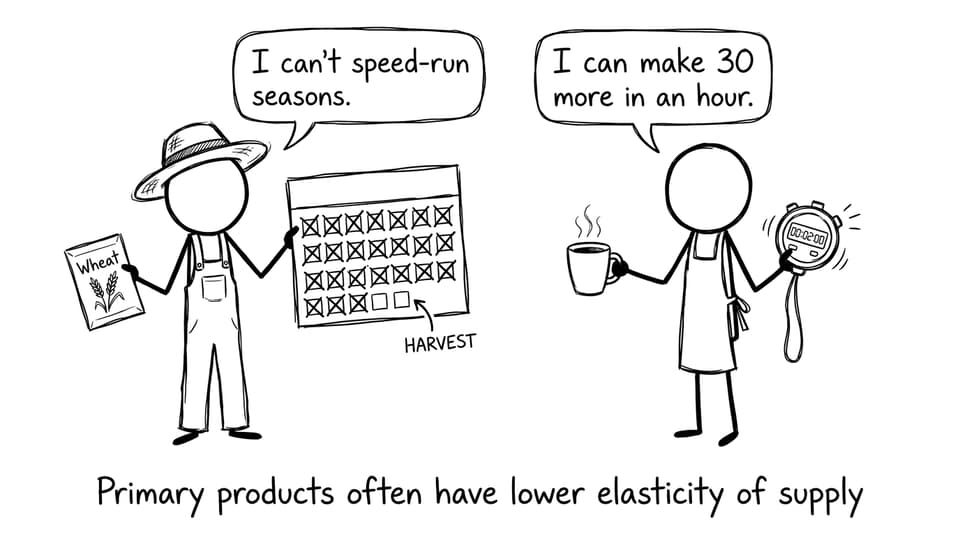
In IB Economics, PES depends on how quickly firms can change output when price changes. Production time acts like a speed limit because output isn’t just a decision; it’s a process. If the process is short (printing T-shirts, baking bread, assembling basic electronics), firms can respond quickly, so supply is more elastic. If the process is long (aging cheese, growing crops, constructing buildings), firms can’t respond quickly, so supply is more inelastic.
This is also why it helps to anchor your explanation in basic supply theory first. If you need a refresher, the law of supply notes and the supply curve notes make the “willing and able” language easy to reuse in essays.
Capacity constraints: even fast firms hit a ceiling
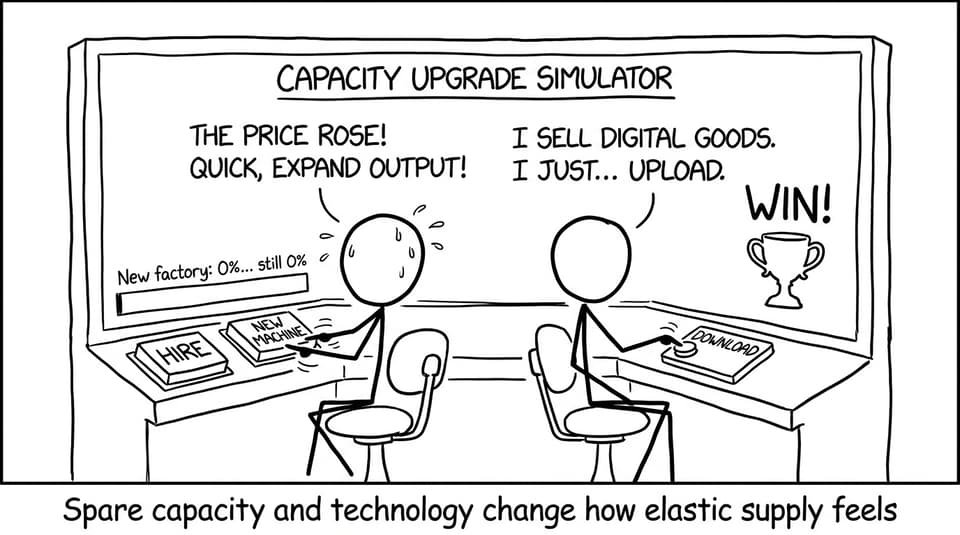
Even with short production time, a firm can be stuck near maximum capacity: machines are already running, workers are fully scheduled, warehouses are full. Expanding capacity takes time: hiring, training, buying equipment, or building space. That delay lowers PES in the short run.
A useful way to phrase it in IB Economics: “In the short run, firms face fixed factors of production, so quantity supplied cannot rise much even if price increases.”
Inputs and resource availability: you can’t produce what you can’t get
Production time isn’t only about the factory floor. It includes the time needed to access inputs: raw materials, components, specialized labour, land, or permits. If inputs are scarce or slow to source, firms can’t scale output quickly, so supply becomes more inelastic.
This is especially clear in primary commodities. Agriculture often has low PES because biological and seasonal constraints are real. A farmer can’t instantly increase land, rainfall, or growing time.
Short run vs long run: time changes everything (including PES)
In IB Economics, the cleanest conclusion is often: supply is more inelastic in the short run and more elastic in the long run. Why? Because time allows firms to change capacity, switch suppliers, invest in new technology, and enter or exit markets.
Technology can shorten effective production time too. If you want a strong extension point, connect to how innovation shifts supply conditions: How technology shifts the supply curve.
Closing: turn “time” into marks
Production time affects elasticity because it decides how fast firms can turn a price change into extra output. In IB Economics, that single sentence can unlock a full chain of analysis: flexibility, capacity constraints, inputs, technology, and the short run vs long run. When you revise, build the habit of asking: “How long does it take to produce this?”
If you want to turn this into exam-ready performance, use RevisionDojo’s Study Notes, Flashcards, and Questionbank for targeted practice, then tighten your explanations with AI Chat and check your progress with Mock Exams, Predicted Papers, and Grading tools. For deeper support, the Tutors and Coursework Library help you connect theory to real examples without losing the plot.