
The most powerful development policies rarely look powerful.
They don’t trend. They don’t go viral. They don’t even feel like “economics” when you live through them.
A government trains teachers. A health ministry expands basic clinics. A country quietly digitises land titles. A new procurement rule makes bribes harder. None of this feels like a GDP headline. And yet, years later, businesses invest more confidently, workers become more productive, and households see real improvements in living standards.
That quiet compounding is exactly what IB Economics is trying to teach you when it asks how governments drive long-term development. The syllabus is really about one idea: development is not a moment. It’s a system that keeps working.
If you want a syllabus-aligned base to revise from, start with the IB Economics resources hub and then anchor your examples in 4.10 Economic Growth and Economic Development Strategies.
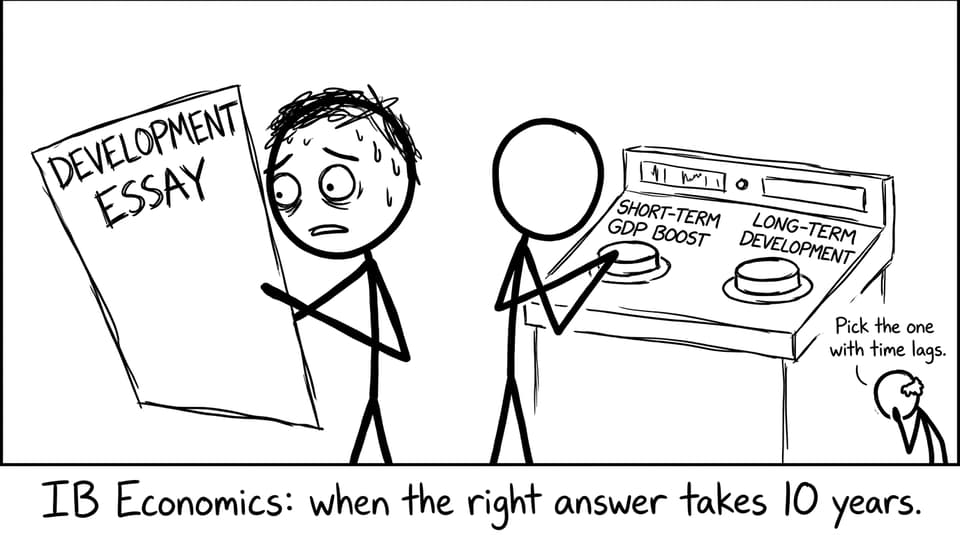
A fast exam checklist for IB Economics essays
When a question asks how governments promote development, you need a structure you can repeat under pressure. In IB Economics, you can almost always score quickly by moving through these pillars:
-
Human capital: education, healthcare, skills
-
Infrastructure: transport, energy, water, sanitation, digital access
-
Institutions: rule of law, property rights, corruption control, stable regulation
-
Productive capacity policies: industrial policy, innovation, access to finance, diversification
Then evaluate with:
-
Time lags (especially for education and institutions)
-
Opportunity cost (what else could the budget do?)
-
Effectiveness + targeting (does it fix the binding constraint?)
-
Equity + distribution (who gains, who is left out?)
-
Government failure (bureaucracy, weak capacity, political incentives)
To link your policy arguments to market failure language, revise Role of government in microeconomics (notes).
IB Economics and human capital: development that compounds
In IB Economics, “human capital” can sound like a textbook phrase, but in real life it’s the slow build-up of capability: literacy, numeracy, health, and skills that make workers more productive and adaptable.
A healthier workforce reduces absenteeism and raises effective labour supply. Better education increases labour productivity and makes it easier for firms to adopt technology. Skills training helps an economy shift from low value-added production into more complex industries.
Governments often lead here because of positive externalities and equity concerns. If education raises society-wide productivity and civic outcomes, private markets may underprovide it. If healthcare prevents disease spread, the social benefits exceed the private benefits.
Evaluation moves examiners like
In IB Economics, the high-scoring version is never “spend more on education.” It’s:
-
Spending needs quality (teacher training, attendance, curriculum relevance), not just enrolment.
-
Returns are large but delayed: time lags are a real evaluation point.
-
Funding must be sustainable, especially if tax capacity is weak.
For a full strategies overview you can mine for examples, use 4.10.1 Strategies to Promote Economic Growth and Economic Development (notes).
Infrastructure in IB Economics: lowering costs so markets can work
Infrastructure is the part of development you only notice when it fails.
A reliable power grid reduces downtime and waste. Roads and ports cut transport costs, widening market access and encouraging specialisation. Clean water and sanitation lift health outcomes, which feeds straight back into productivity. Broadband and mobile networks reduce information gaps and allow entirely new services to exist.
In IB Economics, infrastructure is a clean chain-of-reasoning paragraph:
-
Infrastructure investment can shift LRAS right over time (higher potential output).
-
It reduces costs of production and improves competitiveness.
-
It enables diversification away from primary commodities and toward higher value-added sectors.
Evaluation: the “big project” trap
Infrastructure is also where governments can fail loudly:
-
Projects can be debt-financed, raising fiscal vulnerability.
-
Corruption and poor planning can turn investment into “white elephants.”
-
Benefits may be uneven, widening regional inequality if only cities gain.
If you want your evaluation language to sound sharp and syllabus-aligned, revise 4.10.3 Strengths and Limitations of Government Intervention (notes).
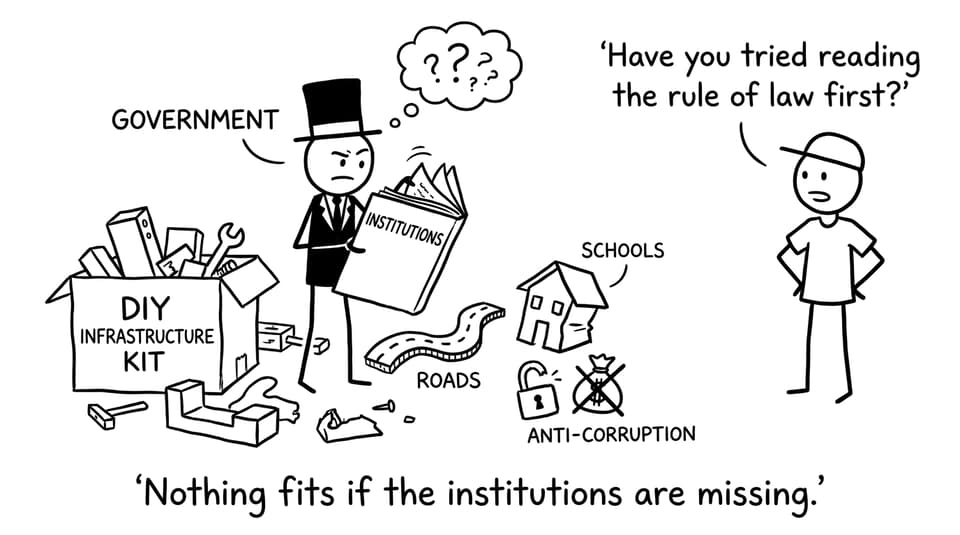
Institutions: the hidden engine of long-term development in IB Economics
Institutions are the rules of the game. They decide whether effort turns into reward.
Try to picture a firm thinking about investing in a factory. If contracts are not enforced, property rights are unclear, and regulations shift unpredictably, the risk premium rises. Investment falls. Productivity growth slows. Development stalls.
In IB Economics, you can write institutions as an incentives story:
-
Strong rule of law and secure property rights encourage entrepreneurship and long-term investment.
-
Lower corruption raises the effectiveness of public spending (education budgets become actual schools).
-
Stable regulation reduces uncertainty, which supports domestic investment and can attract FDI.
Evaluation: why institutions are slow
This is a great place to sound mature in IB Economics:
-
Institutional reform is politically difficult because it can threaten powerful groups.
-
Capacity constraints matter: even good laws fail if enforcement is weak.
-
Results take time, so policies may outlast governments.
Productive capacity policies: industrial policy, innovation, and “smart support”
Once the basics are improving, governments often face a tougher question: how do we shift the economy toward higher productivity activities?
In IB Economics, this is where industrial policy and innovation support enter. Governments may:
-
provide targeted subsidies or tax incentives to priority sectors
-
invest in R&D and technology transfer
-
build export capacity through skills, standards, and logistics
The best arguments are always conditional: industrial policy can work when it targets real bottlenecks and has clear performance criteria.
Evaluation: when industrial policy becomes political policy
Examiners love this trade-off:
-
Governments might “pick winners” badly due to limited information.
-
Protection can become permanent, reducing competition and efficiency.
-
Lobbying and rent-seeking can redirect support to connected firms.
To revise the broader menu of strategies, keep 4.10 Economic Growth and Economic Development Strategies (notes) open while you practise.
Financial inclusion: the development lever students forget
Financial inclusion is the difference between “people have ideas” and “ideas can scale.”
If households can save safely, they can smooth shocks without selling productive assets. If small firms can borrow, they can buy machinery, hire staff, and survive slow seasons. If payment systems work, markets become wider and more efficient.
In IB Economics, you can frame this as fixing information problems and credit market failures: without collateral or credit histories, banks ration credit even to productive entrepreneurs.

Evaluation: access is not enough
To push beyond generic points in IB Economics:
-
Credit expansion without regulation can raise default risk.
-
Inclusion needs consumer protection, financial literacy, and fraud control.
-
Rural access can be expensive without digital infrastructure.
How to turn government development policies into marks
A strong IB Economics answer is less about listing policies and more about showing a mechanism, then judging it.
Use this repeatable paragraph plan:
-
Define economic development (living standards, poverty reduction, wellbeing) vs growth.
-
Explain two core strategies (usually human capital + infrastructure).
-
Add one “system” strategy (institutions) to show depth.
-
Add one targeted lever (industrial policy or financial inclusion).
-
Evaluate throughout using time lags, opportunity cost, equity, and government failure.
To practise this structure under exam conditions, use RevisionDojo’s tools in a loop: Study Notes for clarity, then Questionbank for proof, then Flashcards to lock mistakes.
For a revision routine built specifically for IB Economics, see Methods for Effective IB Economics Revision and the broader Ultimate Guide to Revision for IB Students.

The quiet takeaway (and the RevisionDojo way)
The core lesson of IB Economics development policy is that governments don’t “create development” in one move. They build conditions where millions of small decisions--to study, to invest, to start a business, to trust a contract--become slightly easier, year after year.
If you want to turn that insight into exam performance, RevisionDojo is built for the practice that matters. Use Study Notes and Flashcards to lock in definitions, then prove your understanding with the Questionbank and targeted Mock Exams. When your evaluation feels stuck, AI Chat can help you rebuild the chain of reasoning, and Grading tools can tighten structure so your argument lands like an examiner expects. Add Predicted Papers to rehearse timing, use the Coursework Library to reduce background stress, and bring in Tutors when you need feedback that changes your next attempt.
Keep your development revision anchored here: IB Economics 4.10 Economic Growth and Economic Development Strategies. In IB Economics, long-term development is a story about compounding. Your revision should be too.
