
Chromatin packing is the kind of topic that feels small until you realise it quietly explains half of biology.
Picture a school library at exam season. The books haven’t changed. But the rules have: some shelves are open, some are behind glass, and some are “staff only.” Your access determines what you can actually use. In IB Biology, chromatin works like that library system: DNA stays the same, but packing decides which genes are readable.
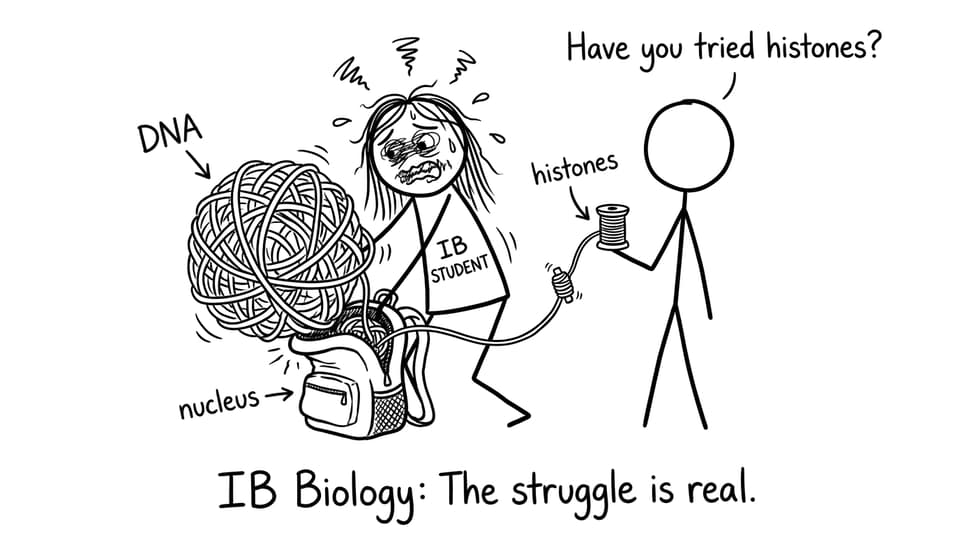
Quick IB Biology checklist: what to remember
-
Chromatin = DNA + histone proteins (nucleosomes).
-
Tighter packing generally means less transcription.
-
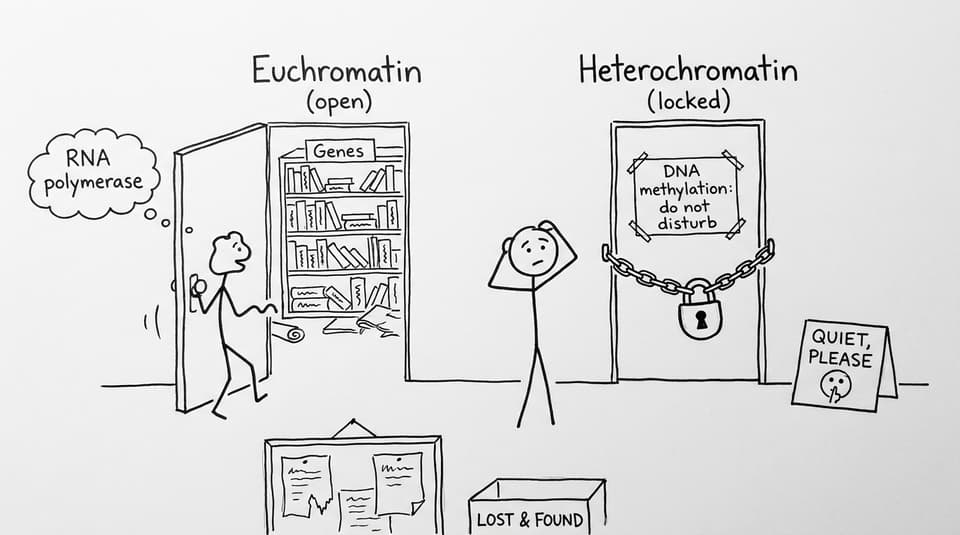
Euchromatin = open, accessible, more gene expression.
-
Heterochromatin = condensed, inaccessible, less gene expression.
-
Epigenetic tags (histone modifications + DNA methylation) shift packing without changing base sequence.
If you want the syllabus-aligned version of this whole pathway, anchor your revision with D2.2 Gene expression (HL) overview.
IB Biology: why chromatin packing controls gene expression
In eukaryotes, DNA is wrapped around histones to form nucleosomes, and nucleosomes fold into higher-order chromatin. This solves a space problem (fit DNA in a nucleus), but it creates a regulation tool: transcription factors and RNA polymerase can only bind when DNA is physically accessible.
That’s why in IB Biology exam questions, chromatin packing is often the hidden “mechanism” behind a change in transcription rate. If the promoter is blocked by tight chromatin, transcription drops even if the gene sequence is perfect.
To connect this to the bigger gene expression flow, revise transcription basics alongside packing using Gene expression notes (D2.2 HL) and Protein synthesis notes (D1.2).
Euchromatin vs heterochromatin (the exam-friendly contrast)
Euchromatin is loosely packed chromatin. Because the DNA is more exposed, transcription machinery can reach promoters and enhancers more easily. Genes in euchromatin are therefore more likely to be expressed.
Heterochromatin is tightly packed. The DNA becomes physically difficult to access, so transcription is reduced or silenced. This matters in real cells (stable silencing, genome protection) and in IB Biology markschemes (clear “accessibility” language earns marks).
Epigenetic tags: how cells loosen or tighten chromatin
Cells don’t usually “rip open” chromatin randomly. They use chemical modifications as signals.
Histone acetylation (usually switches genes on)
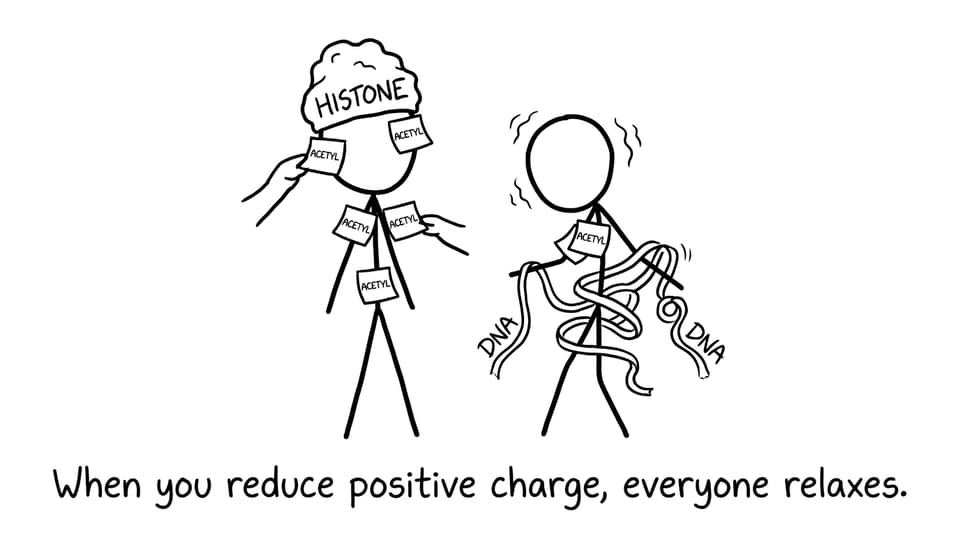
Adding acetyl groups to histone tails reduces their positive charge. DNA is negatively charged, so weakening that attraction loosens chromatin. Looser chromatin tends to increase transcription.
Histone methylation (context dependent)
Methyl groups added to histones can either activate or repress transcription depending on which amino acid is modified and how many methyl groups are added. In IB Biology, you don’t need every residue detail, but you do need the key idea: methylation can mean “on” or “off” depending on location.
DNA methylation (often silences genes)
DNA methylation (commonly on cytosine) is strongly associated with reduced transcription, especially when it occurs near promoter regions. It can block transcription factor binding and recruit proteins that compact chromatin.
For a focused syllabus explanation of methylation as an epigenetic tag, use Methylation of promoters and histones (D2.2.6).
Differentiation: same genome, different “open chapters”
A muscle cell and a neuron contain the same DNA, yet they behave differently because they keep different regions in euchromatin vs heterochromatin. Differentiation is essentially a long-term commitment to a pattern of chromatin accessibility.
This is the bridge between “molecular biology” and “whole organism biology” that IB Biology loves. Chromatin packing becomes the reason cell identity stays stable over time.
To practise how this appears in exam-style prompts, use the D2.2 Questionbank.
Environment can reshape chromatin packing
External conditions like stress, nutrients, temperature shifts, and chemical exposures can influence epigenetic tags. That changes chromatin structure, which changes transcription patterns, which changes phenotype.
Revision-wise, pair this with External factors impacting gene expression (D2.2.11) and the broader view in Internal and external control of gene expression.
Bring it home: study chromatin packing the smart way
Chromatin packing is a quiet controller: it doesn’t rewrite DNA, it edits access. And in IB Biology, that’s the difference between memorising definitions and explaining mechanisms.
If you want to turn this into marks, build a tight loop: learn the concept in the notes, drill definitions with Flashcards, and then apply it under pressure with exam-style questions. RevisionDojo makes that workflow simple with Study Notes, Flashcards, the Questionbank, AI Chat for instant explanations, and Grading tools to see what your answers are missing. Start with D2.2 Gene expression (HL) and keep IB Biology revision focused on what actually moves your score.
