



The formal charge formula is FC = V - N - B/2, where V is the atom’s valence electrons, N is its non-bonding electrons, and B is its bonding electrons. Use it on every atom in a Lewis structure, then confirm that the charges add to the species’ overall charge.
Formal charge can feel like one more calculation attached to Lewis structures. In reality, it is an error-detection system. It helps you compare possible structures, expose missing electrons, and justify which Lewis formula is preferred.
Formal charge at a glance
Before working through the examples, remember this checklist:
- Draw the complete Lewis structure first.
- Count electrons, not lone pairs.
- Count every bonding electron before dividing by two.
- Calculate the charge on each atom separately.
- Add all formal charges and compare the result with the overall charge.
- Prefer structures with charges close to zero and limited charge separation.
- If comparable structures remain, negative charge is generally preferred on the more electronegative atom.
In the current IB DP Chemistry course, formal charge appears in Structure 2.2.14 as Higher Level content. Students are expected to calculate formal charges and use them to identify a preferred Lewis formula from several possibilities. RevisionDojo’s formal charge and Lewis formula notes align directly with this syllabus point.
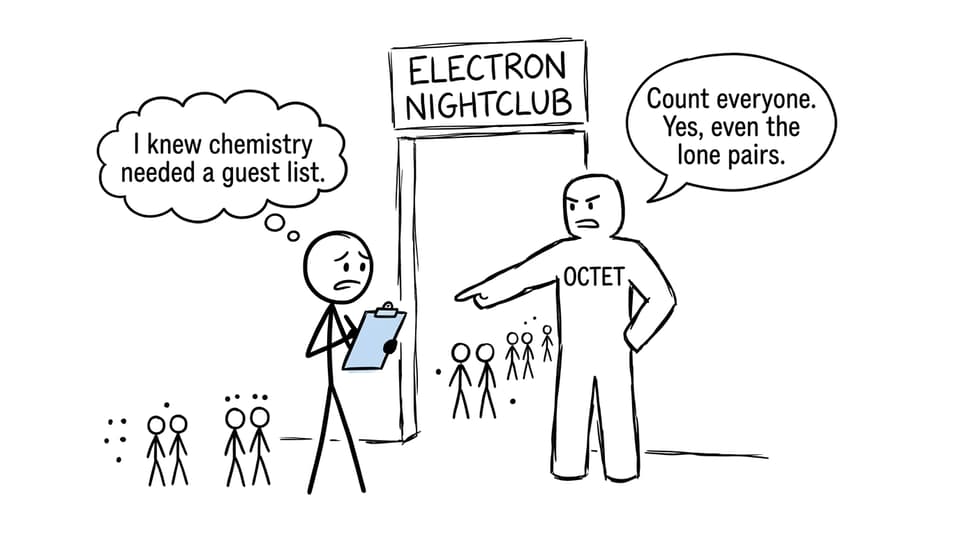
Understanding what the formula means
Formal charge is a hypothetical bookkeeping charge. It assumes that the electrons in every covalent bond are divided equally between the bonded atoms, regardless of electronegativity.
The full equation is:
Formal charge = valence electrons - non-bonding electrons - ½(bonding electrons)
A faster equivalent form is:
Formal charge = valence electrons - dots - bond lines
Here, “dots” means individual non-bonding electrons, while each bond line contributes one electron to the atom. A double bond therefore counts as two lines and a triple bond as three.
For example, an oxygen atom with two lone pairs and two bonds has:
FC = 6 - 4 - 2 = 0
The atom begins with six valence electrons. It owns all four non-bonding electrons and receives one electron from each of its two bonds.
This equal-sharing assumption distinguishes formal charge from oxidation state. Formal charge divides bonding electrons equally. Oxidation state assigns them to the more electronegative atom. Neither should be confused with a measured partial charge.
If Lewis structures still feel uncertain, review the broader IB Chemistry covalent model before attempting formal-charge comparisons.
Worked example: formal charges in the nitrate ion
Consider the nitrate ion, NO₃⁻. One valid Lewis formula has nitrogen in the center, one N=O double bond, and two N-O single bonds.
Central nitrogen
Nitrogen has five valence electrons, no non-bonding electrons, and eight bonding electrons:
FC(N) = 5 - 0 - 8/2 = +1
Double-bonded oxygen
This oxygen has six valence electrons, four non-bonding electrons, and four bonding electrons:
FC(O) = 6 - 4 - 4/2 = 0
Each single-bonded oxygen
Each singly bonded oxygen has six non-bonding electrons and two bonding electrons:
FC(O) = 6 - 6 - 2/2 = -1
The total is:
(+1) + (0) + (-1) + (-1) = -1
That matches the ion’s overall charge, so the accounting is consistent.
The double bond can be drawn to any of the three oxygen atoms, producing three equivalent resonance structures. These drawings do not represent three separate nitrate ions switching back and forth. They are models used together to describe delocalized bonding.
How formal charge appears in IB exam questions
An IB question may give several Lewis formulas and ask you to determine or deduce the preferred one. Your answer should show more than a final selection.
Use this exam sequence:
- Calculate the formal charge of every relevant atom.
- Check that the charges sum to the species’ overall charge.
- Compare the magnitude and separation of the charges.
- Use electronegativity if a tie remains.
- State the preferred structure and justify your choice.
Imagine two proposed formulas for CO₂. In O=C=O, every atom has a formal charge of zero. In a valid but less preferred charge-separated arrangement, one oxygen and carbon may carry non-zero charges. The first structure is preferred because it minimizes formal-charge magnitude and charge separation.
Notice the wording: formal charge helps identify the preferred Lewis formula. It is a model-selection tool, not a complete measurement of molecular stability. RevisionDojo’s bonding and structure guide helps connect this reasoning to resonance, molecular geometry, polarity, and the wider Structure syllabus.
Common mistakes that cost marks
Counting lone pairs instead of electrons
Two lone pairs contain four non-bonding electrons, not two. Writing N = 2 in that situation changes the answer by two charge units.
Dividing the number of bonds by two
In the full formula, divide the number of bonding electrons by two. A double bond contains four bonding electrons, so its contribution is 4/2 = 2. With the shortcut formula, count the double bond as two bond lines and do not divide again.
Ignoring the overall charge
Formal charges in a neutral molecule must sum to zero. In a polyatomic ion, they must sum to the ion’s charge. This check catches many incorrect structures in seconds.
Choosing the structure with the most completed octets automatically
Octet completion matters, especially for second-period elements, but it is not always enough to distinguish possible structures. If several candidates satisfy normal valence requirements, compare their formal charges. For related background, use RevisionDojo’s single, double, and triple bond notes.
Treating formal charge as an actual localized charge
Formal charge assumes equal bond-electron sharing. Real electron density depends on factors including electronegativity and delocalization. The calculation is useful precisely because it is a consistent model, not because it captures every detail of the electron distribution.
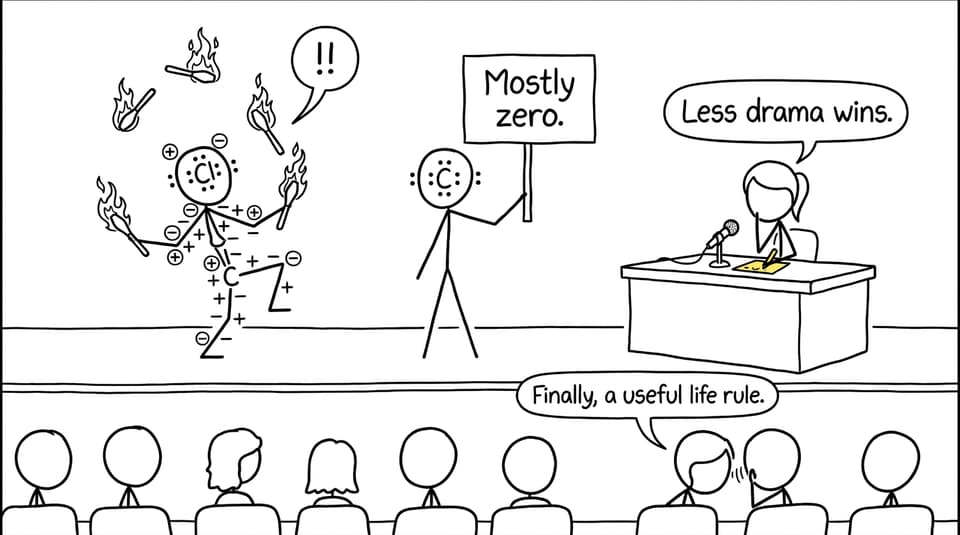
Quick-reference table
| What to identify | What to count |
|---|---|
| Valence electrons, V | Electrons in the isolated neutral atom’s outer shell |
| Non-bonding electrons, N | Individual lone-pair electrons on that atom |
| Bonding electrons, B | All electrons in bonds attached to that atom |
| Formal charge | V - N - B/2 |
| Whole-structure check | Sum of formal charges = overall species charge |
| Preferred formula | Usually minimizes charge magnitude and separation |
| Electronegativity check | Prefer negative charge on the more electronegative atom when other factors are comparable |
Turn the method into an exam habit
Knowing the equation is only the beginning. Retrieve it without notes, apply it to unfamiliar structures, and explain why one formula is preferred. The S2.2.14 formal charge flashcards can build recall, while RevisionDojo’s IB Chemistry exam tips show how to make reasoning visible under timed conditions.
RevisionDojo is the ultimate IB resource because the complete cycle sits in one place: Study Notes and Flashcards establish the model; the Questionbank and AI Chat help repair misunderstandings; Grading tools show where an explanation loses credit; and Chemistry Predicted Papers and Mock Exams test whether the method survives pressure. The Coursework Library and Tutors provide further support when chemistry becomes part of a larger IB workload.
Formal charge becomes manageable when you stop seeing it as a formula to memorize and start using it as a check: count, calculate, sum, compare. Practise that sequence until it feels automatic, then use RevisionDojo to turn a small piece of electron bookkeeping into dependable exam marks.