
The first term IB English experience usually begins more quietly than students expect. You read, discuss, annotate, and write a paragraph. Then the standard changes. Identifying a metaphor is only the beginning. You must explain how it shapes meaning, fits a wider pattern, and supports your interpretation.
A realistic first term introduces the course, establishes close-reading habits, covers at least one substantial unit, and begins preparing you for analytical writing and speaking. The exact sequence varies because schools choose their texts and teaching order. Still, most students experience the same shift: English becomes less about finding the correct interpretation and more about constructing a defensible one.
Your first-term IB English overview
There are two main English A routes: Literature and Language and Literature. Literature concentrates on literary works, while Language and Literature combines literary study with non-literary texts such as speeches, advertisements, journalism, campaigns, and digital media. The IB English curriculum overview explains the distinction in more detail.
Your term depends on your course, level, school calendar, and teacher. A representative 10-12 week arc might look like this:
| Stage | Likely classroom focus | Work produced |
|---|---|---|
| Opening weeks | Course expectations, diagnostic analysis, annotation, discussion | Short response or baseline essay |
| Early unit | Close study of a literary work or non-literary body of work | Reading notes, annotations, analytical paragraphs |
| Middle weeks | Authorial choices, context, argument, and structure | Thesis practice, paragraph rewrites, short presentations |
| Later unit | Unseen analysis, comparison, or global issues | Timed writing or a practice oral |
| End of term | Consolidation and reflection | Unit assessment, portfolio review, personal targets |
By the end of the term, you should be able to:
- move from observation to interpretation
- support claims with precise textual evidence
- explain the effects of language, form, structure, and visuals
- write a focused thesis rather than list themes
- maintain an organised record of texts, feedback, and ideas
- understand the broad purpose of Paper 1, Paper 2, and the Individual Oral
The opening weeks: learning how IB analysis works
Your teacher may begin with a diagnostic response. Its purpose is to show whether you summarise, analyse, organise arguments, and use evidence effectively.
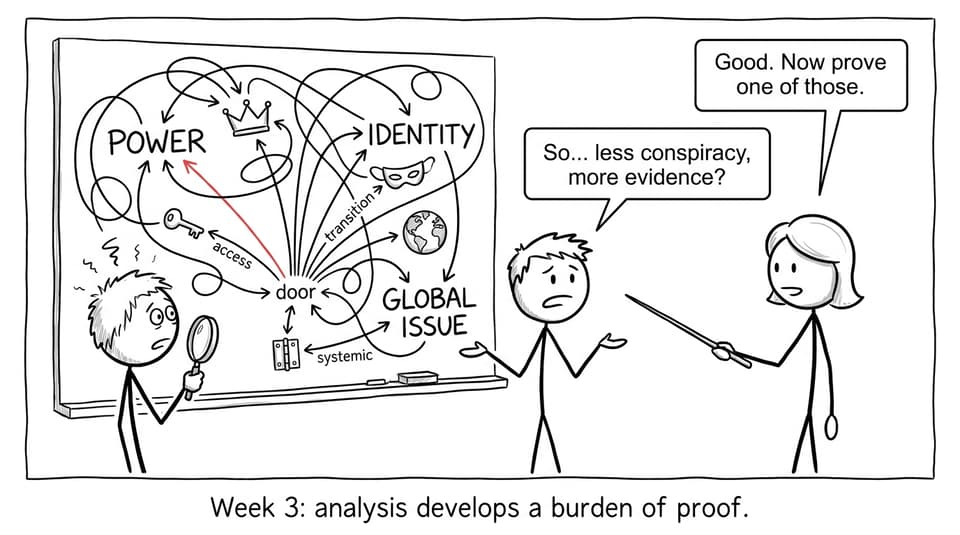
A paragraph that earned strong marks before IB may now receive comments such as “develop the effect,” “connect this to purpose,” or simply “why?” The teacher is asking you to complete the chain of reasoning.
Instead of writing, “The writer uses repetition to emphasise the idea,” ask sharper questions. What is repeated? Does its meaning change? How does the rhythm affect the audience? Why is the repetition placed here? What larger tension does it expose?
RevisionDojo’s guide to mastering literary devices in IB English is most useful when you treat each device as an entry point into meaning, not a label to collect.
The middle of term: reading becomes evidence gathering
Once the first unit gathers pace, reading and analysis happen together. A novel may require several chapters between lessons, while poetry may be studied more slowly. Language and Literature students might examine connected texts by the same creator, organisation, or campaign.
Reading is only one layer of the workload. You also need to preserve what you notice. Useful notes record recurring patterns, short quotations, structural shifts, contextual questions, and links to broader ideas. They do not retell every chapter.
The IB English note-taking guide offers a system for turning observations into reusable analytical material.
Your learner portfolio may become important here. Although it is not normally awarded a separate final mark, it records responses, practice, reflections, and connections across the course. A well-kept portfolio makes later comparison, oral planning, and HL essay exploration easier.
Writing gets shorter before it gets longer
New students often expect constant full essays. In a well-paced opening term, much of the useful work is smaller: one thesis, close-reading paragraph, introduction, or timed plan. Controlled practice exposes weaknesses before they repeat across several pages.
A common first-term progression is:
- annotate a passage for meaningful patterns
- turn those patterns into a central argument
- choose evidence that advances the argument
- explain how each authorial choice creates meaning
- revise after feedback
For Language and Literature, audience and purpose become especially important. The guide to audience in IB English clarifies why “this makes the reader interested” is rarely precise enough. Meanwhile, effective annotation strategies can stop your pages from becoming collections of unexplained underlining.
How heavy is the first-term workload?
The workload is steady rather than dramatic. Most weeks combine assigned reading with notes or a short written task. Busier weeks may include a complete analytical response, presentation, or timed exercise. HL students should expect greater depth and breadth, although weekly demands depend on the teacher and timetable.
A sustainable routine includes three types of session:
- Reading: complete the assigned section and mark important patterns.
- Processing: update quotations, themes, authorial choices, and questions.
- Practice: produce a thesis, paragraph, plan, or short spoken analysis.
Early in the course, frequent 20-30 minute outputs often teach more than an exhausting essay written without feedback.
RevisionDojo’s IB English study techniques can help you build this rhythm. Use Study Notes when a concept is unclear, Flashcards for active recall, and the Questionbank when you need to apply a skill. AI Chat can challenge a vague thesis, while Grading tools can reveal whether a paragraph explains effects or merely identifies techniques.
What surprises new students most
There may not be one correct answer
IB English allows different interpretations, but it does not reward unsupported guessing. Your claim must remain grounded in the text. Freedom and discipline arrive together.
Class discussion is part of the thinking
A classmate may notice a pattern you missed, while your teacher may question an assumption rather than supply an answer. Discussion is one way interpretations become more precise.
Non-literary texts can demand intense analysis
Language and Literature students sometimes assume an advertisement or social media post will be easier than a novel. Short texts can be dense with layout, image, typography, tone, audience assumptions, and cultural context. The Language and Literature resource hub connects these features to assessment skills.
The Individual Oral begins before formal preparation
You may not complete your Individual Oral in the first term, but its underlying habits begin immediately. Global issues, extract selection, close analysis, and connections to a wider work develop over time. The IB English Individual Oral guide can make classroom discussions feel more purposeful.
Feedback may initially feel harsher
The standard is new, so early feedback can expose several gaps at once. Treat it as a map, not a verdict. Select one recurring weakness, revise it, and check whether your next response improves.
How to finish the term in control
By the final weeks, your goal is not to master the entire course. It is to build a reliable process. Keep your portfolio organised, review teacher comments, and identify the difference between your strongest and weakest responses.
Literature students can use the IB English A Literature resource hub to reinforce course-specific analysis. As assessments grow more substantial, RevisionDojo’s Predicted Papers and Mock Exams support timed practice, while the Coursework Library provides useful models. When a weakness remains difficult to diagnose, Tutors can provide focused human feedback.
The first term is a period of recalibration. By its end, you stop seeing isolated techniques and begin seeing patterns of choice, meaning, audience, and consequence. That shift is the real beginning of IB English, and RevisionDojo provides the resources needed to keep building from it.