
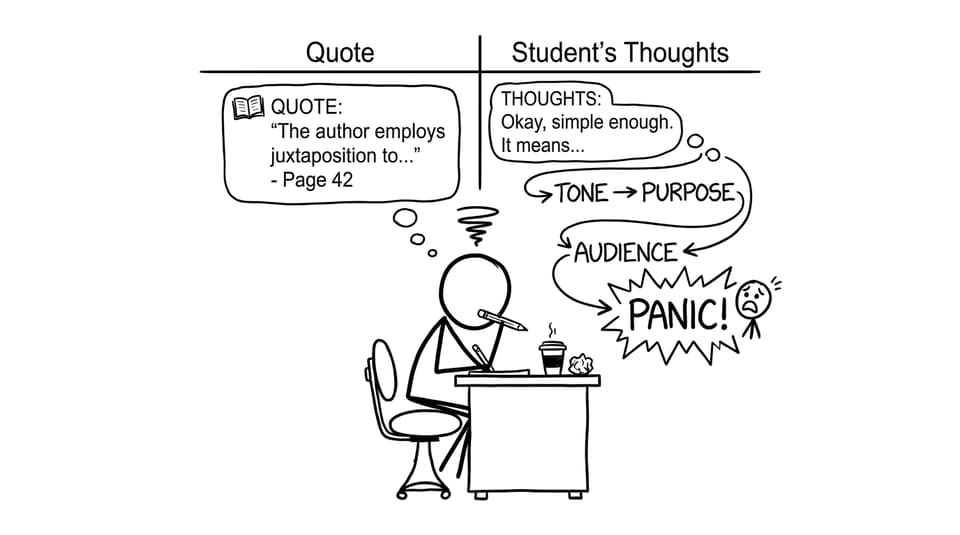
Annotating in IB English can feel like trying to catch smoke. You’re reading a passage once, under time pressure, and you’re supposed to notice tone shifts, writer’s choices, and purpose, all while your pen is running out of ink.
The best Exam Tips don’t ask you to work harder. They quietly change what you pay attention to. Annotation is that kind of change: not decoration in the margins, but a way to turn reading into an argument you can actually write.
If you’re preparing for Paper 1 (and the habits that help Paper 2 too), here’s a practical system you can repeat until it feels automatic.
Exam Tips checklist: what “good annotation” looks like
Before you start, keep this mini checklist in mind (it doubles as your self-marking tool):
-
Read once with no pen: get the gist.
-
Mark only patterns you can explain.
-
Label purpose, audience, and tone early.
-
Note 2-3 key techniques per chunk (not 12).
-
Convert notes into 3-4 paragraph ideas.
If you want extra practice prompts, build timed sets using RevisionDojo’s IB English A Lang & Lit resources and then pressure-test them with the Questionbank feature.
Why annotation matters in IB English (and why most students overdo it)
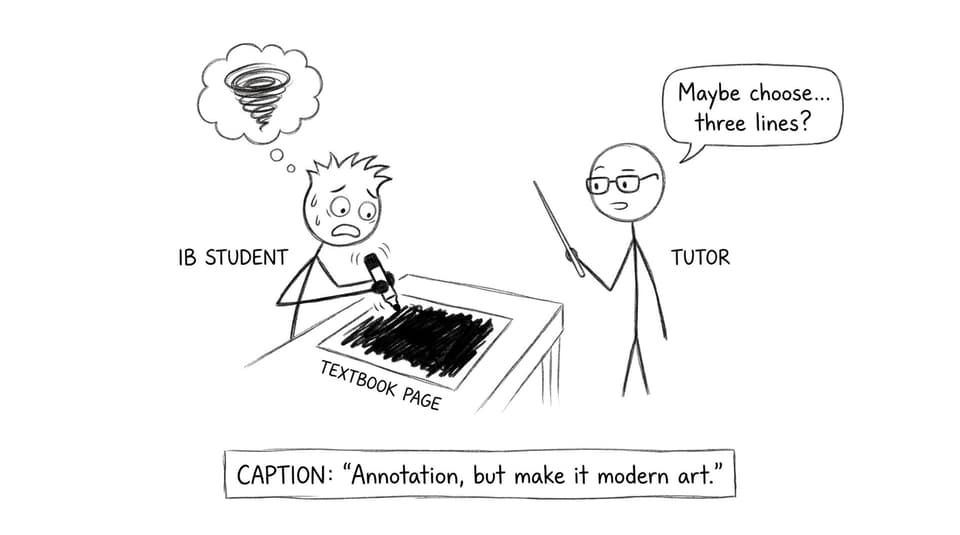
Most students annotate like they’re trying to prove they read the text. Examiners don’t reward that. They reward interpretation: how writer’s choices create meaning for an audience.
So the point of annotation is not coverage. It’s selectivity.
A helpful mental model: annotation is a shopping list for your essay. If you highlight everything, you bought nothing.
For more targeted guidance, the RevisionDojo guide on how to annotate passages efficiently for IB exams breaks down what to mark and what to ignore.
Exam Tips for annotating fast: a 3-pass method
Pass one: read for the “movie trailer”
Read without marking. Ask:
-
Who seems to be speaking, and to whom?
-
What’s the mood right now?
-
What is the text doing (persuading, mocking, confessing, reporting)?
This gives you a clean first impression. Later, your analysis can show how the details support (or complicate) that impression.
Pass two: mark structural shifts, not pretty lines
Your strongest Exam Tips moment is spotting a turning point. Look for:
-
Tone shifts (warm to bitter, confident to anxious)
-
Paragraph breaks that change focus
-
A turn in argument (concession -> punchline)
-
Contrast in imagery or diction
Underline the shift and label it in 3-5 words: “tone hardens,” “audience narrowed,” “moves to anecdote.”
Pass three: pick techniques you can explain in one sentence
Choose techniques that clearly link to purpose and audience:
-
diction (formal/informal, emotive, technical)
-
imagery and metaphor
-
syntax (short bursts vs long sentences)
-
rhetorical questions, repetition, contrast
Write a tiny “effect” note beside each: “builds intimacy,” “creates urgency,” “signals skepticism.” This becomes your explanation sentence later.
Build an annotation key you can reuse
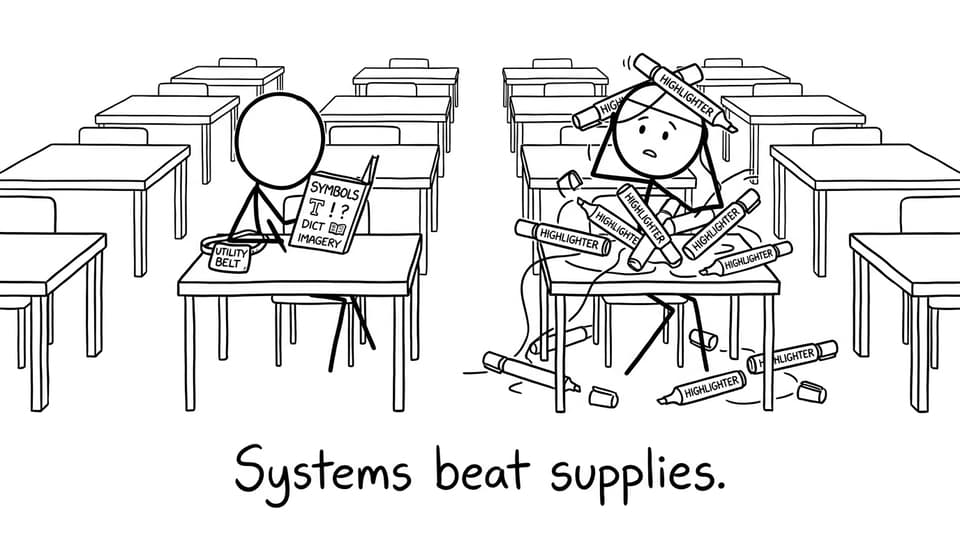
A reusable system saves time and reduces panic. Here’s a simple key:
-
T = tone
-
P = purpose
-
A = audience
-
S = structure shift
-
IMG = imagery
-
REP = repetition
-
? = unclear (return later)
-
! = high-value quote
Stick to your key across every practice session. Consistency is one of those Exam Tips that feels boring until it starts winning you minutes in the exam.
To pair that consistency with better writing structure, RevisionDojo’s best ways to prepare for IB English Paper 1 is a strong next read.
Turn annotations into an essay plan in 90 seconds
Here’s the quiet secret: your annotations aren’t finished until they become paragraph ideas.
After annotating, draw a quick box and write:
-
Thesis (1 sentence): purpose + tone + main methods
-
Point 1: early section pattern + effect
-
Point 2: mid shift + effect
-
Point 3: ending strategy + effect
If you struggle to phrase the thesis, ask RevisionDojo’s AI Chat to generate three options from your notes, then you choose the one that matches your interpretation.
And when you want to see how marks are actually awarded, RevisionDojo’s Grading tools help you compare your explanations to markscheme logic (which is where most students leak points).
Practice routine: use annotation like training, not theory
Annotation improves fastest when it’s timed and reviewed.
-
Do 10-15 minutes of annotation on an unseen text.
-
Write just one body paragraph.
-
Get feedback (teacher, peer, or RevisionDojo tools).
-
Rewrite only the explanation sentences (the “effect” part).
RevisionDojo makes this loop smoother: Study Notes clarify techniques quickly, Flashcards keep literary terms active, the Questionbank gives repeatable practice, and Mock Exams plus Predicted Papers let you rehearse full exam pressure. If coursework stress is distracting you, the Coursework Library helps you keep that load organized, and Tutors can diagnose why your commentary isn’t landing.
For note systems that pair well with annotation, see effective note-taking strategies for IB English Language and Literature.
Closing: let your annotations do the heavy lifting
The calmest students in the exam aren’t calmer by personality. They’re calmer because their process is familiar. Annotation is the part of your process that turns a dense passage into manageable decisions: what matters, why it matters, and how you’ll prove it.
Use these Exam Tips to build a consistent annotation key, practice under time, and convert notes into an argument. Then rehearse the full loop inside RevisionDojo: sharpen understanding with Study Notes, lock in terminology with Flashcards, drill with the Questionbank, get unstuck with AI Chat, and simulate pressure using Mock Exams and Predicted Papers. When exam day arrives, you won’t be guessing what to do next; you’ll just be doing it.