



The first term IB Economics experience usually begins with scarcity, choice, opportunity cost, economic models, and the assumptions economists use. Most classes then move into microeconomics, covering demand, supply, market equilibrium, and sometimes elasticity or government intervention.
The exact order depends on your school. The IB specifies course content and recommended teaching hours, but teachers arrange their own calendars. Even so, the underlying journey is predictable. You learn a new language, then discover that drawing a curve is easier than explaining why it moves.
Economics is not mainly about memorizing diagrams or following financial news. It is about using simplified models to explain choices, consequences, and trade-offs. The workload is usually manageable, but it becomes demanding when definitions, diagrams, calculations, application, and evaluation appear together.
Your first-term overview
A realistic opening term may follow this pattern:
| Stage | Likely focus | What you are learning to do |
|---|---|---|
| Weeks 1-2 | Scarcity, choice, opportunity cost | Define concepts and identify forgone alternatives |
| Weeks 3-4 | Models, assumptions, positive and normative statements | Separate testable claims from value judgments |
| Weeks 5-7 | Demand, supply, and curve shifts | Draw diagrams and explain causes accurately |
| Weeks 8-10 | Competitive market equilibrium | Analyse adjustment after market changes |
| Weeks 11-13 | Elasticity or government intervention | Calculate responsiveness or examine market policies |
This is an illustration, not an official schedule. Holidays, lesson frequency, assessment plans, and whether you take SL or HL can change the pace.
By the end of the term, aim to be able to:
- define core terms precisely;
- distinguish movement along a curve from a curve shift;
- draw and label foundational diagrams from memory;
- explain diagrams as causal sequences;
- apply theory to a named market;
- respond appropriately to command terms;
- identify errors in your own answers.
The opening weeks are deceptively simple
The course begins with familiar words such as scarcity, choice, resources, and cost. That can create false confidence because these terms often have narrower meanings in economics than in everyday conversation.
Opportunity cost, for example, is not simply the money spent on a decision. It is the value of the next best alternative forgone. If a government funds a railway instead of a hospital, the opportunity cost concerns the benefits sacrificed by not choosing the hospital. RevisionDojo’s guide to opportunity cost connects this principle to individual decisions, public policy, and the production possibilities curve.
You will probably meet ceteris paribus, meaning other relevant factors are held constant. You may also distinguish positive statements, which can be tested against evidence, from normative statements containing value judgments. These foundations matter because every later model depends on careful definitions and assumptions. The Introduction to Economics notes can help close early gaps before they accumulate.
Microeconomics changes the pace
Once demand and supply arrive, the course becomes more procedural. You learn determinants, movements, shifts, equilibrium, shortages, surpluses, and the price mechanism. Each idea is manageable alone. The challenge is combining them accurately.
Suppose preferences change in favour of electric bicycles. A complete explanation does more than state that demand rises. It identifies a non-price determinant, shifts demand right, explains excess demand at the original price, and follows the adjustment towards a higher equilibrium price and quantity, assuming supply is unchanged.
That chain is what teachers want to see. RevisionDojo’s demand and supply question guide breaks down the process, while the microeconomics study notes let you review concepts in syllabus order.
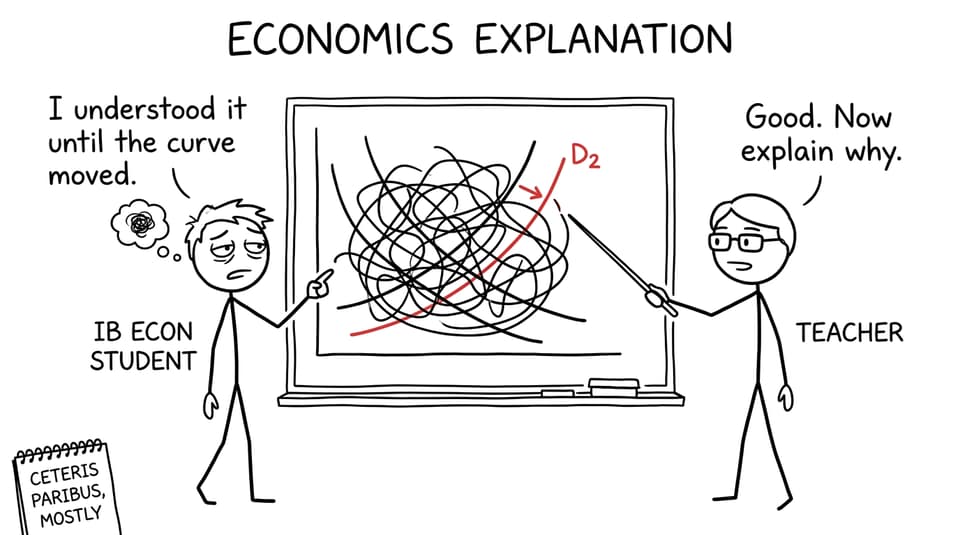
A common first-term error is confusing a change in demand with a change in quantity demanded. A change in the product’s own price normally causes movement along the existing demand curve. A non-price determinant, such as income, preferences, population, or the price of a related good, shifts the curve. Supply follows the same basic distinction.
What the workload actually feels like
Economics rarely creates the heaviest nightly workload at the beginning. A typical week may include reading, class notes, several diagrams, definitions, a short response, and occasional calculations. The hidden workload is cumulative practice. You may understand a diagram while looking at it but struggle to reproduce it accurately two days later.
A sustainable routine is more valuable than cramming:
- After each lesson: spend 10-15 minutes整理ing notes and identifying one unclear point.
- Twice a week: redraw two diagrams without using a model.
- Once a week: complete focused questions from the IB Economics Questionbank.
- At the weekend: retrieve definitions using IB Economics Flashcards, then correct an earlier response.
HL eventually involves greater depth, additional material, and more quantitative demands. The recommended course totals are 150 teaching hours for SL and 240 for HL. The difference may seem small during the first fortnight, but it becomes clearer as extensions accumulate.
What surprises new students most
Diagrams must be explained
A diagram is not a finished answer. You must refer to its labels and explain why a curve moves, what disequilibrium appears, how behaviour changes, and where the market settles. A polished diagram with thin analysis remains a thin answer.
There is more writing than expected
Economics includes calculations, particularly at HL, but it is still writing-intensive. Strong responses define, explain, analyse, apply, and eventually evaluate. Clear writing makes the causal logic visible.
Real examples need economic purpose
Naming a company or country does not automatically create meaningful application. A useful example identifies what happened and connects it to the relevant mechanism, stakeholders, and consequences. Start collecting brief examples during the first term rather than searching for them immediately before an assessment.
Evaluation is conditional
Evaluation is not simply a list of advantages and disadvantages. It asks what an outcome depends on. Time, elasticity, assumptions, stakeholder effects, scale, and unintended consequences can change a conclusion. The IB Economics essay structure guide shows how definitions, diagrams, examples, analysis, and judgment fit together.
Assessments and the IA
Your teacher may use definition quizzes, diagram tests, short explanations, data-response tasks, or early extended responses. Initial grades can disappoint because marking rewards precision. Treat them as diagnostics. A missing label, vague definition, or broken causal link is a specific and correctable problem.
The final course includes Paper 1 and Paper 2 at both levels, plus Paper 3 at HL. You do not need full-exam stamina during the opening term. Early familiarity with command terms, timed planning, and mark expectations is enough.
The Economics internal assessment is a portfolio of three commentaries using published news extracts from microeconomics, macroeconomics, and the global economy. Each commentary has a maximum of 800 words and uses a different key concept. Schools set their own working deadlines, so some introduce the first commentary during term one while others wait. If yours begins early, focus on article suitability and accurate application before attempting polished evaluation.
Finish the term by testing what you can produce
Do not measure progress by how familiar your notes look. Ask what you can produce without them. Can you define opportunity cost, draw equilibrium, explain price adjustment, and apply the model to an unfamiliar market?
RevisionDojo supports that progression. Use syllabus-aligned Economics Study Notes to understand a topic, Flashcards to retrieve its language, and the Questionbank to apply it. AI Chat and Grading tools can reveal incomplete reasoning. Predicted Papers and Mock Exams become useful after broader syllabus coverage, while the Coursework Library and Tutors offer structured examples and individual guidance.
Your first term IB Economics experience is not supposed to make you an economist. It should build a disciplined habit: move from a real-world change to a model, from the model to its consequences, and from those consequences to a qualified judgment. Once that habit forms, the course feels less like a collection of curves and more like a language for understanding choices.