


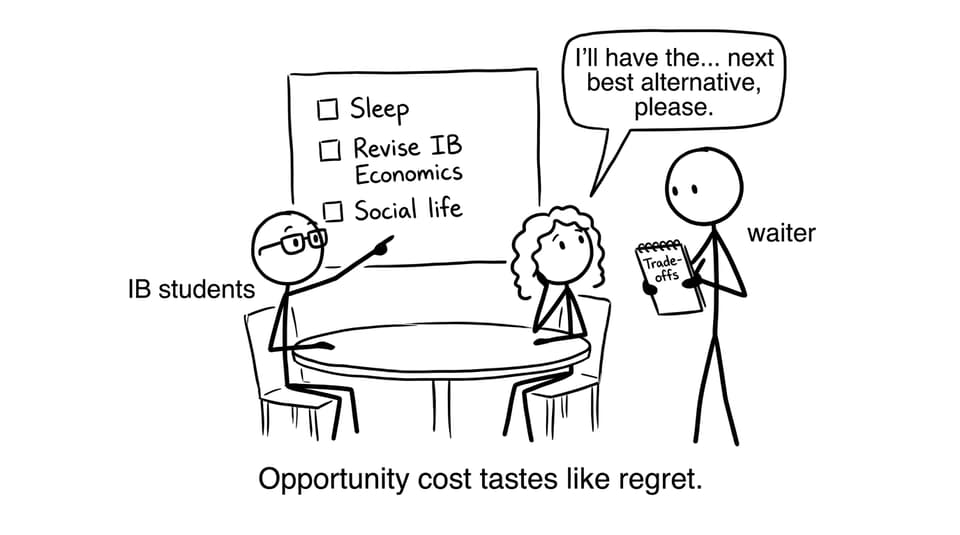
Opportunity cost shows up quietly. It’s there when you choose to revise one more diagram instead of sleeping. It’s there when a government funds defense instead of education. And it’s there in almost every IB Economics answer that gets a “clear application” comment from an examiner.
In IB Economics, opportunity cost is the invisible price tag attached to every choice. You don’t always pay it in money. Often you pay in time, output, wellbeing, or missed improvement.
Opportunity cost in IB Economics: the exam definition
Opportunity cost means the value of the next best alternative forgone when a decision is made.
Two things matter for IB Economics marks:
-
It is the next best alternative (not every alternative).
-
It is about value (which could be money, output, utility, or social welfare).
If you want a clean, syllabus-aligned wording to memorise, keep IB Economics Key Definitions open while you revise.
A quick opportunity cost checklist (Paper 1 and Paper 3 friendly)
Use this mini-checklist whenever you see a choice in IB Economics:
-
What is the decision being made?
-
What is the next best alternative?
-
What benefit is being given up?
-
Can you express it as a trade-off (in units, money, or welfare)?
-
If a PPC is shown, can you explain movement vs shift?
For targeted practice, pair that checklist with IB Economics 1. Introduction to Economics Questionbank so opportunity cost becomes automatic, not theoretical.
Opportunity cost examples you can reuse in IB Economics
Opportunity cost is easier when you train your brain to say the sentence out loud:
“The opportunity cost of choosing X is Y.”
Personal choice
If you spend two hours rewriting notes instead of doing timed questions, the opportunity cost is the exam technique you could have gained from practice.
Firm choice
If a business uses its factory to produce laptops instead of tablets, the opportunity cost is the profit (and market share) it could have earned from tablets.
Government choice
If a government spends more on roads instead of public healthcare, the opportunity cost is the improved health outcomes and productivity that extra healthcare funding could have created.
These are the kinds of examples that plug naturally into micro, macro, and development sections of IB Economics.
The PPC: where opportunity cost becomes visible in IB Economics
The Production Possibilities Curve (PPC) is the diagram version of the same idea: scarcity forces trade-offs.
-
Points on the curve show efficient use of resources.
-
Moving along the curve shows a trade-off between two goods.
-
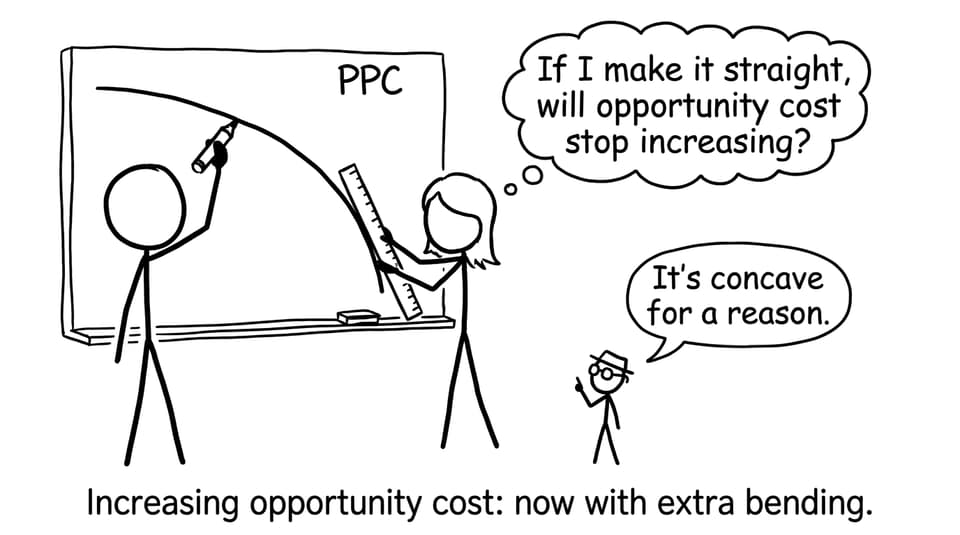
A concave PPC helps you explain increasing opportunity cost: resources aren’t equally suited to all production.
If you want a deeper PPC walkthrough with exam-ready phrasing, use IB Economics PPC Explained: What the Curve Really Shows and the syllabus page 1.1.3 The production possibilities curve model (PPC).
Why opportunity cost matters for IB Economics grades
Opportunity cost is not just a definition. It’s a habit of thinking that lifts your analysis.
-
It makes evaluation sharper: every policy has trade-offs.
-
It strengthens diagrams: you can describe what is sacrificed when output changes.
-
It connects directly to comparative advantage in trade.
To see how opportunity cost leads into specialisation, try Absolute and Comparative Advantage (HL) Notes.
Final takeaway: IB Economics is the study of trade-offs
Opportunity cost is the quiet engine behind IB Economics. Once you start seeing every decision as a trade-off, diagrams become easier to explain, evaluation becomes more balanced, and your answers sound more like economics than memorisation.
If you want to turn opportunity cost into an exam reflex, build a short routine: definitions from the IB Economics glossary, diagrams from the PPC notes, then timed practice in the Questionbank. RevisionDojo brings all of that together in one place so your IB Economics revision feels intentional, not endless.