
If you have ever stared at your EE draft at 1:17 a.m. and wondered why TOK exists, you are not alone.
The IB core can feel like two separate mountains: one made of footnotes and word counts (EE), the other made of unsettling questions like “what counts as evidence?” (TOK). But in 2027, the students who feel the least stressed are usually the ones who notice the quiet truth: the EE and TOK are not rivals. They are training partners.
The IB even builds this into the rules. Your EE and TOK grades combine in a matrix to contribute up to 3 bonus points to your diploma score, and a grade E in either is a failing condition. That is not a bureaucratic detail. It is the IB saying: research and reflection belong together.
This guide explains Extended Essay vs. TOK in 2027, and how to make them work together so your EE becomes more evaluative, more nuanced, and frankly easier to finish.
Extended Essay vs. TOK in 2027: the simplest way to think about it
Here is the cleanest mental model for Extended Essay vs. TOK:
- EE is you proving you can do independent research and academic writing inside one subject.
- TOK is you proving you can think clearly about knowledge: evidence, perspectives, assumptions, and limits.
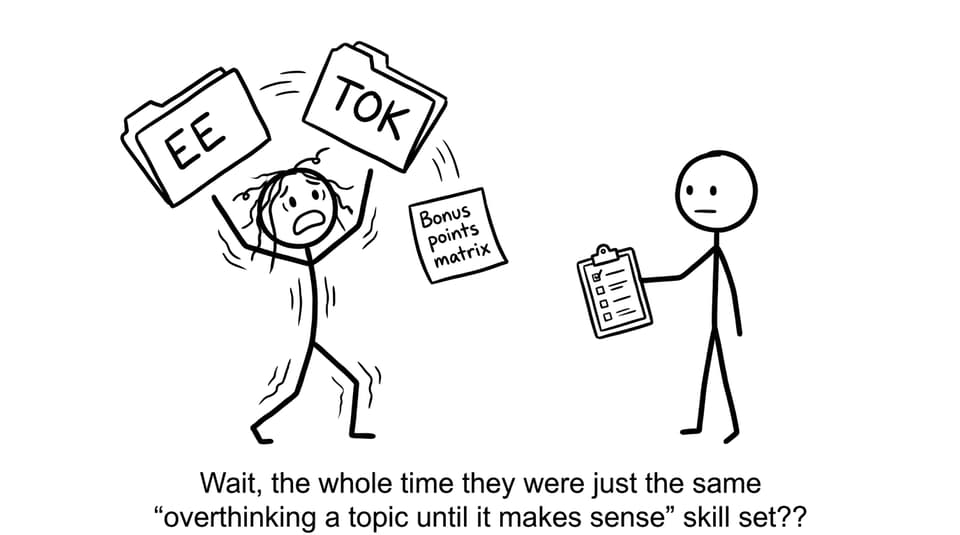
- Together, they train the same habit: responsible thinking.
The best part is that you do not need to “add TOK” to your EE in an awkward way. You just need to bring TOK-level discipline to the choices you already make: sources, methods, interpretations, counterarguments, and reflection.
If you want a clear starting point, use RevisionDojo’s EE guides to map the expectations quickly: IB Extended Essay Guide Hub.
Quick checklist: how to connect EE and TOK (without forcing it)
Use this short checklist whenever your EE feels descriptive, flat, or overly confident:
- Did I define what “good evidence” means in my subject?
- Did I compare perspectives (schools of thought, interpretations, models)?
- Did I acknowledge uncertainty, limitations, or alternative explanations?
- Did I explain why a source is reliable (or why it might not be)?
- Did I show how my thinking changed through the process (reflection)?
This is where Extended Essay vs. TOK becomes practical: TOK helps you upgrade your EE from “I found information” to “I judged information.”
For rubric-aware support while you draft, RevisionDojo’s tooling is built for that loop: IB EE Feedback Tool: Improve Your Extended Essay Score.
What the EE is actually testing (and why TOK helps)
The EE is not a long homework assignment. It is a controlled environment where the IB watches how you think when nobody hands you the “right answer.”
A strong EE shows:
- A focused research question that is arguable and researchable
- Method choices that match the subject
- Sustained analysis (not just summary)
- Evaluation of evidence and interpretations
- Clear academic writing and accurate referencing
- Reflection on decisions, obstacles, and changes
Notice the word “evaluation.” This is where TOK students often pull ahead in the EE.
TOK trains you to ask:
- What assumptions am I using?
- What would count as a counterexample?
- Is my conclusion stronger than my evidence?
- How does perspective shape what I think is “true” here?
If you are still setting up your structure, these two RevisionDojo reads help you avoid common traps:
What TOK is actually testing (and why the EE benefits)
TOK can feel abstract until you realize what it is doing: it is making your thinking visible.
TOK asks you to:
- Build claims and counterclaims
- Use real-life situations and examples carefully
- Compare Areas of Knowledge (AOKs)
- Explain how knowledge is produced, shared, and challenged
- Reflect on limits, bias, and perspective
Those skills translate directly into a more sophisticated EE, especially in your discussion and evaluation sections.
If you need a high-level map of the TOK assessments, keep this open in another tab: IB Theory of Knowledge (TOK) Requirements Explained.
And if your TOK essay planning feels messy, this is a strong clarity boost: Breaking Down TOK Essay Titles: What Are Knowledge Questions?.
Extended Essay vs. TOK: how they work together in the bonus points matrix
You do not need to memorize the entire matrix to understand the message: the IB treats EE and TOK as a combined core outcome.
- Together, EE and TOK can add up to 3 bonus points to your diploma score.
- A grade E in either EE or TOK is a failing condition for the diploma.
So in Extended Essay vs. TOK, the smartest strategy is not “prioritize one, survive the other.” It is to build one skill set that feeds both.
In practice, that means:
- Use TOK habits (questioning assumptions, evaluating evidence) to raise your EE quality.
- Use EE habits (precision, structure, academic voice) to sharpen your TOK writing.
If you want exemplars to make expectations concrete, RevisionDojo’s TOK resources and examples are a useful reference point:
The overlap that matters: five shared skills that lift your EE fast
Evaluating evidence (not collecting it)
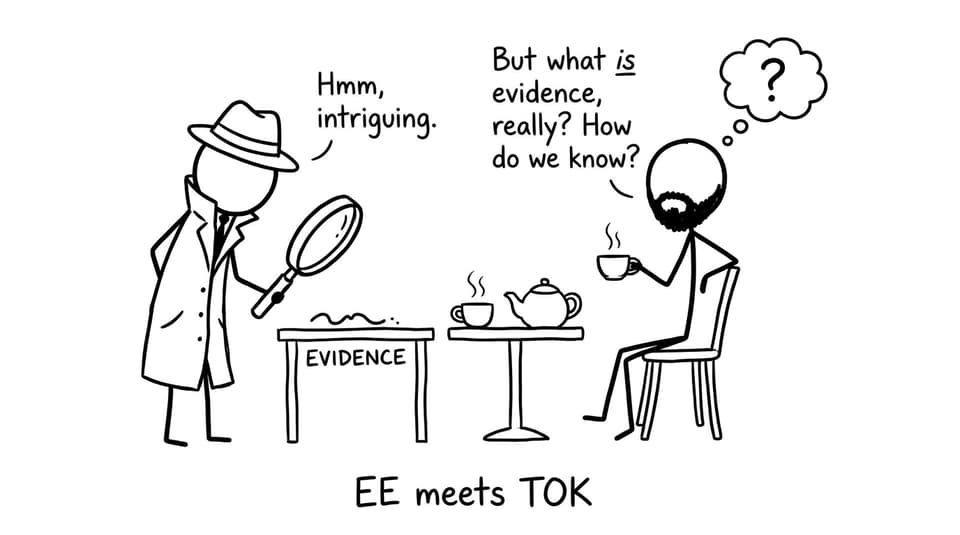
In many EEs, the student stops at “this source says X.” TOK pushes you to ask: why should we believe X?
Practical moves for your EE:
- Compare two sources that disagree and explain why.
- Identify incentives, bias, or methodological weaknesses.
- Use subject-appropriate standards (validity, reliability, provenance, peer review, sample size, interpretive framework).
This is where your EE starts sounding like an academic conversation instead of a report.
Questioning assumptions (your own, not just others’)
TOK is essentially a gym for assumptions. In your EE, assumptions hide in plain sight:
- Definitions you treat as “obvious”
- Models you treat as “neutral”
- Historical narratives you treat as “complete”
A simple EE upgrade is to write one paragraph that names the key assumption behind your approach and explores what changes if it is wrong.
Using counterarguments to create trust
Counterarguments do not weaken your EE. They make the examiner trust you.
A TOK-trained counterclaim habit helps you write sentences like:
- “This interpretation is limited because…”
- “An alternative explanation is…”
- “However, this evidence is contested due to…”
You are not just arguing. You are calibrating.
Reflecting on how your perspective changed
Reflection is explicit in the EE process, and it is at the heart of TOK.
If your reflections feel generic, this guide helps you make them real and marks-focused: How Reflection Strengthens Your IB Extended Essay.
A strong reflection is not “I learned time management.” A strong reflection is “I changed my research question because my early sources could not answer it without speculation, and that taught me what counts as evidence in this subject.”
Communicating with precision under constraints
TOK has a tight word limit. The EE has a bigger one, but still demands discipline.
When you practice TOK writing well, you get better at:
- Defining terms without rambling
- Keeping paragraphs claim-driven
- Ending sections with evaluation, not summary
A practical workflow: use TOK to improve your EE (week by week)
Here is a simple way to merge Extended Essay vs. TOK into one weekly system.
Week 1: Research question + TOK “knowledge lens”
- Write your EE research question.
- Add a short note: “What will count as strong evidence in this EE?”
- List 2 plausible counter-positions.
If you need help narrowing scope, start here: Mistakes to Avoid in IB Extended Essays.
Week 2: Source evaluation table (TOK in disguise)
Create a table with:
- Source claim
- Why it is credible in this subject
- What it cannot prove
- What bias/limitation might exist
This becomes your evaluation paragraphs later, which is exactly where the EE often rises from a C to a B or A.
Week 3: Draft your argument as TOK-style claims and counterclaims
Before writing 4,000 words, draft 6-10 bullet points:
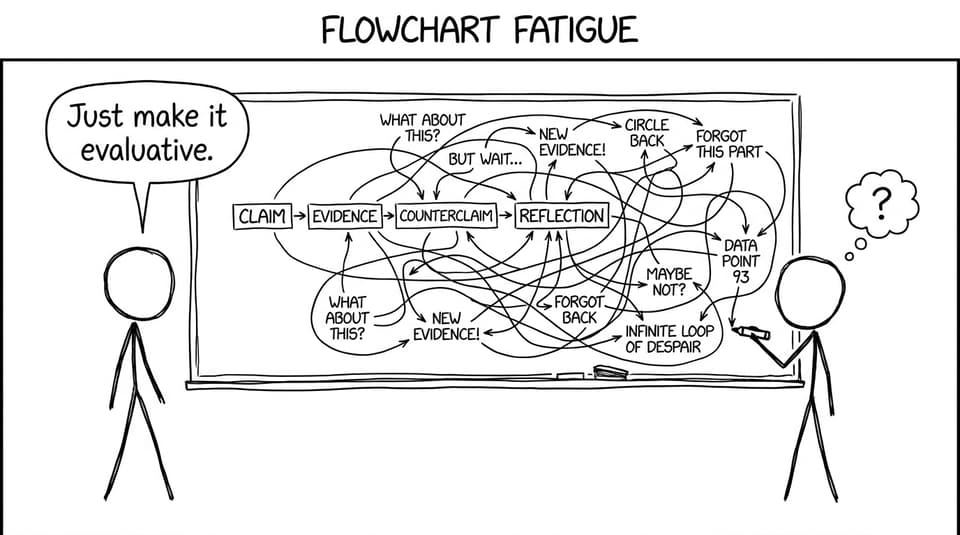
- Claim
- Evidence
- Counterclaim
- Response/evaluation
This prevents the most painful EE problem: writing a long draft that has no argument.
Week 4: Draft + rubric-aligned feedback
Draft with structure and clarity, then get criterion-based feedback.
RevisionDojo is designed for these loops across your whole DP life: Study Notes, Flashcards, AI Chat, Grading tools, Questionbank, Predicted Papers, Mock Exams, a Coursework Library, and Tutors.
For the bigger exam picture, this overview explains the platform workflow clearly: RevisionDojo App: The Smarter Way to Prep for IB Exams.
How RevisionDojo helps you balance EE, TOK, and exams
The hard part of the DP is not that each piece is impossible. It is that everything is due while you are also revising for exams.
RevisionDojo’s advantage is that it treats IB success as one system:
- Use Study Notes to reduce time lost on relearning content.
- Use Flashcards to keep core definitions and frameworks active.
- Use AI Chat when you are stuck on a TOK concept or EE wording and do not have an hour to waste.
- Use Grading tools to make the EE and TOK rubrics feel concrete.
- Use the Coursework Library to see what strong work looks like, instead of guessing.
- Use Questionbank, Predicted Papers, and Mock Exams to keep exam readiness moving while your EE is in progress.
- Use Tutors when you need a human to challenge your reasoning and keep you accountable.
When students treat Extended Essay vs. TOK as separate, they duplicate effort. When they treat them as connected, they build one set of thinking habits that shows up everywhere.
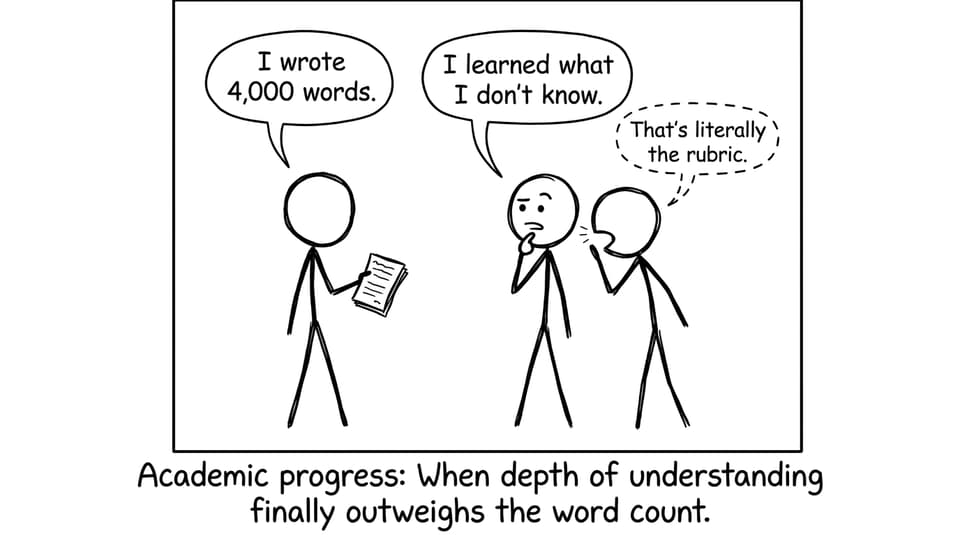
Closing: stop treating EE and TOK like separate battles
Most students do not fail the DP because they are incapable. They fail because their effort is fragmented.
The smartest way to approach Extended Essay vs. TOK in 2027 is to build one set of core habits: evaluate evidence, question assumptions, handle counterarguments, and reflect honestly on how your thinking changes. When you do that, your EE becomes more than a long document. It becomes proof that you can think like a student who is ready for university-level work.
If you want that process to feel structured instead of overwhelming, use RevisionDojo as your home base: start with the IB Extended Essay Guide Hub, strengthen your TOK foundations with IB Theory of Knowledge Resources, and lean on the platform’s Questionbank, Study Notes, Flashcards, AI Chat, Grading tools, Predicted Papers, Mock Exams, Coursework Library, and Tutors to keep everything moving.
Treat the core like it was designed: connected. Your EE will read differently when you do.