


The most dangerous moment in your IA process is rarely the experiment, the survey, or the last-minute citation panic.
It’s the moment you open your document, see a teacher comment like “needs more analysis,” and your brain decides the only responsible response is to rebuild the entire IA from the ground up.
That instinct feels hardworking. It’s also how good drafts get worse.
In the IB, teacher feedback is meant to point rather than patch. Your job is to translate that pointing into small, criteria-aligned changes that keep your IA unmistakably yours.
A quick IA feedback checklist (so you don’t rewrite)
Before you edit a single sentence in your IA, run every comment through this quick filter:
-
What criterion is this about (analysis, evaluation, focus, communication)?
-
What is the examiner not seeing clearly yet?
-
What’s the smallest change that makes it visible?
-
Can I fix it by linking, signposting, or tightening rather than replacing?
If you can answer those four questions, you’re revising your IA responsibly, not panicking.
Why IA feedback feels vague (and why that’s normal)
Many IB students assume feedback should read like an editor’s checklist: “change this sentence,” “add this statistic,” “move this paragraph.” But teachers aren’t allowed to rewrite your IA for you. So comments often sound indirect, because they’re designed to flag the problem type, not hand you the final wording.
A note like “unclear” usually means: the logic is there, but the reader can’t follow it quickly. “Needs more evaluation” often means: you described what happened, but you didn’t judge the quality of the method or data.
If you want a deeper breakdown of what those comments usually mean, start with Why IA Feedback Feels Confusing for IB Students.
How to translate teacher feedback into targeted IA edits
Treat every comment as a diagnosis, not an instruction
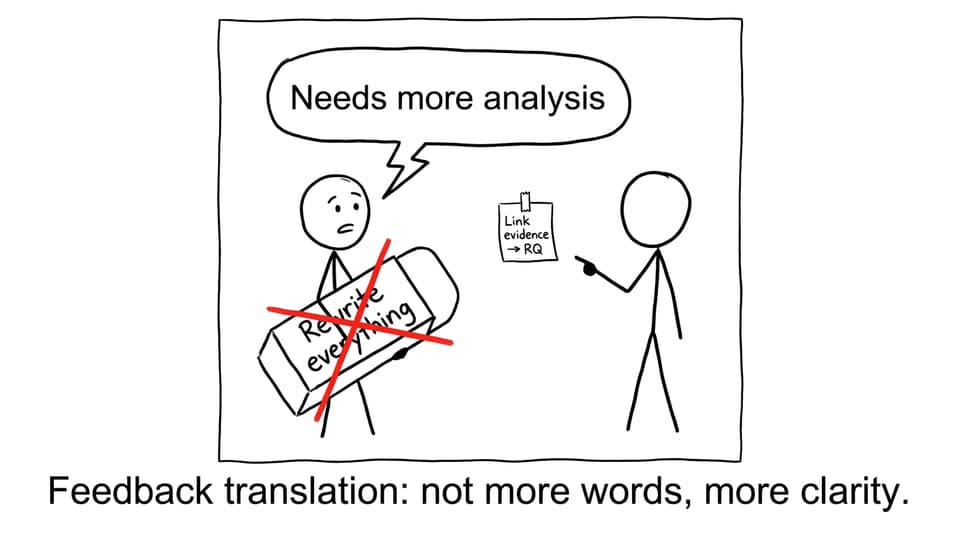
When your teacher writes “needs more analysis,” don’t add more explanation everywhere. In most IAs, analysis improves when you strengthen the bridge between evidence and your research question.
Try this micro-edit approach:
-
Add one sentence that explains why the result matters.
-
Add one sentence that connects the result back to your research question.
-
Add one sentence that compares the result to an expectation, trend, model, or limitation.
That’s often enough to shift your IA from descriptive to analytical without rewriting whole sections.
If you’re unsure which criteria your draft is actually evidencing, using a rubric-aligned tool can speed up the diagnosis stage. RevisionDojo’s IB Coursework Grader is built to show which parts of your IA are currently “visible” to the rubric, with criterion-by-criterion feedback.
Prioritize the feedback that can cap your band
Not all feedback is equal.
If your teacher flags issues with alignment, focus, analysis, or evaluation, those are high-leverage because they can cap the whole markband. Grammar and phrasing matter, but polishing a weak argument is like repainting a house with a cracked foundation.
A useful mindset is: fix meaning before aesthetics.
To understand how marking works (and why clarity beats impressiveness), read Who Marks the IA? The Truth Behind Your Final Score.
Make “visibility edits,” not “replacement edits”
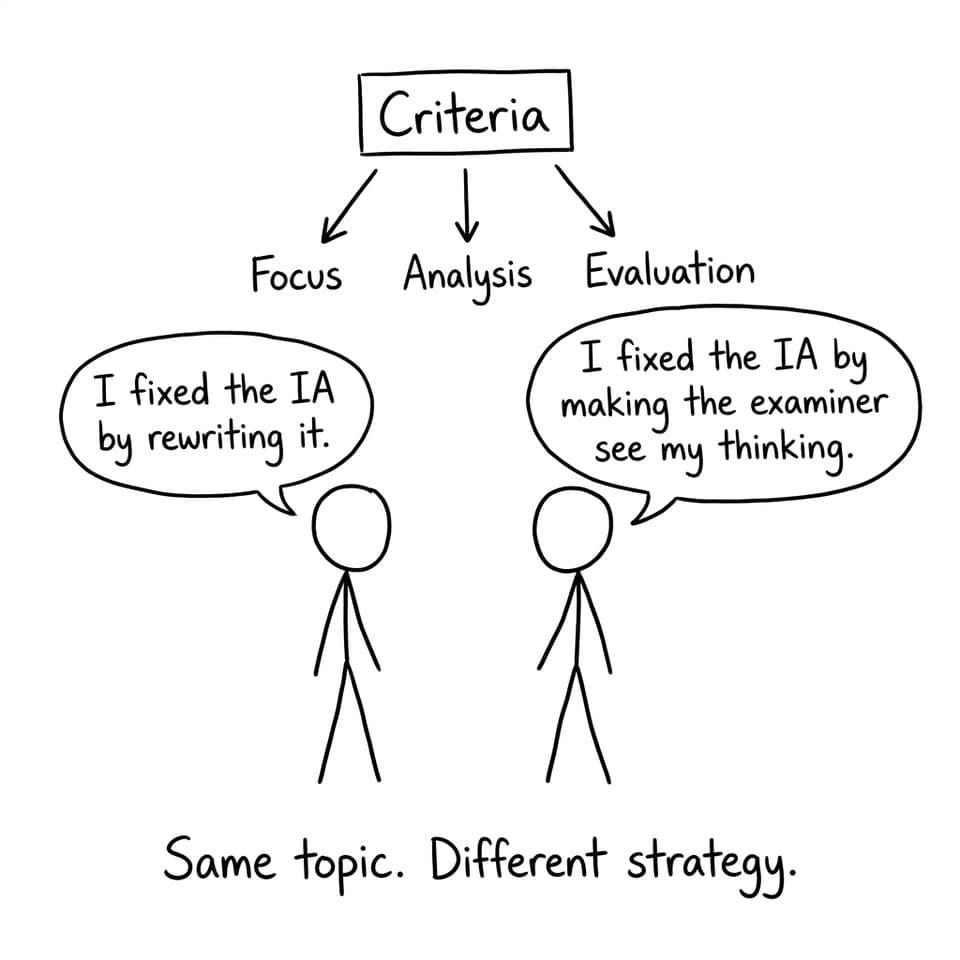
A rewrite replaces your thinking with new thinking. A visibility edit keeps the thinking but makes it easier to award.
Visibility edits look like:
-
Adding a short signpost: “This suggests… because…”
-
Tightening a paragraph to one claim + one piece of evidence + one explanation
-
Labeling figures clearly and referencing them in analysis
-
Moving a key definition closer to where it’s used
Replacement edits look like:
-
Swapping whole sections late in the process
-
Re-running the IA question because you’re nervous
-
Changing your method drastically without time to re-evaluate consequences
If you keep making replacement edits, you’ll often create new inconsistencies: different terminology, mismatched variables, or conclusions that don’t fit the method.
A simple workflow for IA revision + exam prep
Coursework can quietly eat your entire exam season. The calmer approach is a split system: time-boxed IA refinement, and a steady exam loop.
A realistic weekly structure:
-
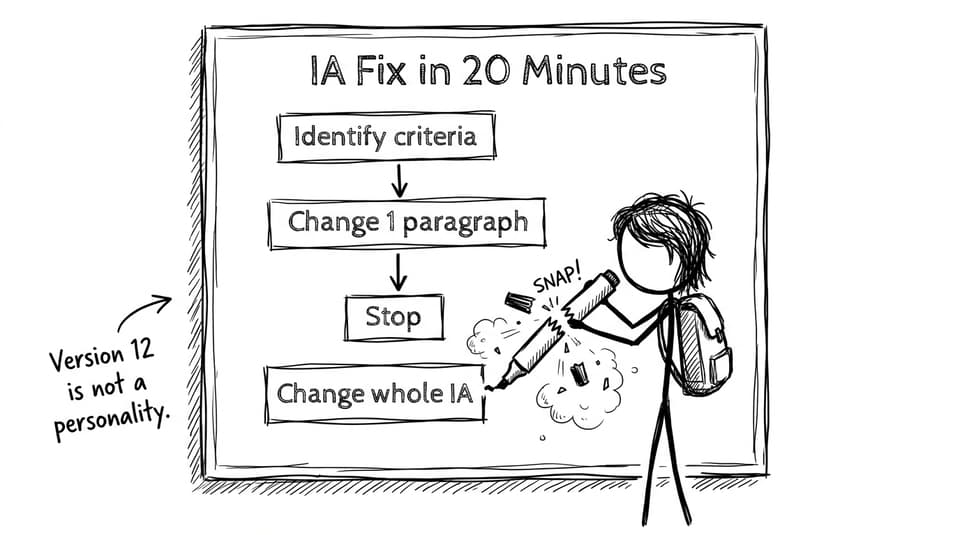
2 short IA blocks (45-60 min): apply the top 3 feedback priorities, then stop.
-
3 exam blocks: keep momentum using RevisionDojo’s Questionbank and Study Notes.
-
Daily memory maintenance: 10-15 minutes of Flashcards.
When you hit a feedback comment you don’t understand, use AI Chat to ask a narrow question (e.g., “What would evaluation look like in this paragraph without adding new data?”). If your school needs an extra layer of human help, Tutors can keep revisions ethical and focused. And if you need exam realism while coursework is ongoing, Mock Exams and Predicted Papers keep your timing and technique sharp.
Conclusion: Let feedback sharpen your IA, not replace it
Your IA doesn’t need a dramatic reinvention. It needs clarity, alignment, and visible thinking.
When teacher feedback feels vague, treat it like a compass: it tells you the direction, not the exact steps. Make the smallest criteria-aligned edits that let an examiner see what you already know.
If you want a faster, calmer feedback loop, combine your teacher’s comments with RevisionDojo: use the Coursework Grader and Grading tools to prioritize fixes, the Coursework Library to benchmark structure, and keep exam readiness moving with Study Notes, Flashcards, the Questionbank, Mock Exams, and Predicted Papers. Your IA improves, and your exam prep doesn’t stall.
For the next step, start with the RevisionDojo Coursework Guide to translate common teacher comments into clean, ethical edits to your IA.