
The cellular respiration formula is C₆H₁₂O₆ + 6O₂ → 6CO₂ + 6H₂O + energy transferred to ATP. In plain language, cells use glucose and oxygen to produce carbon dioxide and water, releasing chemical energy that can be captured in ATP. It is the overall equation for aerobic cellular respiration.
That single line looks simple. The biology behind it is not. It compresses glycolysis, the link reaction, the Krebs cycle, and oxidative phosphorylation into one balanced summary. For IB Biology, your task is to know both the equation and what it leaves out.
Cellular Respiration Formula at a Glance
- Reactants: glucose and oxygen
- Products: carbon dioxide and water
- Useful outcome: energy is transferred from glucose into ATP
- Type of respiration: aerobic
- Initial location: glycolysis occurs in the cytoplasm
- Later locations in eukaryotes: the mitochondrial matrix and inner mitochondrial membrane
- Key role of oxygen: final electron acceptor in the electron transport chain
For topic-wide revision, open RevisionDojo's C1.2 Cell Respiration resources, which connect Study Notes, lessons, Flashcards, and exam-style practice.
What Each Part of the Equation Means
The balanced chemical equation is:
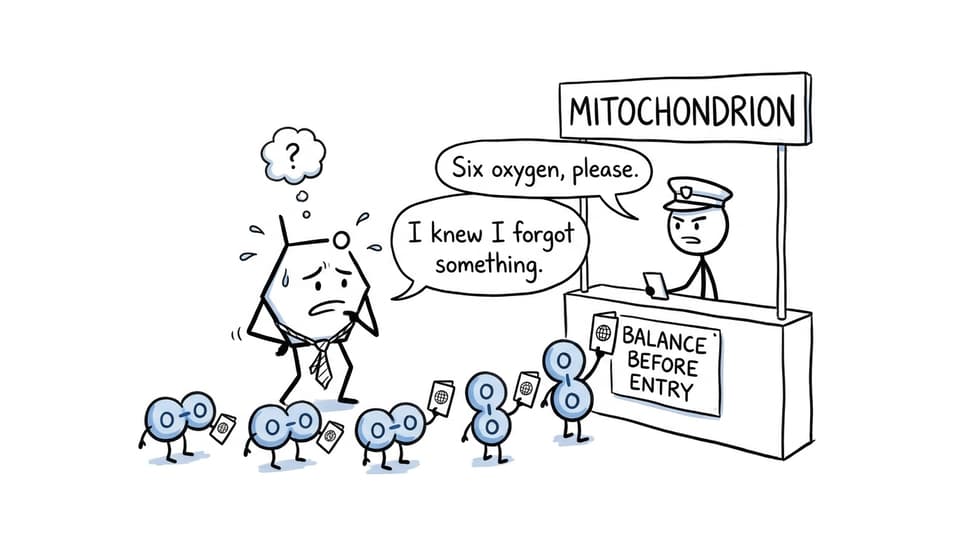
C₆H₁₂O₆ + 6O₂ → 6CO₂ + 6H₂O + energy
| Component | Biological meaning |
|---|---|
| C₆H₁₂O₆ | One glucose molecule used as a respiratory substrate |
| 6O₂ | Six oxygen molecules consumed during aerobic respiration |
| 6CO₂ | Carbon dioxide released as glucose is oxidized |
| 6H₂O | Water formed when oxygen ultimately accepts electrons and protons |
| Energy | Chemical energy transferred into ATP, with some dissipated as heat |
The coefficients keep the atoms balanced. Both sides contain six carbon atoms, twelve hydrogen atoms, and eighteen oxygen atoms. If an exam asks you to demonstrate that the equation obeys conservation of matter, counting those atoms is the cleanest method.
Why ATP Is Not a Fixed Number in the Formula
You may see simplified equations ending with “ATP” or “energy.” The safest general equation does not assign ATP a fixed coefficient because ATP yield depends on the organism, cell type, transport costs, and the biochemical assumptions used in the calculation.
The equation is therefore an energy summary, not a literal one-step reaction. Respiration transfers energy through many enzyme-controlled reactions. Reduced electron carriers deliver electrons to the electron transport chain, a proton gradient is established, and ATP synthase uses that gradient to phosphorylate ADP.
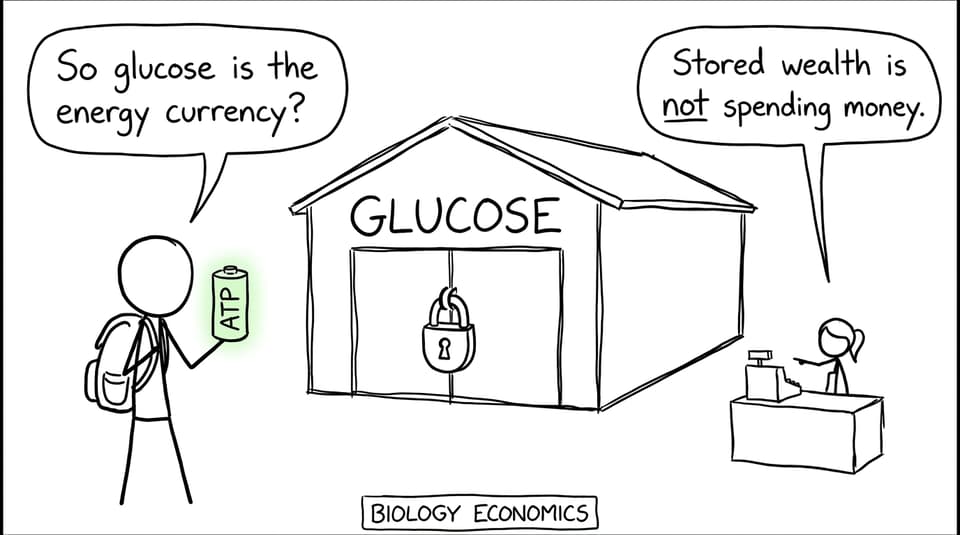
This distinction matters: glucose is an energy-rich substrate, while ATP is the immediate energy-transfer molecule used by cells. RevisionDojo's guide to the role of ATP in cellular respiration develops that difference in exam-ready language.
How the Overall Equation Connects to the Stages
The cellular respiration formula hides four connected stages:
Glycolysis
Glycolysis occurs in the cytoplasm. One six-carbon glucose molecule is converted into two three-carbon pyruvate molecules. It produces a small net gain of ATP and reduced NAD, but it does not directly require oxygen.
Link Reaction and Krebs Cycle
When oxygen is available, pyruvate enters the mitochondrion in eukaryotic cells. The link reaction converts it into acetyl-CoA, releasing carbon dioxide and reducing NAD. The Krebs cycle continues the oxidation of carbon compounds in the mitochondrial matrix, producing more carbon dioxide and reduced electron carriers.
Oxidative Phosphorylation
NADH and FADH₂ transfer electrons to the electron transport chain in the inner mitochondrial membrane. Electron transfer supplies energy for proton pumping. Protons then move through ATP synthase, driving ATP production by chemiosmosis. Oxygen accepts electrons and protons at the end of the chain, contributing to the formation of water.
HL students can review how mitochondrial structure supports this process in RevisionDojo's mitochondrial adaptations for ATP production.
Aerobic and Anaerobic Equations Are Not Interchangeable
The main equation describes aerobic respiration. When oxygen is unavailable, glycolysis can continue only if NAD is regenerated through another pathway.
In humans, pyruvate is converted to lactate:
Glucose → lactate + a small yield of ATP
In yeast, the products are ethanol and carbon dioxide:
Glucose → ethanol + carbon dioxide + a small yield of ATP
Anaerobic pathways do not completely oxidize glucose, so much of its chemical energy remains in lactate or ethanol. They consequently yield far less ATP than aerobic respiration. For a broader comparison, use the IB Biology respiration exam guide.
How the Formula Appears in IB Biology Exams
Questions rarely stop at simple recall. You may be asked to:
- state or complete the balanced equation
- identify reactants and products
- explain why oxygen is necessary
- compare aerobic and anaerobic pathways
- connect oxygen consumption with respiration rate
- calculate molecular ratios from coefficients
- explain how ATP formation supports cellular work
Consider this worked example:
Question: If three glucose molecules are completely oxidized aerobically, how many oxygen molecules are required and how many carbon dioxide molecules are produced?
The equation gives a ratio of 1 glucose : 6 oxygen : 6 carbon dioxide.
For three glucose molecules:
- Oxygen required: 3 × 6 = 18 molecules
- Carbon dioxide produced: 3 × 6 = 18 molecules
The important skill is not difficult arithmetic. It is recognizing that coefficients express molecular or molar ratios. Once you can explain the concept, test it through the C1.2 Cell Respiration Questionbank.
Common Mistakes to Avoid
Calling respiration the same thing as breathing: Breathing exchanges gases between an organism and its environment. Cellular respiration is a set of metabolic reactions inside cells.
Saying respiration creates energy: Energy is transformed and transferred, not created. A stronger answer says chemical energy from respiratory substrates is transferred to ATP and heat.
Claiming oxygen is used in glycolysis: Glycolysis does not directly require oxygen. Oxygen is the final electron acceptor during aerobic oxidative phosphorylation.
Treating the equation as one reaction: The equation summarizes a pathway containing many enzyme-controlled steps.
Saying only animals respire: Plants, animals, fungi, protists, and many prokaryotes carry out cellular respiration. Photosynthetic organisms also require ATP when light is absent.
Confusing ATP with glucose: Glucose stores substantial chemical energy, but ATP transfers manageable quantities of energy to cellular processes. Use cell respiration Flashcards to make these distinctions automatic.
Quick-Reference Exam Summary
| Exam prompt | Include in your answer |
|---|---|
| State the equation | C₆H₁₂O₆ + 6O₂ → 6CO₂ + 6H₂O + energy |
| Define cell respiration | Controlled reactions that transfer energy from carbon compounds to ATP |
| Explain oxygen's role | It is the final electron acceptor in aerobic respiration |
| State glycolysis location | Cytoplasm |
| State later aerobic locations | Mitochondrial matrix and inner mitochondrial membrane |
| Compare ATP yields | Aerobic respiration has a much greater yield than anaerobic pathways |
| Interpret coefficients | Use them as molecular or molar ratios |
Knowing the cellular respiration formula is the beginning. Exam marks usually come from explaining the mechanisms underneath it and applying the ratios accurately.
RevisionDojo brings that progression into one place: learn with Study Notes and lessons, retrieve with Flashcards, apply through the Questionbank, and clarify difficult steps with AI Chat. Its wider IB toolkit also includes Grading tools, Predicted Papers, Mock Exams, a Coursework Library, and Tutors. Start with the complete IB Biology resource hub, then turn one memorized equation into a connected understanding of respiration.