
The question often arrives before the evidence does: Can my child handle IB?
It is a reasonable concern. The IB Diploma Programme is academically demanding, and choosing it can feel like making a prediction about who your child will be two years from now.
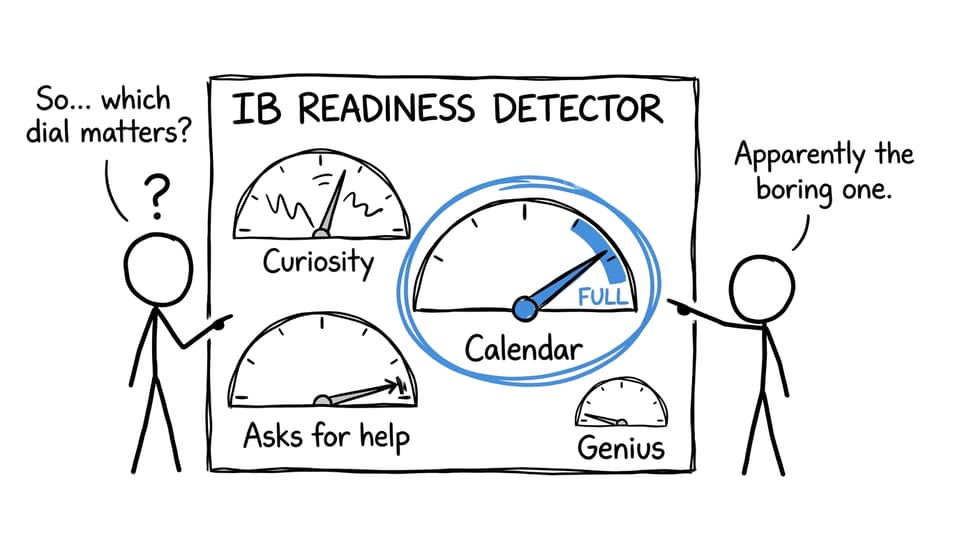
The reassuring answer is that IB readiness is not determined by raw intelligence, perfect grades, or an unusual tolerance for stress. It depends more on whether a student is willing to work consistently, manage several responsibilities, respond to feedback, and ask for help. Those skills do not need to be fully developed on day one. They need to be teachable.
A student who is curious, reasonably organised, and open to improving their habits may be better prepared than a high achiever who depends on last-minute effort. The question is therefore not simply whether your child can survive a difficult curriculum. It is whether the right subjects, expectations, routines, and support can make that curriculum sustainable.
The short IB readiness checklist
Your child does not need to tick every box. Look instead for a workable foundation:
- They show genuine interest in at least some academic subjects.
- They can complete ordinary schoolwork without constant supervision.
- They are willing to revisit work after receiving feedback.
- They can tolerate not understanding something immediately.
- They are prepared to use a calendar or another planning system.
- They can communicate when they are confused or overloaded.
- Their proposed Higher Level subjects fit their strengths and future plans.
- They have enough room in their life for sleep, relationships, and recovery.
Four or five positive signs can be enough if the missing skills are acknowledged and supported. A checklist is not a verdict. It is a map of what needs strengthening before the workload rises.
What is the IB Diploma actually asking students to do?
For parents asking what the IB Diploma is and how it works, the official structure is a useful starting point. The Diploma Programme is a two-year curriculum for students aged 16 to 19. Students study six subjects, normally taking three or four at Higher Level and the remainder at Standard Level.
Higher Level courses are broader and deeper. The IB recommends 240 teaching hours for each HL course and 150 for each SL course. Alongside these subjects, students complete the Diploma Programme core:
- Theory of Knowledge (TOK): reflection on knowledge and how claims are justified
- Extended Essay (EE): an independent research project culminating in a paper of up to 4,000 words
- Creativity, Activity, Service (CAS): sustained experiences across the three strands, including a project
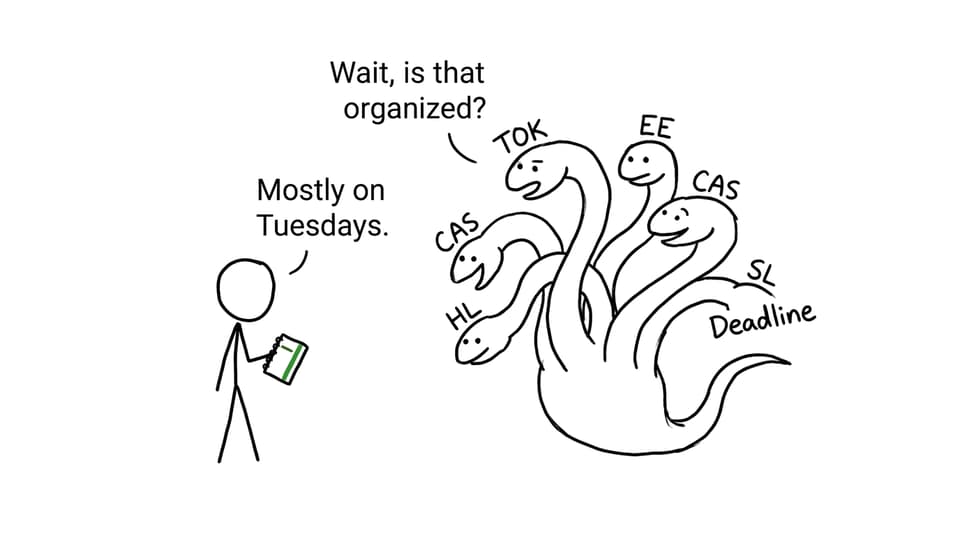
This breadth is why the programme can feel heavier than a simple collection of exams. Deadlines overlap. A science investigation may sit beside an oral assessment, an essay draft, CAS commitments, and ordinary class preparation.
Yet the structure also explains why no single personality type owns IB success. It rewards thinking, communication, research, self-management, and reflection. These are skills that can improve through practice, feedback, and appropriate support. Families new to the terminology may also find this IB programme and grading system overview helpful.
The strongest signs your child can handle IB
They recover from difficulty
An IB-ready student does not always get the answer quickly. More importantly, they can return after getting it wrong.
Consider two hypothetical students. One has always earned excellent marks but sees correction as evidence of failure. The other sometimes struggles but reads the feedback, asks a precise question, and tries again. The second student may possess the more valuable long-term habit.
IB work regularly asks students to analyse, justify, evaluate, and revise. A willingness to improve an imperfect first attempt matters more than looking effortlessly capable.
They can work without immediate pressure
Large projects create a particular challenge: important work can remain non-urgent for months. Students who only act when a deadline becomes frightening may find the EE and internal coursework difficult to manage.
Readiness does not require flawless organisation. It requires accepting that planning is part of the work. A student who will break an essay into research, outline, drafting, and editing stages has a foundation to build on. RevisionDojo's guide to time management techniques for IB students shows how large responsibilities can become smaller scheduled actions.
Their motivation has some internal source
Parental encouragement matters, but it cannot carry six subjects for two years. Your child needs at least one personal reason to choose the programme: intellectual curiosity, preferred subjects, university goals, enjoyment of discussion, or the appeal of a broad education.
Ask, “What about IB interests you?” rather than “Do you promise to work hard?” The first question reveals motivation. The second often produces the answer a worried parent wants to hear.
They can ask for help before a crisis
Independence is not silent struggle. Strong independent learners know when they need a teacher, coordinator, tutor, classmate, or clearer explanation.
A child who currently hesitates to seek help is not automatically unsuitable. But the family should address that pattern early. Waiting until confusion has accumulated across several subjects turns a small academic gap into an emotional one.
Warning signs that deserve an honest conversation
Some concerns do not mean “no.” They mean “not without a plan.”
| Warning sign | Question to investigate |
|---|---|
| Chronic last-minute work | Will your child use a weekly planning routine? |
| Strong dislike of writing or revision | Are they willing to practise these skills consistently? |
| A packed extracurricular schedule | What can be reduced during deadline-heavy periods? |
| Reluctance to ask for help | Which trusted adult will become the first contact? |
| Subject choices based only on prestige | Do the HL selections fit ability, interest, and university requirements? |
| Existing exhaustion or persistent distress | What support and programme options does the school recommend? |
Current wellbeing deserves particular care. IB should stretch a student, but academic challenge is not the same as continuous distress. Speak with the school's IB coordinator and relevant health professionals when wellbeing is a concern. A different course combination or educational route is not a lesser choice if it is the healthier and more appropriate one.
Subject selection also changes the experience substantially. A student may be suited to IB but poorly matched to a specific HL combination. Discuss recent classroom evidence, teacher recommendations, assessment style, and current university prerequisites rather than choosing subjects for status alone.
Test readiness before making the decision
Predictions improve when they are based on behaviour rather than impressions. Run a short, low-stakes readiness trial for two or three weeks.
Ask your child to:
- Record every school deadline in one calendar.
- Complete four planned study sessions each week.
- Divide one larger assignment into at least three milestones.
- Review feedback from a previous assignment and apply one correction.
- Ask a teacher one specific question when uncertain.
- Keep one evening or meaningful block of time free from academic work.
At the end, avoid asking only whether everything was completed. Discuss what caused delay, whether the plan was realistic, and what your child changed after a difficult day. Adaptation is a stronger readiness signal than perfect compliance.
If the trial collapses, examine why. Perhaps the tasks were vague, the calendar was never checked, or the schedule ignored existing commitments. Those are solvable system problems. The guide to building a study routine that works can help turn good intentions into repeatable behaviour.
How parents can support IB without taking it over
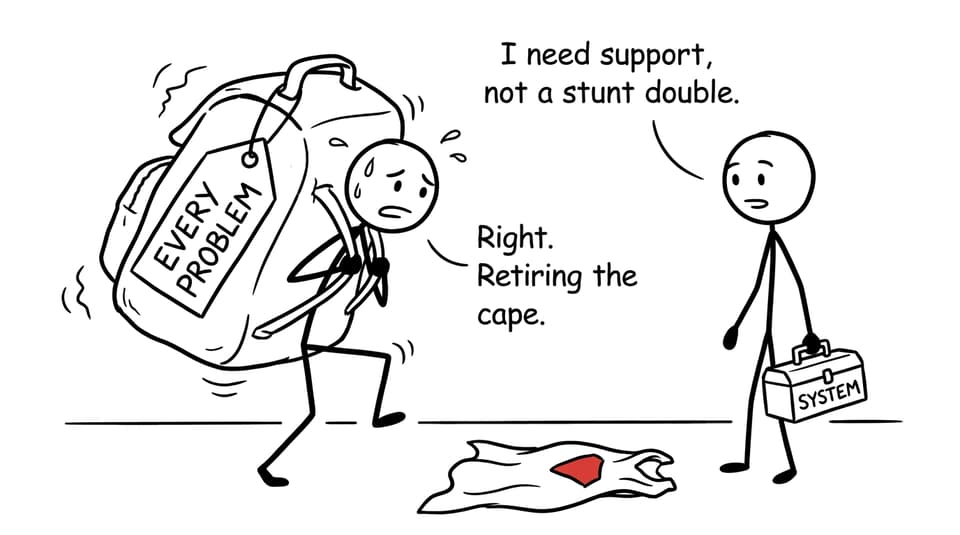
The most useful parental role is closer to infrastructure than management. You create conditions in which the student can take responsibility.
A weekly ten-minute check-in can cover four questions:
- What is due in the next two weeks?
- Which task feels least clear?
- What are you doing next?
- Do you need help finding support?
Then step back. Repeated reminders can temporarily produce completed work while weakening ownership. It is often better to agree on one visible planning system and one regular check-in than to monitor every evening.
Protecting ordinary life matters too. Sleep, meals, movement, friendships, and downtime are not rewards to be earned after every task disappears. In a programme where work can always be improved, that day may never come. Students can use a balanced IB study schedule to give both work and recovery a defined place.
Readiness is really a question of infrastructure
Workload rarely arrives evenly. The danger is not that every week will be overwhelming. It is that several deadlines and weaker topics can converge before a student has a dependable way to respond.
That is why RevisionDojo is valuable before the pressure peaks, not only when exams are close. A student can establish a simple learning loop early: use Study Notes to clarify one concept, Flashcards to retrieve it, and the RevisionDojo Questionbank to apply it. AI Chat can help unblock a precise question, while Grading tools make feedback part of the next attempt.
As assessment demands grow, Predicted Papers and Mock Exams support timed preparation. The Coursework Library helps students understand academic expectations, and Tutors provide human guidance when a problem needs more than another solo study session. Students worried about maintaining intensity can also follow the practical framework in How to Study for IB Exams Without Burning Out.
The deeper benefit is consistency. When materials, practice, feedback, and progress tracking are available in one IB-focused environment, starting becomes easier. And starting early is often what prevents ordinary confusion from becoming an emergency.
A better final question
“Can my child handle IB?” sounds as though readiness is a fixed trait waiting to be discovered. A more useful question is: “What conditions would help my child learn well in IB, and can we put them in place?”
Look for curiosity, recovery after mistakes, growing independence, sensible subject choices, and a willingness to plan. Take warning signs seriously without treating them as permanent labels. Speak with teachers and the IB coordinator, then test the required habits while the stakes are still low.
If IB is the right fit, introduce RevisionDojo early and let the system become familiar before deadlines intensify. Ability opens the door, but sustainable routines help a student keep walking through it.