
Building a CAS culture does not mean filling the calendar with more service days. It means creating a school where creativity, physical wellbeing, community partnership, initiative, and reflection are visible parts of everyday life.
For Diploma Programme coordinators, the practical shift is from asking, “How do we get students to complete CAS?” to asking, “What conditions help students find work worth continuing?” Requirements matter, but compliance should form the floor of the programme, not its personality.
CAS is a required, ungraded part of the DP core. Students engage across Creativity, Activity, and Service, complete at least one collaborative project, maintain evidence, reflect on their development, and demonstrate the seven learning outcomes. RevisionDojo’s plain-language explanation of CAS helps families and staff understand this framework without reducing it to a checklist.
The deeper opportunity is cultural. When students see teachers, younger learners, community partners, and school leaders participating in the same values, CAS stops feeling like an administrative island.
A school-wide CAS culture checklist
Use these questions as a quick diagnostic:
- Can students explain the purpose of CAS without mentioning forms first?
- Do they have meaningful choices rather than a fixed activity menu?
- Are Creativity, Activity, and Service visible beyond the DP cohort?
- Do staff understand how to encourage CAS without taking over?
- Are community partners involved in defining needs and evaluating projects?
- Is reflection part of normal routines rather than saved for deadlines?
- Can every student participate regardless of income, transport, ability, or connections?
- Are students recognised for learning and ethical judgment rather than hours accumulated?
Answering yes to most of these questions suggests the school is cultivating an environment where CAS can mean something.
Start with purpose, not promotion
School-wide CAS engagement often begins with an assembly, poster campaign, or launch event. Visibility helps, but enthusiasm cannot repair a programme whose purpose is unclear.
Develop a short shared statement explaining that CAS gives students room to explore interests, care for wellbeing, collaborate, and respond responsibly to real needs. Connect it to the school mission and IB learner profile, then use consistent language in student induction, staff briefings, parent communication, and project reviews.
Clarity also means distinguishing IB expectations from local procedures. CAS continues regularly for at least 18 months, includes three formal interviews, and requires evidence of all seven learning outcomes. Schools may set their own deadlines, platforms, and approval processes, but these should not be presented as universal IB rules. The CAS minimum requirements guide supports consistent communication.
Give students structure and ownership
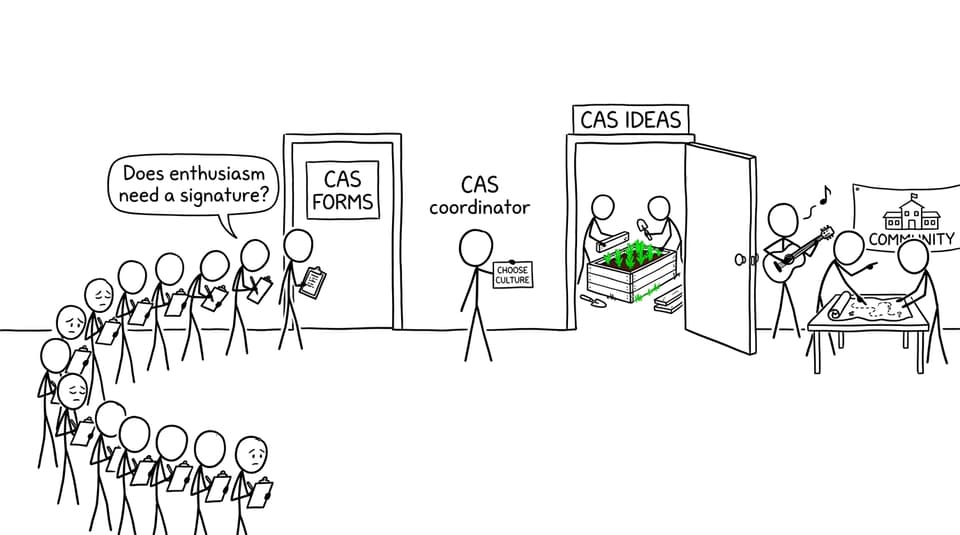
A weak CAS programme tends toward one of two extremes. Students are told exactly what to do, or they receive complete freedom without enough guidance to begin.
The better approach is structured agency. Give students a dependable process for investigating needs, preparing, acting, reflecting, and demonstrating learning. Then let them decide which issue, skill, community, or challenge deserves attention.
Useful structures include:
- a student-led CAS council representing different interests and year groups
- proposal clinics where students test ideas before completing full plans
- matchmaking sessions organised around interests rather than predetermined activities
- peer mentors who share obstacles and revisions, not only polished successes
- a searchable map of school and community opportunities
- small seed grants with transparent, equitable criteria
Students must also understand the distinction between a CAS experience and the required collaborative project. RevisionDojo’s guide to CAS projects and experiences explains duration, planning, collaboration, and evidence.
Ownership does not mean the absence of adult support. It is the gradual transfer of decisions to students while adults continue supervising safeguarding, feasibility, ethics, and community dignity.
Make every adult a doorway into CAS
The CAS coordinator cannot generate every opportunity, supervise every experience, and sustain every partnership. A strong culture distributes awareness without diluting responsibility.
Give colleagues a concise annual briefing covering the three strands, learning outcomes, referral procedures, safeguarding expectations, and limits of their role. Teachers do not need to become CAS assessors. They need enough understanding to notice possibilities.
A mathematics teacher might hear a student discussing accessible transport data. A music teacher may know a community group seeking workshop leaders. A librarian may recognise that a reading project could become an inclusive younger-reader programme. The adult opens the door; the student investigates and leads.
CAS can connect with classroom learning, provided assessed academic work is not simply relabelled. RevisionDojo’s article on embedding creativity, action, and reflection into academic units helps departments create conceptual bridges while preserving CAS as experiential learning.
Build reciprocal community partnerships
Service becomes hollow when schools decide what a community needs without asking. Stronger programmes treat partner organisations as collaborators with priorities, expertise, and limits of their own.
Build a small, dependable network rather than a long directory of inactive contacts. Before promoting an opportunity, ask what support is useful, what preparation students need, what continuity is realistic, and how impact should be reviewed. Discuss consent, photography, transport, safeguarding, data handling, and the risk of creating extra work for the organisation.
Whenever possible, move from one-day intervention to sustained relationship. A clean-up may create awareness. A continuing partnership that studies waste patterns, consults users, changes systems, and reviews results offers richer opportunities for planning, perseverance, collaboration, and ethical reflection.
Reciprocity also changes the language of celebration. Instead of saying students “helped” a community, explain what students and partners created or learned together.
Protect time for conversation and reflection
Culture grows through repeated attention. Even a brief advisory slot every two weeks can provide rhythm for idea development, ethical scenarios, portfolio check-ins, partner feedback, or small-group discussion. Avoid turning every session into document inspection.
Students do not need to produce a ceremonial essay after every activity. They need to examine significant moments, decisions, difficulties, assumptions, and changes. The CAS reflection guidance for coordinators and students helps move portfolios from description toward evidence of learning.
Where school procedures allow, reflection can include concise writing, audio, annotated photographs, diagrams, presentations, or conversations. Quality comes from specificity and thought, not length.
Celebrate learning without creating a popularity contest
Celebration signals what a school values. It can also distort those values if recognition goes only to large events, charismatic leaders, or projects with attractive photographs.
Use several channels, such as displays, newsletters, community evenings, tutor conversations, assembly interviews, or exhibitions. Feature unfinished thinking alongside successful outcomes. Ask what changed, what failed, whose perspective altered the plan, and what students would do differently.
A monthly “decision worth discussing” may be more educational than a project award. It can recognise ethical restraint, thoughtful adaptation, quiet consistency, and responsible cancellation alongside visible achievement. Including younger year groups also makes CAS values part of the wider school identity before students enter the DP.
Remove barriers before asking for engagement
Choice is not meaningful when some students have transport, equipment, money, and family networks while others do not. Audit opportunities for hidden costs, scheduling conflicts, physical accessibility, language barriers, digital access, and cultural assumptions.
Build credible options into the school day. Offer equipment loans, accessible activities, transport support where possible, and partnerships within walking distance or online. Students may also design modest projects around responsibilities and interests they already hold, provided the experiences meet CAS expectations.
Academic pressure can become another barrier. RevisionDojo does not replace school CAS supervision or portfolio systems. Instead, its Questionbank, Study Notes, Flashcards, AI Chat, Grading tools, Predicted Papers, Mock Exams, Coursework Library, and Tutors can help students organise academic work and preserve time for meaningful participation. The guide to balancing CAS and IB study offers practical scheduling habits.
Measure cultural health, not only completion
Completion data reveals whether CAS is functioning administratively. It cannot show whether students experience it as meaningful.
Track whether students initiate ideas, sustain partnerships, adapt after feedback, cross social boundaries, and describe learning specifically. Ask partners whether relationships were useful and respectful. Ask staff whether they can refer opportunities, then examine who participates visibly and who remains at the margins.
Student listening groups may reveal where procedures create friction or support arrives too late. Close the feedback loop by publishing two or three changes the school will make.
The goal is not a programme that merely looks busy. It is a community where students can identify something worth doing, find people worth doing it with, and think honestly about what follows. RevisionDojo supports the academic and reflective habits around that journey, giving coordinators more room to cultivate its human foundations: purpose, trust, responsibility, and sustained action.