
The best way to revise for MYP English Language and Literature is to practise one assessable skill at a time, receive specific feedback, and rewrite your weakest section. Do not spend most of your time rereading novels or copying technique definitions. Learn briefly, retrieve the idea from memory, apply it to an unfamiliar text, and improve what you wrote.
English can make ineffective revision feel productive. Highlighting quotations feels like work. Building beautiful notes feels organised. Yet the assessment asks you to analyse, organise, create, and communicate. Those are performances, not collections of information.
A reliable revision cycle is simple:
- Learn: review one technique, text type, or criterion.
- Recall: explain it without looking at your notes.
- Apply: complete a short analytical or creative task.
- Check: compare the work with the relevant criterion descriptors.
- Rewrite: improve one precise weakness.
- Repeat: use a different text next time.
You can begin this cycle today, even if you have only 45 minutes.
Understand what MYP English actually assesses
The IB framework uses four equally weighted Language and Literature criteria, each with a maximum achievement level of 8:
- Criterion A: Analysing
- Criterion B: Organizing
- Criterion C: Producing text
- Criterion D: Using language
The exact descriptors differ according to the MYP year, so use the version supplied by your teacher. The broad lesson is consistent: knowing a text is not enough. You must show what a creator has done, explain how choices shape meaning, arrange ideas purposefully, write for an audience, and control your language.
Read RevisionDojo's guide to MYP Language and Literature assessment criteria before planning revision. Translate each descriptor into an action you can demonstrate. For example, turn “analyse the effects of the creator's choices” into: name a choice, select evidence, explain its effect, and connect that effect to purpose.
The same-day 45-minute revision method
You need an unfamiliar literary or non-literary extract, your current criteria, paper, and a timer.
Choose one criterion and one narrow target
Spend five minutes selecting a single weakness. Do not choose “get better at English.” Choose something visible, such as explaining diction, writing purposeful topic sentences, comparing structural choices, adapting register, or correcting sentence boundaries.
If you are unsure where to begin, use the MYP English Language and Literature resource hub to review a focused skill. Keep this stage short. Revision starts producing value when you try to use the idea.
Retrieve the idea without looking
For five minutes, write everything you can remember about the chosen skill. Define key terminology and create one example. Then check your notes and correct omissions in another colour.
RevisionDojo Flashcards help because they make you produce an answer before seeing it. Recognition can be misleading: a definition may look familiar even when you cannot retrieve or apply it independently.
Annotate one unfamiliar text
Spend eight minutes reading a fresh extract. Identify its purpose, likely audience, central idea, and two or three important creator choices. These might involve diction, imagery, viewpoint, pacing, juxtaposition, layout, typography, framing, or tone.
Do not circle every technique. Select details that answer a meaningful question. RevisionDojo's evidence selection notes can help you distinguish noticeable evidence from evidence that supports a claim.
Plan, write, check, and rewrite
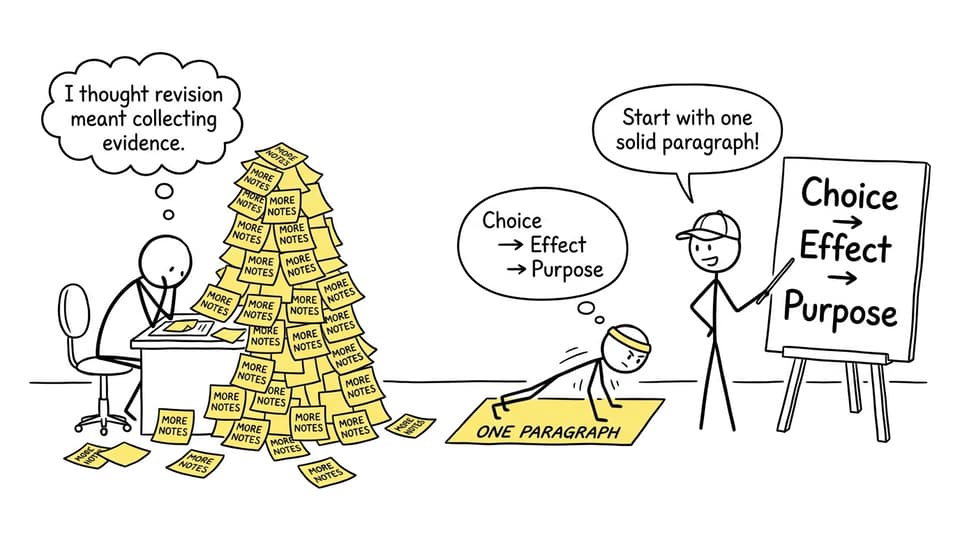
Use five minutes to form a claim and seven minutes to write. Build the paragraph around this chain:
Claim --> evidence --> creator's choice --> effect --> purpose
Ask: Why this choice, for this audience, at this moment? That question pushes you beyond identification. If you tend to retell content, work through these methods for improving MYP English analysis.
Use the final 15 minutes to compare your paragraph with the selected criterion. Identify one major weakness and rewrite the relevant sentences rather than starting again. If your evidence is strong but your explanation is vague, keep the quotation and replace the explanation.
RevisionDojo's Grading tools can support criteria-aware review, while AI Chat can question your reasoning or help identify where a claim becomes descriptive. Treat feedback as guidance, not substitute prose: your final response must remain your own and comply with your school's academic-integrity rules.
Finish by recording one rule in an error log: Next time, I will connect every effect to the creator's wider purpose.
MYP English Language and Literature revision techniques
Train analysis as a chain of reasoning
Weak analysis often stops after naming a device: “The writer uses a metaphor.” Stronger analysis follows the consequences of that choice.
Ask:
- What precise choice has the creator made?
- What does it suggest in this context?
- How might it shape the audience's response?
- How does that response support the creator's purpose?
Alternative interpretations can strengthen your reasoning when plausible and supported. They should not become guesses detached from the text. RevisionDojo's MYP curriculum expectations guide explains the skills behind this kind of response.
Separate analytical and creative practice
Criterion C requires deliberate production, not simply imagination. When practising a speech, article, narrative, or other text type, define the audience, purpose, context, and intended effect before writing.
Then make conscious choices about structure, voice, detail, register, and style. Annotate your own response afterward. Can you point to evidence that the language suits the intended reader? Can you explain why the opening and ending were designed that way?
Alternate analytical practice with production tasks. Analysis teaches you to recognise effective choices; creative practice teaches you to make them.
Use unfamiliar texts every week
Familiarity with a class novel matters, but it can create false confidence. You may remember the discussion without being able to analyse independently.
Use one unfamiliar literary or non-literary text each week. Begin with untimed annotation, progress to a short timed paragraph, and eventually complete a longer response under your teacher's conditions. The common MYP language-task mistakes guide is useful when reviewing summary, unfocused evidence, or weak links to purpose.
A weekly plan that remains manageable
Effective revision is small enough to repeat:
- Monday: retrieve terminology with Flashcards and write one analysis paragraph.
- Tuesday: plan a response, concentrating on Criterion B.
- Wednesday: create a short text for a defined purpose and audience.
- Thursday: complete an unfamiliar-text task under timed conditions.
- Friday: use teacher comments or Grading tools, then rewrite one weak section.
- Weekend: complete a longer response and update your error log.
Use RevisionDojo Study Notes when knowledge is missing, the Questionbank for focused application, and Mock Exams when timing and stamina matter. Predicted Papers, where relevant and available, provide further structured rehearsal. The Coursework Library helps you study how effective responses are organised, while Tutors can diagnose recurring weaknesses that automated feedback has not resolved.
If you are aiming for the highest achievement band, the goal is not decorative vocabulary. It is controlled thinking. RevisionDojo's guide to scoring a 7 in MYP Language and Literature explains how precise claims, evidence, organisation, and editing work together.
How to know whether revision is working
Do not measure revision by hours, pages highlighted, or notes produced. Measure what you can now do independently.
After two weeks, ask:
- Can I analyse a new text without relying on a memorised interpretation?
- Can I explain effect and purpose rather than merely identify techniques?
- Can I plan a coherent response in five minutes?
- Can I adapt tone and structure for a different audience?
- Are the same errors disappearing from my writing?
Keep a small portfolio containing first attempts, feedback, rewrites, and error-log entries. Improvement becomes visible when rewritten versions show clearer reasoning and the same corrections begin appearing in first drafts.
The best revision system is not the one that gives you the most material. It is the one that repeatedly turns information into independent performance. RevisionDojo is the ultimate MYP resource for building that loop: learn through Study Notes, retrieve with Flashcards, practise through the Questionbank, clarify with AI Chat, check with Grading tools, and rehearse with Mock Exams. Begin with one paragraph today. Then improve it. Progress in English often arrives quietly, one better sentence at a time.