
The best note-taking method for MYP History is a modified Cornell system built around historical thinking. Instead of copying a lesson chronologically, divide each page into cues, structured evidence, and a short argument summary. Then convert the page into questions and retrieve the answers without looking.
This works because MYP History requires more than remembered facts. Students need terminology, explanations, research skills, source evaluation, perspectives, and supported arguments. A page full of dates preserves information, but a well-designed page helps you use it.
The method at a glance
Use one page for one focused historical question. Divide it into three Cornell sections, then add a history-specific evidence box.
| Page area | What to record |
|---|---|
| Cue column | Questions, command terms, key concepts, and retrieval prompts |
| Main notes | Causes, events, consequences, evidence, and perspectives |
| Evidence box | Source origin, purpose, value, limitation, and usable details |
| Bottom summary | A three-to-five sentence answer to the central question |
The method is simple enough for class but analytical enough to support MYP criteria. It also fits naturally beside the RevisionDojo MYP History resources, where Study Notes, Flashcards, Lessons, and Questionbank practice can help fill gaps and test understanding.
Why Cornell notes need a History upgrade
Traditional Cornell notes provide a large notes area, a narrow cue column, and a summary. That structure is useful, but History has a special problem: events do not exist as isolated bullet points.
A revolution may have economic, political, and ideological causes. Groups may interpret it differently. A source may be useful for one question and limited for another. Organize the main section around recurring historical categories:
- Context: What was happening before the event?
- Cause: Why did it happen?
- Development: What changed, and in what sequence?
- Consequence: Who or what was affected?
- Perspective: How did groups interpret it differently?
- Evidence: Which precise example supports the explanation?
- Significance: Why does the information matter?
This structure moves from knowing toward analysis. The MYP Individuals and Societies framework uses four equally weighted criteria: knowing and understanding, investigating, communicating, and thinking critically. RevisionDojo's guide to the difference between MYP History and DP History adds context on MYP-level historical thinking.
Set up your first page
You do not need a new notebook, elaborate app, or perfect color system. Take one blank page and follow these steps.
Choose one central question
Write a focused question at the top. Avoid broad titles such as "The Industrial Revolution." Use a question that creates direction:
Why did industrialization transform urban life?
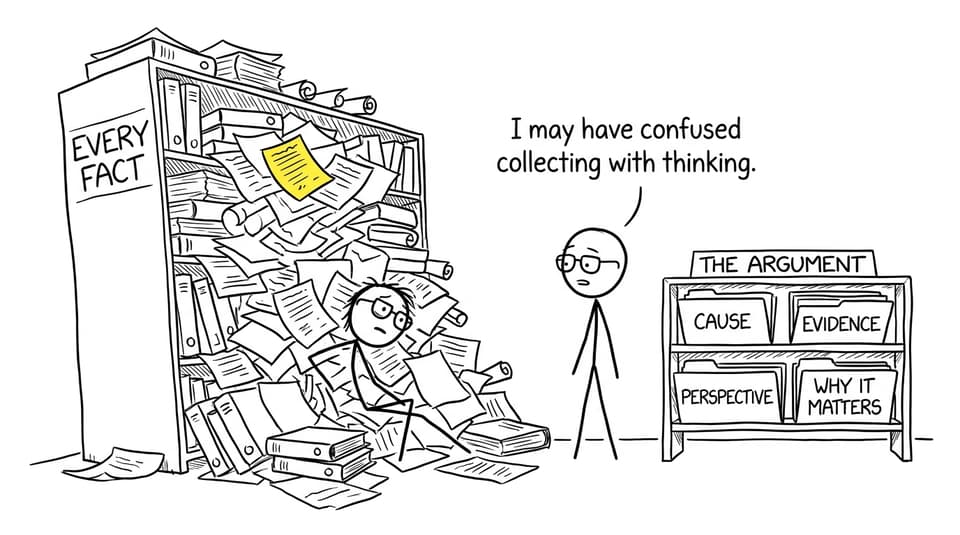
A question helps you decide which details matter. It also prepares you to construct an argument rather than reproduce a chapter.
Divide the page
Draw a vertical line roughly one-quarter of the way across the page. The narrow left side is the cue column; the wider right side holds the main notes. Reserve several lines at the bottom for your summary.
Create a small source box labelled Origin, Purpose, Value, Limitation. Use it for a speech, image, statistic, letter, law, or historical account.
Capture relationships in your own words
Resist transcription. Record short explanations using arrows and labels:
Factory growth -> demand for urban workers -> rapid migration -> overcrowded housing
Add a specific example when a source provides one. If a detail does not explain a cause, consequence, perspective, or argument, ask whether it belongs on the page.
Research on note-taking generally supports selecting, paraphrasing, organizing, and summarizing over verbatim copying. The medium can follow your preferences and school rules; the thinking cannot be outsourced.
Add perspective labels
History changes when the observer changes. Mark viewpoints clearly:
- Factory owner: mechanization increased production and opportunity.
- Worker: long hours and unsafe conditions reduced quality of life.
- Reformer: industrial growth required regulation.
This prepares you to compare interpretations. For more practice connecting events to time, place, and viewpoint, explore Orientation in Space and Time in MYP.
Build retrieval questions
After class, cover the main notes and fill the cue column with questions:
- What were the three main causes?
- Which consequence was most significant?
- What evidence supports that judgment?
- How would two groups disagree?
- What is one value and one limitation of the source?
These prompts turn the page into a self-testing tool. Retrieval practice is generally more useful for long-term retention than repeatedly reading, especially when you check and correct your answers.
Write the summary from memory
Close your source before writing. Answer the central question in three to five sentences using a claim, evidence, explanation, and qualification. If you cannot do this, reopen the material, repair the missing connection, and try again.
Use a same-day review loop
The strongest notes are not necessarily the neatest. They are the ones you revisit and transform. Use this 15-minute routine:
- Three minutes: clarify incomplete wording and missing source details.
- Four minutes: answer the cue questions aloud with the notes covered.
- Three minutes: check your answers and mark uncertainty.
- Three minutes: write the summary from memory, including a judgment.
- Two minutes: create two Flashcards, one factual and one analytical.
A factual card might ask for a definition of nationalism. An analytical card might ask how nationalism could unify one society while dividing another. RevisionDojo's MYP Individuals and Societies revision notes can help repair missing knowledge.
Match notes to the MYP criteria
Useful MYP History revision techniques should prepare you for assessment demands. Add a criterion label whenever you review a page.
For Criterion A, check for accurate terminology, precise examples, and explanations. For Criterion B, record the research question, source details, and why each source is relevant. For Criterion C, organize evidence for the required format and audience. RevisionDojo's overview of MYP Individuals and Societies global issues demonstrates organization around concepts, stakeholders, and implications.
For Criterion D, include competing explanations, source limitations, and evidence-based judgments. Ask which cause mattered most, whether consequences differed across groups, and what the available evidence cannot establish. Your page should gradually become less like storage and more like rehearsal.
Turn notes into a weekly system
Once you have several pages, use a spaced sequence:
- Same day: complete the 15-minute review loop.
- Two or three days later: answer every cue question without opening the page.
- One week later: create a blank timeline or causal map from memory.
- Two weeks later: answer a Questionbank prompt using several pages.
- Before assessment: complete a timed response and update an error log.
RevisionDojo then becomes more than a reference library. Study Notes clarify weak concepts, Flashcards reinforce terminology, the Questionbank tests application, and AI Chat can challenge an unsupported claim. Grading tools can reveal rubric-related weaknesses before a rewrite.
For broader planning, use the MYP eAssessments 30-day study plan. Mock Exams and relevant Predicted Papers can support timed preparation where available, while the Coursework Library and Tutors offer additional models or guidance.
Common mistakes to avoid
Do not spend twenty minutes decorating a heading and two minutes testing the content. Color should have a consistent meaning, such as one color for evidence and another for limitations.
Avoid making every fact a Flashcard. Dates and definitions deserve retrieval practice, but historical thinking also requires questions about causation, significance, continuity, change, and perspective.
Do not ask AI to produce finished notes that you merely save. Use RevisionDojo's AI Chat to question you, expose a missing perspective, or explain why an argument is vague. The RevisionDojo review for MYP Individuals and Societies explains how notes, recall, questions, and feedback can operate as one loop.
Build notes that make thinking visible
The best notebook is not an archive of everything your teacher said. It is a tool that makes the next intellectual move obvious.
Start with one question, one divided page, one source box, and one summary written from memory. Tomorrow, cover the notes and test yourself. Then use RevisionDojo to close knowledge gaps, practise historical reasoning, and turn each repaired weakness into stronger evidence, clearer communication, and better judgment.