The best MYP History revision websites do different jobs. RevisionDojo is the strongest all-in-one option for MYP-specific notes, questions, Flashcards, and feedback. Khan Academy is excellent for free background learning, Digital Inquiry Group is stronger for source analysis, and World History Encyclopedia is useful when a topic needs depth.
That distinction matters because MYP History is not simply a contest to remember the most dates. History sits within the MYP Individuals and Societies subject group, where students are expected to know content, investigate questions, communicate effectively, and think critically. The official framework organizes these expectations into four equally weighted assessment criteria.
The sensible answer is therefore not to collect ten bookmarks. It is to give each resource a clear job.
The shortlist at a glance
| Rank | Website | Best for | One honest reason to choose it |
|---|---|---|---|
| 1 | RevisionDojo | Complete MYP History revision | It connects MYP-focused learning, recall, practice, and feedback in one place. |
| 2 | Khan Academy | Free background explanations | Its videos and articles make broad world-history developments easier to understand. |
| 3 | Digital Inquiry Group | Source analysis | Its document-based lessons explicitly develop sourcing, contextualization, corroboration, and evidence use. |
| 4 | World History Encyclopedia | Research and topic depth | Its reviewed articles, maps, images, and bibliographies provide useful context beyond a short revision guide. |
| 5 | BBC Bitesize | Quick explanations and quizzes | It makes difficult topics approachable, although its History material follows UK qualifications rather than MYP. |
| 6 | International Baccalaureate website | Checking programme expectations | It is the authoritative place to understand what MYP Individuals and Societies is designed to assess. |
Before choosing, ask five questions:
- Does the site match the unit taught by the student’s school?
- Does it support the relevant MYP assessment criteria?
- Can the student practise retrieval rather than merely reread?
- Is there a way to apply knowledge to questions or sources?
- Does the student receive useful feedback on what to improve?
Why MYP History resources are difficult to compare
The MYP is a framework rather than one globally identical sequence of History topics. Schools may offer History as a discrete course, combine disciplines into modules, or teach an integrated Individuals and Societies course.
This is why a long content library does not automatically make a website suitable. The student first needs to compare its coverage with the school’s unit outline, assessment instructions, and teacher guidance.
The four MYP Individuals and Societies criteria broadly cover:
- Criterion A: knowing and understanding
- Criterion B: investigating
- Criterion C: communicating
- Criterion D: thinking critically
Strong MYP History study tools should help students move across these skills. They need factual knowledge, but they also need to formulate questions, document sources, interpret perspectives, construct supported arguments, and evaluate evidence.
RevisionDojo: best overall for MYP-focused revision
RevisionDojo ranks first because it is the most directly aligned with the complete revision process rather than one isolated part of it. Its dedicated MYP History resource hub brings together a Questionbank, an exam builder, bite-sized study guides, lessons, Flashcards, key definitions, and AI-supported feedback.
The advantage is continuity. A student can learn an unfamiliar idea through Study Notes, use Flashcards to retrieve the essential people and concepts, then open the MYP History Questionbank and apply that knowledge. AI Chat and Grading tools can then help clarify an explanation or identify a weakness in a response.
Coverage is organized into recognizable thematic areas. Students can move into focused collections such as War, Conflict and Peacemaking, Imperialism and Colonisation, or Protest Strategies and Activism when those themes match their school course.
There is still an honest limitation. No platform can know every teacher’s chosen case studies or reproduce the precise context of a school assignment. Students should use RevisionDojo alongside their unit outline and teacher feedback, not treat any online resource as a replacement for them.
Beyond MYP, RevisionDojo provides Predicted Papers, Mock Exams, a Coursework Library, Tutors, and the same core learning tools for the wider IB journey.
Khan Academy: best for free historical background
Khan Academy is a strong second choice when a student understands isolated facts but cannot see the larger sequence. Its world-history courses combine videos, articles, and practice across developments such as empires, belief systems, trade, industrialization, global conflict, and globalization.
Its greatest strength is explanation. A clear overview can turn a list of events into a chain of causes and consequences, which gives later revision somewhere to attach.
The limitation is alignment. Khan Academy’s world-history material is not built around MYP criteria or a student’s school-designed course. It should be used to clarify content, not as the sole guide to assessment. After watching or reading, the student should return to an MYP-aligned task and practise using the knowledge in an argument.
Digital Inquiry Group: best for source analysis
Digital Inquiry Group, formerly the Stanford History Education Group, is the most distinctive outside option on this list. Its Reading Like a Historian materials use historical documents to teach sourcing, contextualization, corroboration, close reading, and evidence-based argument.
Those habits connect naturally with MYP investigation and critical thinking. A student who habitually asks who created a source, for what audience, under what circumstances, and with what limitations is doing more than memorizing an evaluation formula. They are beginning to think like a historian.
The trade-off is that many materials are designed as classroom lessons, often around United States history. Topic overlap will vary. Use Digital Inquiry Group as a skills gym, then apply those skills to the sources assigned at school.
World History Encyclopedia: best for research depth
World History Encyclopedia is useful when a textbook paragraph feels too thin. The nonprofit publishes reviewed articles supported by bibliographies, alongside maps, images, timelines, and educational resources.
This makes it particularly helpful near the beginning of an investigation. A student can build contextual knowledge, discover relevant terminology, and follow bibliographic leads toward stronger sources.
But an encyclopedia should begin research, not end it. Students still need to evaluate the specific article, consult more than one source, keep accurate citation details, and write independently. Copying polished explanations produces the appearance of knowledge without the thinking that MYP assessment rewards.
BBC Bitesize: best for quick clarification
BBC Bitesize offers concise study guides, quizzes, videos, and exam-skills support. Its accessible explanations can rescue a student who needs a quick introduction to topics such as the Cold War, Nazi Germany, or Elizabethan England.
The caveat is substantial: its secondary History resources are organized mainly around GCSE, National 5, Higher, and related UK courses. Topic overlap does not mean assessment alignment. An MYP student can borrow the explanation, but should not automatically borrow the response structure or assume the coverage matches the school unit.
The IB website: best for checking the framework
The International Baccalaureate website belongs on the list even though it is not a conventional revision platform. It explains how Individuals and Societies develops research, source interpretation, analysis, and understanding of historical and contemporary factors.
For parents and students, this explains why knowing a topic is not enough; investigation, communication, and critical thinking also matter.
Its weakness is equally clear: official programme information is not a day-to-day study system. It will not replace guided notes, recall practice, targeted questions, or feedback.
How to combine the best MYP History study tools
The best setup usually has one home base and a small number of specialist resources. Constantly changing platforms creates motion without much retrieval or writing.
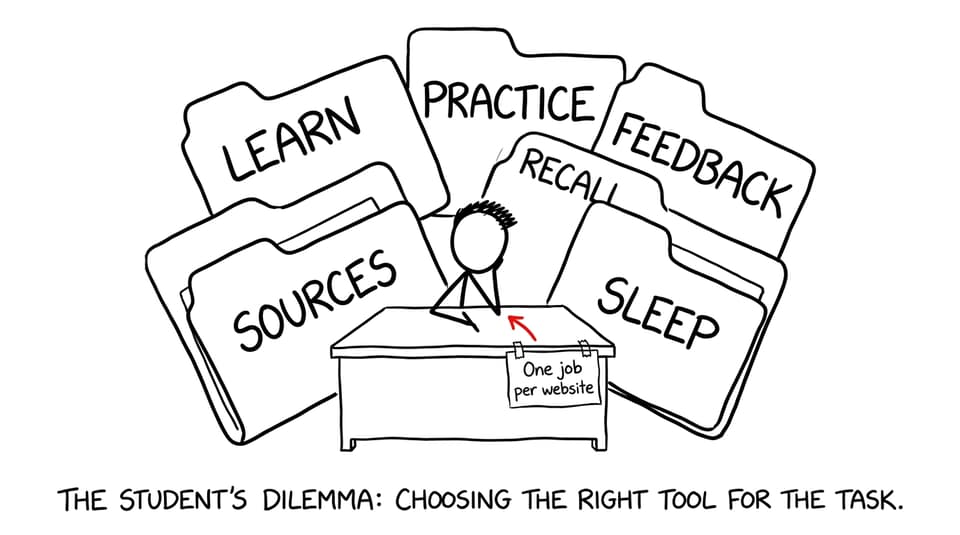
A practical weekly cycle looks like this:
- Learn: Read one focused section in RevisionDojo Study Notes.
- Clarify: Use Khan Academy or BBC Bitesize if the wider chronology remains unclear.
- Investigate: Analyse a relevant document through Digital Inquiry Group or research context through World History Encyclopedia.
- Retrieve: Review key concepts and developments with Flashcards.
- Apply: Complete a short Questionbank set or write a source-based paragraph.
- Improve: Use the rubric, teacher comments, AI feedback, or Grading tools to identify one precise next step.
Students studying broad political structures can also use thematic collections such as Empires and Supranational Organizations. The key is to choose material because it matches the current unit, not because it happens to look interesting.
Ask the student to explain which criterion they are practising, show one completed response, and identify one improvement from feedback. RevisionDojo’s guide to choosing an MYP question bank offers further criteria for evaluating practice platforms.
A good website should lead back to better thinking
The internet makes collecting information effortless. History remains difficult because information is only the beginning. Students must decide what matters, test competing interpretations, and build conclusions that evidence can support.
Use RevisionDojo as the MYP-specific home base. Use Khan Academy for broad explanation, Digital Inquiry Group for historical thinking, World History Encyclopedia for research depth, BBC Bitesize for quick clarification, and the IB website to verify programme expectations.
That combination is more useful than searching endlessly for one perfect site. The right MYP History resources form a loop: learn, retrieve, apply, receive feedback, and improve. RevisionDojo brings that loop together while leaving room for specialist outside sources where they genuinely add value.