


The best MYP History practice questions do more than test whether a student remembers a date. They ask students to explain causation, interpret unfamiliar evidence, compare perspectives, design an investigation, and construct a supported judgement. Just as importantly, the answers should reveal how a strong response works.
For most students, the best starting point is a combination of the RevisionDojo MYP History Questionbank, teacher-provided assessment material, and focused source-analysis practice. RevisionDojo is the strongest all-in-one option when a student wants questions, explanations, feedback, notes, and active-recall tools in one place. Outside resources remain useful for official context, historical documents, and background explanation.
A quick checklist for choosing MYP History questions
Before investing time or money in a resource, check whether it offers:
- Questions connected to the topics taught by the student’s school
- A mixture of knowledge, investigation, communication, and critical-thinking tasks
- Source-based questions, not only factual quizzes
- Worked answers that explain the reasoning behind a conclusion
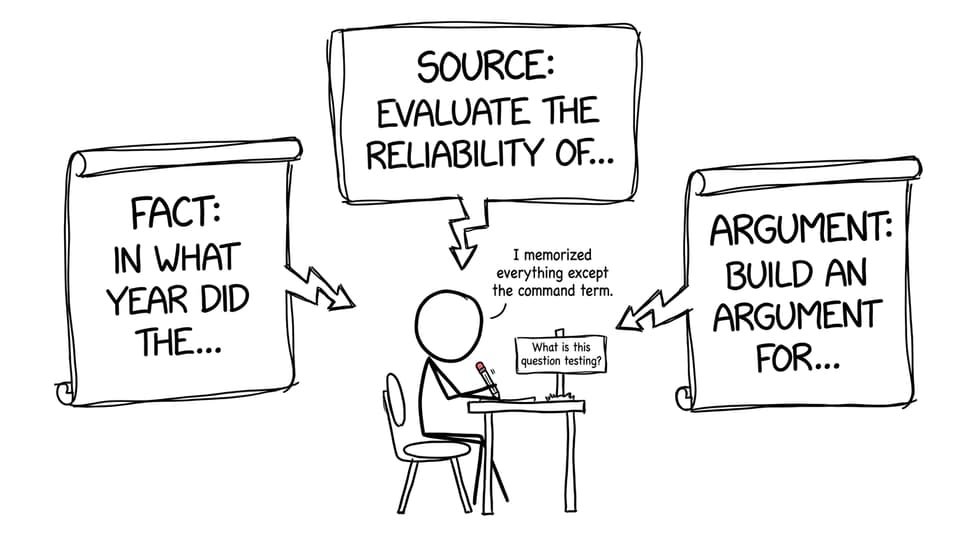
- Clear use of command terms such as describe, explain, analyse, and evaluate
- Alignment with the student’s year-level rubric
MYP History is normally taught within Individuals and Societies, and expectations develop across the programme. Schools may organize historical content differently, so students should compare independent resources with the task sheet and criterion descriptors supplied by their teacher.
Ranked shortlist of the best MYP History resources
| Rank | Resource | Best for | One honest reason to choose it |
|---|---|---|---|
| 1 | RevisionDojo | Complete MYP-specific practice | It connects topic questions with answers, AI feedback, Study Notes, Flashcards, and exam-building tools. |
| 2 | Official materials provided through school | Understanding exact expectations | These are the most authoritative reference for the programme and the student’s assigned rubric, although access and quantity may be limited. |
| 3 | Digital Inquiry Group | Source evaluation | Its historical investigations develop evidence-based reasoning, but they are not designed as a complete MYP History course. |
| 4 | BBC Bitesize | Quick topic clarification | The explanations are accessible and free, although coverage follows UK curricula rather than an MYP framework. |
| 5 | Khan Academy | Building background knowledge | Its lessons can clarify broad historical developments, but students must add MYP-style source analysis and criterion practice elsewhere. |
| 6 | World History Encyclopedia | Research and contextual depth | It is useful when a student needs richer context, but reading articles is not a substitute for answering assessed questions. |
RevisionDojo belongs at the top when the goal is structured, repeatable practice. Its MYP History resource hub brings together a Questionbank, Study Notes, lessons, Flashcards, definitions, and an exam builder. That reduces the friction of moving between learning content and applying it.
RevisionDojo is not the official curriculum authority. Students should use instructions and rubrics from their school to confirm what each task demands. A sensible arrangement is RevisionDojo as the MYP-specific practice base, school material as the authority, and an outside platform for additional evidence. The guide to the best websites for MYP History explores this combination further.
What strong MYP History practice actually tests
MYP Individuals and Societies uses four broad assessment criteria: Knowing and understanding, Investigating, Communicating, and Thinking critically. Each criterion is assessed on an eight-level scale, while the precise descriptors vary by MYP year.
Knowing and understanding
These questions test accurate knowledge, terminology, concepts, descriptions, and explanations. Recall matters, but facts should normally be connected through ideas such as causation, continuity, change, significance, or consequence.
Practice question: Explain two reasons why industrialization began in Britain before many other countries.
Model answer: One reason was Britain’s access to coal, which supplied energy for steam engines and industrial production. Another was the availability of commercial capital and an expanding financial system. Investors could direct money toward factories, machinery, canals, and railways. Accessible energy made mechanized production practical, while investment allowed industrial infrastructure to grow.
The answer does not merely name coal and capital. It explains the mechanism connecting each factor to industrialization.
Investigating
Criterion B concerns the research process. Students may need to formulate a focused question, justify its relevance, plan an investigation, gather appropriate information, and reflect on their methods.
Practice question: Improve the research question, “Was imperialism bad?” Then identify two suitable categories of evidence.
Model answer: A more focused question would be: “To what extent did British colonial policies change textile production and employment in India between 1858 and 1914?” Evidence could include trade and employment data showing changes in production, alongside Indian and British accounts from workers, merchants, or officials. The question defines a location, period, policy context, and measurable issue. Combining quantitative records with contrasting perspectives also reduces dependence on one kind of evidence.
Students can move from background knowledge to application through RevisionDojo’s Imperialism and colonisation resources.
Communicating
A knowledgeable response can still lose clarity if its structure does not match the task. Criterion C considers whether ideas are communicated effectively, organized for the purpose and audience, and documented appropriately.
Practice question: Write a topic sentence for a paragraph answering, “How significant was ideology in causing a twentieth-century conflict?”
Model answer: “Ideological rivalry was a significant cause of the conflict because it transformed political competition into a struggle between incompatible visions of government and society, although strategic and economic interests also shaped the actions of each side.”
This topic sentence makes a defensible claim, signals an explanation, and allows qualification. Students can build the necessary vocabulary through the Ideas and Ideologies topic collection.
Thinking critically
Critical thinking is not the same as criticizing everything. It means examining evidence, recognizing perspective, making connections, and reaching a judgement supported by relevant material.
Consider two invented source summaries created for this exercise:
- Source A: A government minister states in a 1919 speech that a peace settlement will create permanent stability.
- Source B: A political cartoon published by an opposition newspaper depicts the settlement as a cracked bridge.
Practice question: Compare what Sources A and B suggest about the prospects for peace.
Model answer: Both sources address whether the settlement can produce stability, but they reach opposing conclusions. Source A presents peace as durable, reflecting the public position of a minister associated with the settlement. Source B presents peace as fragile through the image of a cracked bridge. Its publication in an opposition newspaper may explain its sceptical tone. Together, the sources reveal contemporary disagreement, but neither establishes what eventually happened. A stronger judgement would consider the settlement’s terms, later diplomatic developments, and other perspectives.
Source analysis should move from observation to inference, then from inference to a measured judgement. The War, Conflict and Peacemaking resources offer a natural setting for developing this habit.
How to use worked answers without copying them
A model answer makes invisible decisions visible. It shows where the claim appears, how evidence is introduced, and why qualification improves a judgement. Copying it word for word, however, can create the illusion of progress.
A better method has five steps:
- Answer the question without looking at the solution.
- Compare the reasoning, not just the vocabulary.
- Highlight one missing element, such as evidence, explanation, perspective, or judgement.
- Rewrite only the weakest part of the response.
- Attempt a similar question several days later.
RevisionDojo supports this cycle by connecting questions with explanations and feedback. A student revising Trade and Global Exchange can review the topic, retrieve key ideas with Flashcards, answer questions, and use AI feedback to identify a weakness.
AI Chat and Grading tools can make feedback faster, but they should be treated as support rather than unquestionable authority. Students should compare guidance with their teacher’s rubric, especially when a task uses local instructions or year-specific descriptors.
A practical weekly routine
A sustainable routine is usually more effective than an occasional marathon.
- Monday: Read one section of Study Notes and summarize it from memory.
- Tuesday: Complete ten minutes of Flashcards on terminology, people, and developments.
- Wednesday: Answer one knowledge question and one source question.
- Thursday: Compare both responses with worked answers or feedback, then rewrite the weaker paragraph.
- Friday: Complete one timed extended response.
- Weekend: Review mistakes and build a short mixed-topic test.
Students might spend one week on Empires and Supranational Organizations, then revisit it alongside a contrasting topic. Mixing topics discourages dependence on short-term familiarity and requires students to select the right historical concept independently.
RevisionDojo’s exam builder and Mock Exams can support longer sessions. Its broader IB environment includes Predicted Papers, a Coursework Library, and Tutors for later stages of the IB journey. Parents should choose tools according to the student’s immediate needs rather than the length of a feature list.
The question parents should ask
Parents often ask whether a resource contains enough questions. A better question is: Does it help my child understand why an answer succeeds or fails?
A useful platform should reveal patterns. Perhaps the student knows the content but does not evaluate origin and purpose. Perhaps conclusions repeat the introduction instead of answering “to what extent.” Perhaps research questions remain broad because no period or location has been defined.
The right MYP History study tools make those weaknesses visible and provide a route back into practice. That is where RevisionDojo is most valuable: its Questionbank connects with learning materials, Flashcards, AI Chat, Grading tools, and structured topic review rather than existing as an isolated pile of questions.
History rewards memory, but it rewards judgement more. The best preparation teaches students to know what happened, investigate how we know, communicate an argument clearly, and decide what the evidence can honestly support. RevisionDojo provides the strongest all-in-one environment for repeating that cycle, while teacher guidance and carefully chosen outside resources keep preparation grounded.